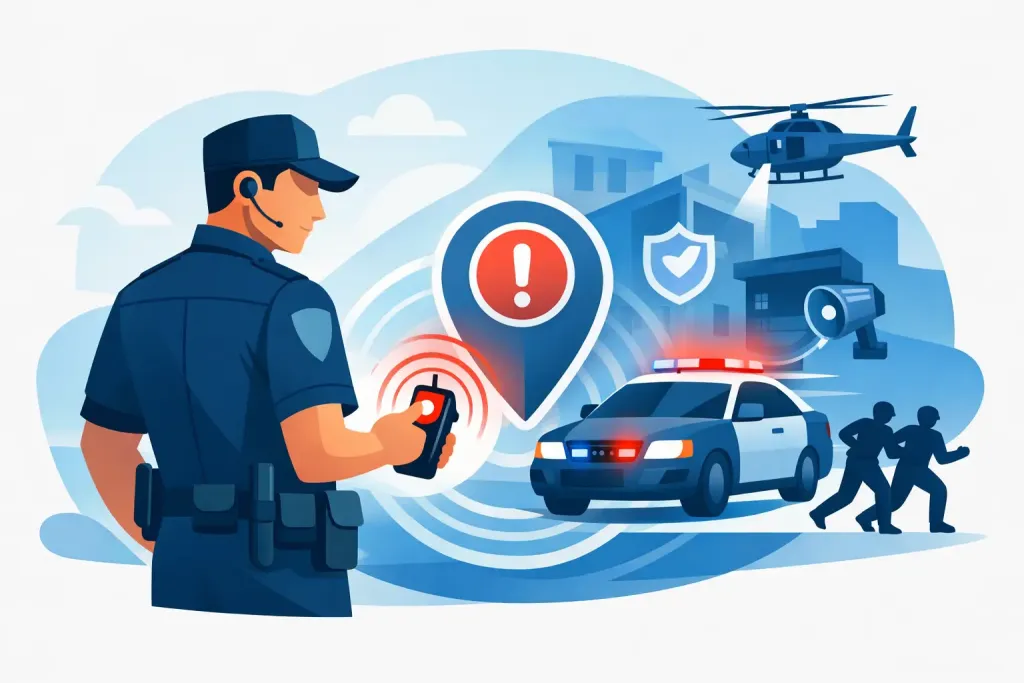
A panic alarm for security guards is not simply a button on a phone. It is the point at which a lone worker’s exposure becomes a live operational event: an alert is raised, the location is identified, responsible people are notified and the response can be evidenced afterwards. When a guard is confronted, injured, threatened or unable to use a radio, seconds matter. A delayed call to the control room can turn a manageable incident into a serious safety failure.
For security providers and in-house teams, the question is not whether guards face risk. It is whether the organisation can detect distress immediately, coordinate the right response and demonstrate that reasonable safeguards were in place.
What a panic alarm must achieve
A panic alarm should give a guard a fast, discreet route to request help when normal communication is unsafe, impractical or impossible. The alarm must reach the people who can act, not sit in an inbox or wait for the end of a shift to synchronise.
At a minimum, an effective panic alarm workflow needs to capture the time of activation, the guard’s identity, their latest known location and the site or patrol context. It should then notify nominated responders through clearly defined escalation rules. Depending on the site, this may mean a control room operator, supervisor, duty manager, nearby mobile patrol officer or emergency services contact.
The operational value comes from joining alerting to action. A lone guard working at a warehouse perimeter at 02:00 requires a different response from a concierge in a staffed office reception. The alarm process must reflect the risk assessment, staffing model and physical layout of each contract.
Why a panic alarm for security guards needs live location
An alarm without location creates a critical delay. If a control room receives a distress message but cannot establish where the officer is, responders may need to search multiple floors, buildings or external patrol zones. On large estates, construction projects, industrial facilities and campuses, that delay can be significant.
Live GPS location can help managers identify where an alarm was raised, particularly for mobile patrols, vehicle checks and remote sites. However, GPS is not equally reliable everywhere. Multi-storey buildings, underground areas, dense urban locations and internal plant rooms can reduce accuracy. This is why location should not rely on one technology alone.
A practical patrol platform can add context through QR checkpoints, NFC tags, beacons and GPS-based virtual checkpoints. If the guard has recently scanned a checkpoint, managers have a verified record of their last confirmed position. That information can support a quicker search, even where a live signal is weak.
The distinction matters. GPS may indicate an approximate outdoor position; a checkpoint scan can prove presence at a specific door, floor, gatehouse or plant area. For an active alarm, teams need both immediate visibility and reliable site context.
The response workflow must be agreed before an incident
Buying an alarm feature is not the same as having a response plan. If the control room does not know who owns the first response, what to do when an alert is not acknowledged or when to contact emergency services, the technology cannot compensate for uncertainty.
A clear escalation process should define who receives the first notification, the expected acknowledgement time and the next step if the initial responder is unavailable. It should also specify how operators attempt contact, when a colleague is sent to check welfare and how the incident is recorded.
For higher-risk sites, response procedures may need to account for duress alarms that are activated silently. A guard dealing with aggression at a reception desk, for example, may need assistance without escalating the behaviour of the person in front of them. The alarm should be simple enough to activate under pressure, while the response remains discreet and controlled.
Managers should test the workflow in realistic conditions. Run drills at night, during shift handovers and when the usual supervisor is unavailable. Check whether alerts reach the right people, whether locations are understandable and whether staff can follow the procedure without searching through a paper folder.
Panic alarms and man-down protection solve different problems
A panic alarm is intentionally activated by a guard who recognises danger and can request help. A man-down alert is designed to identify potential incapacitation, often through prolonged inactivity, an impact event or an unusual device orientation.
Both controls are valuable, but neither replaces the other. A guard facing verbal abuse may need to trigger a silent panic alarm before physical harm occurs. A guard who slips in an isolated service corridor may be unable to activate anything, making a man-down mechanism more relevant.
The trade-off is false alerts. If sensitivity settings are too aggressive, ordinary movement can create unnecessary notifications and reduce confidence in the system. If they are too relaxed, a genuine welfare event may go undetected. Settings should be tested against the actual duties, equipment and movements of guards on each site.
Evidence matters after the alarm has stopped
The immediate priority is always welfare. Once the situation is stable, managers need a complete and defensible account of what happened. This supports internal review, client communication, insurance matters, police enquiries, staff welfare follow-up and health and safety obligations.
A digital incident record should bring together the alarm timestamp, location information, acknowledgement and response times, communications, photographs where appropriate, witness details and the guard’s occurrence report. This is stronger than relying on handwritten notes completed hours later, when details may be incomplete or disputed.
It also reveals operational patterns. Repeated alarms near a poorly lit access point, recurring confrontations during a particular delivery window or frequent welfare concerns on a lone night shift are not isolated records. They are evidence that the risk assessment, patrol plan or staffing arrangement may need to change.
For organisations working to client SLAs and recognised standards such as BS 7499, transparent records help demonstrate that the service was monitored and incidents were managed with appropriate control. They also support GDPR-aware handling of personal location data, with clear access controls, retention rules and a legitimate operational purpose.
Choosing the right alarm setup for each site
There is no single configuration that suits every security operation. A static retail guard, a mobile response officer and a lone facilities patrol officer work in different environments and face different risks. The right setup depends on the site assessment, connectivity, existing communications and available response resource.
Consider four practical questions before deploying a panic alarm system:
- Can guards activate an alert quickly with gloves, in poor light or under duress?
- Will the system provide a useful location indoors as well as outside?
- Who receives the alert at every hour of every shift, including holidays and absence?
- Can the organisation prove the alert was received, acknowledged and acted upon?
A smartphone-first solution can reduce the cost and complexity of separate alarm hardware, particularly where guards already use a mobile device for patrol checkpoints, incident forms and task instructions. It also keeps critical safety functions within the same operational record. Yet hardware may still be appropriate where personal phones are prohibited, devices are exposed to harsh conditions or an organisation requires a dedicated wearable alarm.
The key is to avoid creating another disconnected system. If alarm records, patrol activity and incident reports sit in separate places, supervisors lose time piecing together the story when they most need clarity.
Making alarm readiness part of daily patrol management
An alarm function is most dependable when it is embedded in normal guard operations. Guards should know how to activate it, what response to expect and what information to provide once safe. Supervisors should review alerts, near misses and response times as part of routine operational oversight, not only after a major incident.
QR-Patrol brings panic alarms, man-down protection, live patrol monitoring and digital reporting into one cloud-based control environment. That gives managers a live view of active security operations while preserving the records needed to investigate and improve them.
A panic alarm is a promise made to every guard working alone or under pressure: if they need help, the organisation will know, respond and be able to show what it did. Make that promise credible through tested procedures, reliable location intelligence and a response team that is ready before the alarm is ever activated.