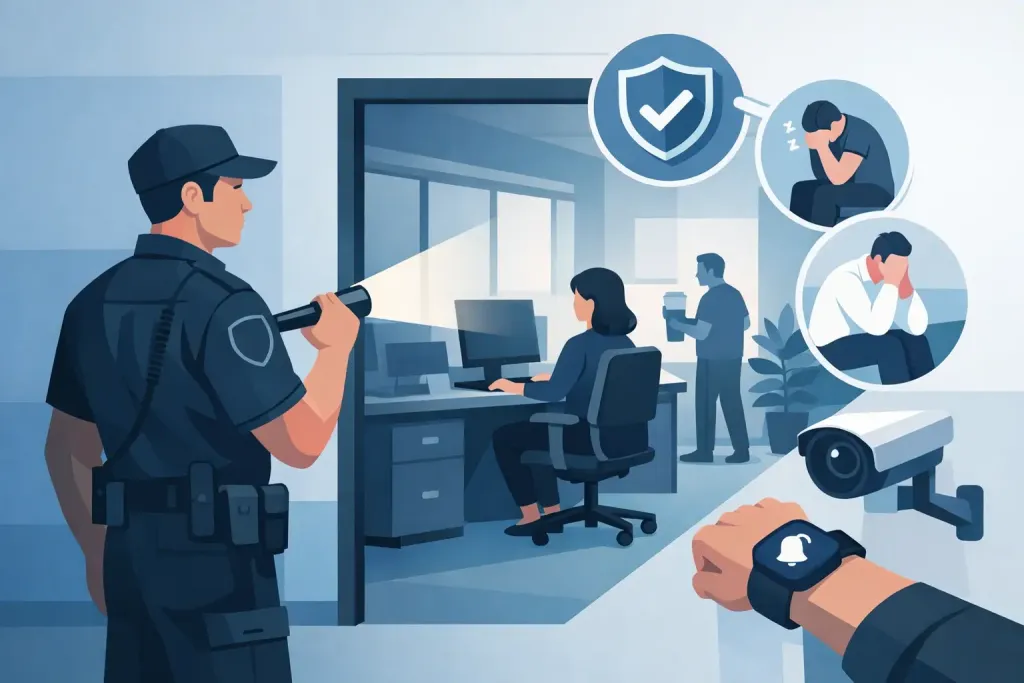
A guard can be on site, completing patrols and appearing fully active, yet still be unable to call for help after a fall, confrontation or sudden illness. Security guard welfare checks close that dangerous gap. They give control rooms and supervisors a defined way to confirm that a worker is safe, identify missed contact quickly and trigger a proportionate response before a concern becomes a serious incident.
For security providers and in-house teams, this is not simply a staff welfare measure. It is an operational control. A documented welfare-check process provides clear accountability, supports lone-worker risk assessments and gives clients evidence that the service is being actively managed.
What security guard welfare checks should achieve
A welfare check is a planned confirmation that a guard is safe, contactable and able to continue their duties. It may be completed through a mobile app check-in, a QR or NFC checkpoint scan, a GPS-based location confirmation, a call to a control room, or a combination of methods.
The objective is not to monitor every minute of a guard’s shift. Excessive checking can distract staff, create alert fatigue and undermine trust. The right frequency depends on the environment, the task and the level of risk. A daytime receptionist in an occupied office requires a different arrangement from a lone guard locking down a remote industrial estate at 02:00.
An effective process answers four practical questions: when contact is expected, how it will be confirmed, who receives an exception alert and what happens if no response is received. If any of those points is unclear, a missed check can turn into a chain of assumptions.
Why scheduled contact alone is not enough
Traditional hourly radio calls or telephone check-ins can be useful, but they have limitations. A guard may be unable to reach a handset, may answer while under pressure, or may be working in an area with poor signal. A control room operator may also record a check manually but have no reliable proof of where the guard was at the time.
Digital patrol data adds context. When a guard scans a checkpoint during a scheduled route, the system can record the time, location and identity of the operative. When a scheduled scan is missed, supervisors can see the exception immediately rather than discovering it at the end of a shift or when reviewing paper records.
This does not mean that checkpoint activity replaces human judgement. A scan shows presence at a point. It does not always prove wellbeing. For higher-risk assignments, scheduled scans should sit alongside direct check-ins, panic alarms and a clear escalation procedure.
Match the check to the risk
Risk assessments should set the welfare-check model, not convenience or a generic company rule. Consider whether guards work alone, handle confrontational situations, access confined or isolated areas, patrol large grounds, carry out lock-up duties or travel between sites. Also account for known communication black spots, weather exposure, fatigue risk and the time it would take for help to arrive.
A construction site may need location-based checks around changing work zones and out-of-hours access points. A retail security team may require more frequent confirmation following an aggressive incident. At a corporate office, check-ins may be tied to opening, closing and key patrol milestones. The process should be reviewed whenever the site, shift pattern or threat profile changes.
Build a welfare-check procedure that people can follow
The best procedures are simple under pressure. Guards should know exactly what to do without searching through a lengthy instruction folder, while supervisors need a live view of outstanding checks and incidents.
Start by defining the expected contact points across the shift. These might include arrival, patrol completion, entry to a high-risk zone, lock-up, vehicle movements and departure. Set a realistic tolerance period for each check. A five-minute missed check at a small, high-risk site may warrant immediate action; at a large estate, the tolerance may need to reflect the normal travel time between checkpoints.
Next, make the escalation path explicit. A missed welfare check should not result in repeated messages with no owner. The procedure should state who makes the first attempt to contact the guard, how long they wait, who takes over if contact fails and when a physical response, emergency services or a client contact is required.
A practical escalation sequence often includes these stages:
- An automated alert is sent when the scheduled check is overdue.
- The control room attempts contact through the agreed channel.
- A supervisor reviews the guard’s last confirmed location, route activity and recent incident reports.
- A nominated responder is sent to the location if contact cannot be re-established.
- The event, decisions and outcome are recorded for review.
The precise timings and response measures must reflect the risk assessment. Sending a colleague into a potentially hostile situation without suitable information or support can create a second casualty. Where violence, criminal activity or a medical emergency is suspected, the response must be led by the circumstances and emergency protocols.
Give guards a way to raise the alarm first
Welfare checks are reactive when expected contact is missed. Lone-worker protection should also allow guards to initiate an immediate alert. A discreet panic alarm can be vital when a guard feels threatened but cannot safely make a call. Man-down alerts can add protection where a worker suffers a fall, collapse or period of immobility.
These features need testing in realistic conditions. Teams should confirm who receives the alert, whether location data is accurate enough to direct assistance and what happens if the device has no signal. Training should cover accidental activation too, so staff report and resolve false alerts without becoming reluctant to use the function when it matters.
Turn live information into a controlled response
A cloud-based guard tour system makes welfare checks more actionable because managers do not have to wait for a handset to return to base or for paper occurrence books to be collected. Live exceptions, last known checkpoint activity, incident reports and task status can be viewed from one operational record.
For example, if a guard misses a required check after entering a plant room, the supervisor can establish whether the guard scanned into the area, submitted an issue report or completed a related task. That context supports a faster and better-informed decision than a simple unanswered telephone call.
QR-Patrol can combine timed patrol checkpoints, GPS-based checkpoints, panic alarms, man-down notifications and digital occurrence reporting in the same workflow. The outcome is not technology for its own sake. It is a clearer line from a missed check to a named response, supported by time-stamped evidence.
Keep welfare data proportionate and defensible
Location and welfare information is sensitive workforce data. Security teams need enough detail to protect people and prove service delivery, but should not collect information without a defined operational purpose. Policies should explain when tracking applies, what data is captured, who can access it, how long it is retained and how staff can raise concerns.
For UK organisations, this should align with data-protection responsibilities, employment practices and the organisation’s documented lawful basis for processing. It also needs to reflect the practical requirements of client contracts, health and safety arrangements and standards such as BS 7499 where relevant.
Transparency matters. Guards are more likely to engage with the process when it is presented accurately: welfare checks are there to protect them, support rapid assistance and create a fair record of what happened. They should not be used as a substitute for competent supervision, suitable staffing levels or proper site induction.
Review every missed check, not just the serious ones
A resolved missed check can still expose a weakness. Perhaps a QR code was damaged, a guard was diverted by a visitor, the scheduled interval was unrealistic or the control-room alert was not seen quickly enough. These small failures are useful signals when reviewed consistently.
Look for patterns by site, shift, checkpoint, operative and type of exception. Repeated late check-ins at one location may indicate a poorly designed patrol route. Frequent connectivity problems may require a different checkpoint technology or revised process. A growing number of panic activations may point to a security threat that needs wider intervention.
Security guard welfare checks work best when they are treated as a live safety process rather than a box-ticking report. Define the check, make missed contact visible, give people authority to act and use the record to improve the next shift. A guard who knows help will be noticed and mobilised is better protected, and a manager has the evidence needed to act with confidence.