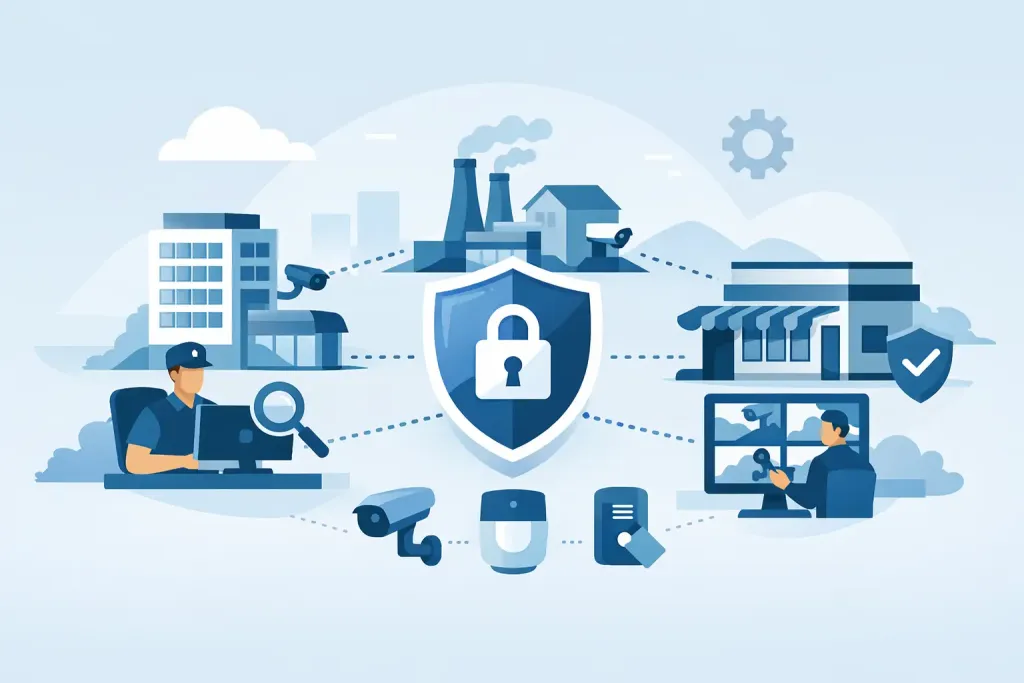
A missed patrol at one building can be dealt with quickly. A missed patrol across a dispersed estate can go unnoticed until a client complains, an incident occurs or an audit exposes a gap. Multi-site security management gives operations teams one live view of whether guards are present, patrols are complete and risks are being escalated at every location.
For security providers, facilities teams and in-house departments, the challenge is not simply deploying officers to more than one site. It is maintaining the same standard of evidence, response and accountability at a city-centre office, an isolated construction project and a warehouse on a night shift. That requires more than a spreadsheet, paper occurrence books and a manager chasing updates by phone.
Why multi-site security management breaks down
Each additional site introduces its own patrol routes, access restrictions, risk profile, client requirements and shift patterns. When records sit in separate notebooks, folders or offline guard tour devices, managers cannot see the full picture until someone manually gathers the information. By then, the opportunity to intervene may have passed.
The operational consequences are familiar. A supervisor may learn that a checkpoint was missed only at the end of a shift. An incident report may arrive without a clear time, location or supporting photographs. Relief officers may not see outstanding tasks. A client may request proof of service for a disputed date, while the team searches through paper records.
This fragmentation also creates an uneven service. One site might have a diligent supervisor and well-maintained records; another may depend on verbal handovers and personal judgement. The problem is not necessarily the quality of individual guards. It is the lack of a consistent operating system that makes good practice repeatable and visible.
Build one operating picture across every site
Effective multi-site security management centralises control without treating every location as identical. A distribution centre with vehicle movements needs different checkpoints and escalation rules from a corporate office or a vacant property. The system should allow each site to retain its own route, forms, schedules and contacts while presenting managers with a single dashboard of live activity.
Start by defining a site structure that reflects how the operation is actually managed. Group locations by contract, region, client portfolio or operational division. Assign supervisors only to the sites they need to oversee, while giving senior managers appropriate estate-wide visibility. This keeps information relevant and prevents local teams being overwhelmed by data from unrelated locations.
Then establish a consistent baseline for every site. Each patrol should have named checkpoints, expected visit windows, clear instructions and an escalation path for exceptions. QR codes, NFC tags, beacons and GPS-based virtual checkpoints can provide proof that an officer attended the required location, rather than simply recording that a patrol was reported as complete.
The objective is not to monitor people for its own sake. It is to verify delivery of the security service, identify exceptions early and create a record that can stand up to scrutiny.
Turn patrol data into live operational control
A central platform is most valuable when it changes what managers can do during a shift. End-of-week reports have their place, but they cannot prevent a missed opening check, a vulnerable lone worker or an unattended fire exit from becoming a larger problem.
A practical workflow should make the following actions routine:
- Guards begin their shift using a mobile device and can see their allocated patrols, instructions and site-specific tasks.
- At each checkpoint, they scan the assigned QR code or NFC tag, or verify attendance through the appropriate location technology.
- Any missed checkpoint, late patrol or failed task creates an immediate exception for the supervisor to review.
- If a guard finds a hazard, damage or suspicious activity, they submit an incident record with notes, photographs, time and location details.
- Managers receive alerts based on the severity and rules set for that site, then record the action taken and follow-up required.
This workflow creates a clear distinction between an event and a managed response. A missed patrol is not merely a red mark on a report. It becomes an exception that has an owner, a reason and, where required, corrective action. That is what clients and auditors expect to see when they ask how a security risk was controlled.
Real-time visibility also improves deployment decisions. If a guard is delayed at one part of a large campus because of an access issue or incident, a supervisor can assess the impact on the remaining route and arrange support. Without live information, the same issue may only surface after the shift has ended.
Protect lone workers across remote locations
Multi-site operations often include locations where guards work alone, particularly overnight, at vacant premises, on construction sites or at remote industrial facilities. In these environments, proof of patrol is only part of the requirement. Managers also need a reliable way to identify when an officer may need help.
Lone-worker features such as welfare checks, panic alarms and man-down alerts should be configured around the site risk assessment, not switched on as generic settings. A high-risk perimeter patrol may need tighter check-in intervals and immediate escalation. A low-risk daytime reception post may require a different response path. The response team must know who receives an alert, how they attempt contact and when emergency services or site contacts are involved.
Technology supports the process, but it does not replace it. Devices need sufficient battery life, officers need training, and escalation contacts must be kept current. Test alert routes regularly. An untested panic alarm is not a safety control.
Create records that support compliance and client confidence
Security managers are frequently asked to prove that contractual and statutory responsibilities have been met. Paper records are vulnerable to incomplete entries, illegible handwriting and delayed filing. They are also difficult to search when a client asks for evidence relating to a specific date, area or incident.
Digital occurrence books, timestamped patrol records, incident forms and photographs provide a more defensible audit trail. They can show when an event was reported, who submitted it, where it occurred and what follow-up was recorded. For organisations working to BS 7499 expectations, this helps demonstrate controlled patrol activity, documented instructions and effective supervision.
Data management still requires discipline. Under GDPR, collect only the information needed for a legitimate operational purpose, restrict access by role and retain records according to a documented policy. Location data and incident photographs can be highly sensitive. Centralising records improves oversight, but only when permissions, retention and staff awareness are properly managed.
Standardise the platform, not every decision
One common mistake is building a single rigid patrol route template for every site. Standardisation should apply to the controls: how patrols are verified, how incidents are logged, how alerts are escalated and how reports are produced. Local instructions should reflect genuine differences in risk, client requirements and premises layout.
Another mistake is attempting a full estate rollout without testing the operating model. Begin with a representative group of sites, such as one high-traffic location, one remote site and one contract with demanding client reporting. Check checkpoint placement, mobile connectivity, notification rules, training needs and supervisor workload before expanding.
Measure the results in operational terms. Look at patrol completion rates, late or missed checkpoint trends, time from incident submission to acknowledgement, overdue follow-up actions and the time required to prepare client reports. These measures show whether the system is reducing blind spots rather than simply generating more data.
QR-Patrol supports this model through smartphone-based patrol verification, live monitoring, incident reporting, workforce safety tools and centralised reporting across dispersed operations. The value comes from configuring those capabilities around the way each contract is managed, then maintaining consistent oversight as the estate grows.
The strongest multi-site operation is not the one with the most reports. It is the one where a supervisor can see an exception as it happens, act with confidence and show exactly what was done afterwards.