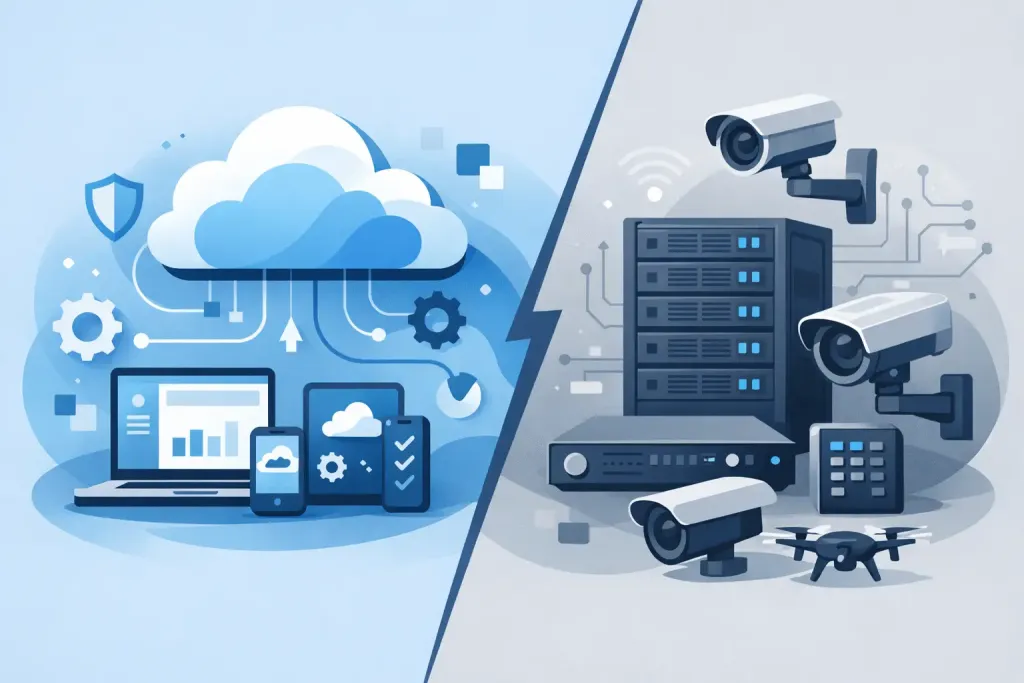
A missed patrol at 02:00 is not simply a gap in a tour record. It may mean an unsecured fire exit, an undetected welfare concern or a client asking why nobody intervened sooner. Cloud patrol software versus hardware is therefore a decision about operational control: how quickly your team can see what is happening, prove what happened and act when a guard needs support.
Traditional guard tour hardware still has a place in certain environments. Yet for security providers, facilities teams and multi-site operators who need live accountability, the difference is increasingly clear. A cloud platform turns patrol data into an active management tool. A hardware-only system often records activity for review after the event.
Cloud Patrol Software Versus Hardware: The Core Difference
A traditional hardware guard tour system usually consists of fixed checkpoint tags, a dedicated reader or data collector, and desktop software. Guards visit points and scan them with the device. At the end of a shift, or when the device returns to a docking station, the information is uploaded for reporting.
This approach can establish basic proof that a route was completed. Its limitation is timing. If a patrol is late, a checkpoint is missed or a guard reports an incident, supervisors may not know until the device is manually downloaded. That creates a period in which the operation is effectively blind.
Cloud patrol software uses a mobile application and a central web platform. Guards scan QR codes, NFC tags or other checkpoint technologies with a smartphone, while GPS-based virtual checkpoints and beacons can support locations where fixed tags are unsuitable. Information synchronises to the control centre as connectivity allows, giving managers a live picture of completed tours, exceptions, tasks and incidents.
The distinction is not that hardware collects no evidence. It is that cloud systems make evidence available when it can still influence the outcome.
Why Live Visibility Changes Patrol Management
A patrol programme is only useful when supervisors can identify failure early enough to correct it. With cloud software, a missed checkpoint can trigger an automated notification. A control room or site supervisor can contact the officer, investigate a potential access issue or dispatch support while the situation is current.
The same principle applies to incident reporting. A guard can submit photographs, notes, forms and location details from the point of discovery. The report is time-stamped and retained in a central record rather than being written in a notebook, retyped later and potentially separated from the patrol history.
For a security contractor, this creates stronger client reporting. Rather than relying on a monthly statement that a service was delivered, the business can provide transparent records of patrol completion, exception handling and response activity. For an in-house security team, it gives operations managers a defensible audit trail across buildings, shifts and contractors.
QR-Patrol combines these functions in one mobile and web-based environment, allowing patrol activity, occurrence reporting, schedules and lone-worker safeguards to be managed from the same operational view.
Where Dedicated Hardware Still Makes Sense
Replacing every dedicated device is not automatically the right decision. Purpose-built hardware can be a practical choice in tightly controlled, low-complexity environments. A small site with a fixed route, limited reporting requirements and little need for immediate oversight may only require basic checkpoint verification.
Dedicated readers can also be attractive where there is a concern about staff using personal phones, or where the device must withstand particularly harsh handling. However, this should be assessed against the full cost of ownership. Hardware requires purchase, allocation, charging, maintenance, replacement and collection for data transfer. If a reader is lost or fails during a shift, the patrol record may be disrupted.
Smartphone-first systems do not remove the need for equipment planning. Organisations must decide whether to use company-managed handsets, approved personal devices or a mix of both. For higher-risk sites, a managed handset with a protective case, charging policy and mobile data plan is often the most controlled option. The advantage is that one device can support patrol verification, communications, incident capture, panic alerts and lone-worker protection.
Connectivity Is a Design Question, Not a Reason to Stay Offline
A common objection to cloud patrol software is unreliable signal. It is a valid operational concern, particularly in basements, large industrial sites, remote estates and construction locations. Real-time monitoring depends on an available connection. No provider should imply otherwise.
The practical question is how the system behaves when connectivity drops. A capable mobile patrol app should retain scans, reports and time data locally, then synchronise when coverage returns. Managers can still see the last known activity and identify where a communication gap has occurred. This is materially different from an offline hardware workflow where information may remain inaccessible until the end of the shift.
Site surveys are essential before deployment. Test mobile coverage on actual patrol routes, including plant rooms, loading bays, perimeter paths and stairwells. Where coverage is weak, consider Wi-Fi, suitable mobile networks, checkpoint placement and escalation procedures. Technology should reflect the site risk assessment, not force the operation into a convenient but unreliable model.
Guard Safety Needs More Than a Checkpoint Scan
Hardware guard tour systems were designed primarily to confirm route completion. Modern security operations must also address welfare. Lone working, night shifts, isolated areas and confrontational incidents require a faster route to assistance.
Cloud patrol software can bring safety tools into the same device guards already carry. Man-down alerts can identify possible immobility. Panic alarms can send an urgent notification with relevant location information. Scheduled welfare checks, task prompts and escalation rules give supervisors a clearer process for responding when an officer does not check in.
These features do not replace training, procedures or competent control-room staffing. They make those arrangements easier to execute and evidence. A panic feature is only valuable if someone is accountable for receiving it, assessing the risk and escalating without delay.
Compliance and Client Evidence
For UK security operations, records are often tested after an incident, complaint or contract dispute. The question is rarely whether a patrol system existed. It is whether the organisation can show a reliable sequence of events: who was assigned, where they attended, what they observed, when they escalated and how the matter was closed.
Cloud records can strengthen this position through time-stamped logs, named user activity, photographs, digital occurrence books and standardised forms. Managers can create reports that show service delivery against site instructions and client SLAs without chasing paper sheets or manually combining data from separate systems.
This supports, rather than guarantees, compliance with obligations connected to BS 7499, health and safety duties, data protection and contractual reporting. The platform itself is not the policy. Organisations still need clear retention rules, access controls, staff training and a lawful basis for collecting location and personal data under GDPR.
Cost Should Be Measured Across the Operation
The purchase price of a hardware reader can appear lower than a subscription platform, especially for a single static site. But the comparison should include labour and administrative cost. Consider the time spent downloading devices, chasing missing logs, transcribing incident notes, building reports, replacing failed equipment and investigating disputes without live data.
Cloud software is usually paid for as an ongoing service, often per guard or package level. That cost should be examined alongside the value of faster intervention, easier expansion and reduced reporting effort. It can also provide a clearer route to scale: new sites, users, forms and patrol routes can be configured without ordering a new fleet of single-purpose readers.
For a small, stable site with straightforward verification needs, hardware may remain economical. For a contractor managing several clients, or an organisation with dispersed premises and changing risk profiles, the operational value of a cloud platform generally grows quickly.
A Practical Decision Framework
Start with the outcome you need to control. If the requirement is simply to prove that a guard visited a small set of fixed points, dedicated hardware may be sufficient. If you need live exception alerts, incident capture, guard welfare tools, digital reports and oversight across multiple sites, cloud patrol software is the stronger fit.
Then assess the real patrol environment. Map connectivity, device risks, shift patterns, lone-working exposure and reporting obligations. Involve the people who will use the system each day: officers, supervisors, control-room staff and the client representative. Their workflow will expose practical issues long before they become costly deployment problems.
The best patrol solution is not the one with the most devices or the longest feature list. It is the one that gives managers timely, reliable proof of service while helping guards respond safely and consistently when conditions change.