
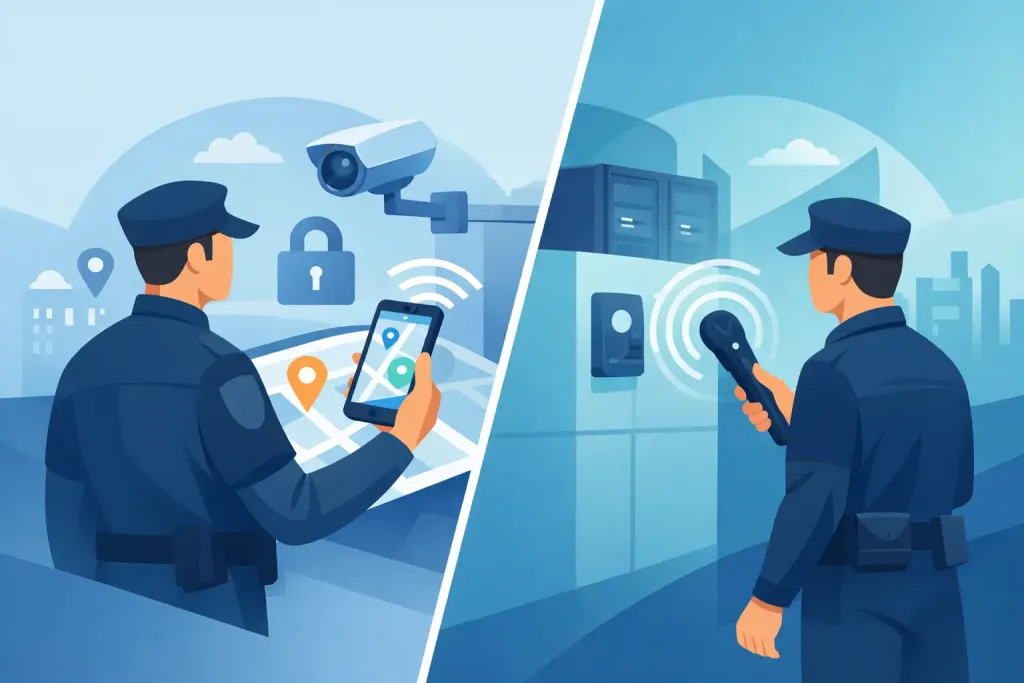
A missed patrol at 02:15 is not merely a gap in a tour record. At a warehouse, campus or vacant property, it may mean a fire door left open, an intruder unnoticed or a lone guard without support. That is why the choice between smartphone patrols versus RFID wands matters: it determines what supervisors can verify during a shift, what evidence remains after an incident and how quickly a team can act.
RFID wand systems have served the guarding sector for years. They are familiar, purpose-built and straightforward: a guard touches a wand to fixed RFID checkpoints, then returns the device for its records to be downloaded. Smartphone patrol systems use an app to capture checkpoint scans and send patrol data to a cloud platform, often alongside incidents, photographs, tasks, location information and welfare alerts.
Neither option is automatically right for every contract. The operational difference is that an RFID wand primarily records that a checkpoint was scanned, while a well-configured smartphone platform turns the patrol into a live, accountable security workflow.
Smartphone patrols versus RFID wands: the operational difference
An RFID wand is designed around a single job: proving a physical visit to a checkpoint. It is durable, simple to issue and generally requires little technical confidence from the user. On small, stable sites where reporting is reviewed after each shift and patrols follow the same route every day, that simplicity can be useful.
Its limitations become clear when conditions change. If a guard discovers damage to a fence, finds an unsecured door or encounters an aggressive visitor, the wand cannot document the full event as it happens. The guard must use a separate radio, phone, paper occurrence book or later report. Supervisors may not know there is a problem until the wand is docked, the data is downloaded and someone reviews it.
A smartphone patrol app brings these actions together. A guard can scan a QR code, NFC tag or other checkpoint, complete a location-specific task, raise an incident, attach photographs and notify the control room from the same device. The manager receives a time-stamped record while the shift is still under way.
This is not simply a different scanning method. It changes the management model from retrospective checking to active oversight. If a checkpoint is missed, a patrol runs late or an incident is raised, an authorised manager can respond before the risk develops further.
Real-time visibility changes response times
For operations managers, the strongest case for smartphone patrols is visibility. Traditional wand data often remains on the device until the end of a shift or until it is physically connected to a reader. A completed tour may look compliant in the morning, but the manager had no chance to intervene at the point of failure overnight.
Cloud-connected smartphone systems synchronise records as guards work, subject to available connectivity. Managers can see completed and missed checkpoints, patrol progress, open incidents and outstanding tasks through a central web application. This is particularly valuable across multi-site estates, where a supervisor cannot physically attend every location.
Consider a construction site with temporary access points and changing hazards. A wand can confirm that a tagged point was touched. A smartphone can confirm the checkpoint, record a photograph of a damaged perimeter, capture notes from the guard and alert the duty manager immediately. The resulting record supports a faster decision about whether to send a mobile response, contact the site manager or escalate to emergency services.
Real-time data also improves client service. Rather than assembling records manually after a complaint, a security provider can produce transparent evidence of patrol activity, response actions and incident handling. For in-house teams, the same evidence gives facilities and risk leaders a clearer view of where security controls are holding and where they need attention.
Evidence quality is more than a timestamp
Both technologies can create a time-stamped record, but the depth and defensibility of that record differ considerably.
RFID wand records are usually limited to the identity of the tag, the device and a time. This can be enough to show that a scan occurred. It does not necessarily explain what the guard observed, whether a required check was carried out or what action followed an exception. The more detail required, the more the operation falls back on separate paperwork and manually matched records.
Smartphone patrols can combine proof of presence with digital forms, photographs, notes, task completion and an electronic occurrence book. A fire exit inspection, for example, can require the guard to answer defined questions, report defects and capture an image where necessary. The manager receives a consistent record rather than a vague handwritten entry that must be interpreted later.
That matters when demonstrating delivery against a client SLA, investigating a claim or reviewing health and safety controls. Clear records help security teams show what was checked, by whom, when and what happened next. They can support compliance processes associated with BS 7499, GDPR and internal policies, although no patrol system replaces sound procedures, training or proper management oversight.
Guard safety needs a separate assessment
Patrol accountability and lone-worker protection are closely connected, but they are not the same thing. RFID wands can show a missing scan after the fact. They cannot usually tell a supervisor that a guard needs urgent assistance.
A smartphone carried by the guard can support panic alarms, man-down alerts, scheduled welfare checks and direct incident notifications. On remote industrial sites, large estates or night patrols, that additional capability may be decisive. If a guard slips in an isolated plant room or faces a confrontation in a car park, the ability to raise an alert from their working device gives the control room a clearer starting point for intervention.
There are practical conditions. The organisation must define escalation procedures, keep contact details current and ensure alerts are actively monitored. A panic function is only useful when someone knows who is responsible for responding. Teams should also assess coverage blackspots, device charging, protective cases and the suitability of the device for the environment.
For high-risk environments, a dedicated intrinsically safe device or another specialist communication method may still be required. Smartphone patrol software should strengthen a wider safety plan, not be treated as the whole plan.
Deployment, durability and total cost
RFID wands remain attractive because they are physically tough and narrowly focused. They can be a sensible choice in wet, dirty or high-impact locations, especially where network access is unreliable and the contract only requires basic attendance records. Staff training is brief, and some teams value a device that cannot be used for unrelated activity.
However, the apparent lower cost can conceal operational overhead. Checkpoints may need proprietary tags, readers and replacement hardware. Records must be collected, downloaded and distributed. Incident reporting, scheduling and client reporting may continue in separate systems, creating duplicated administration and more opportunities for records to be missed.
Smartphone patrols require disciplined device management. Organisations need a clear policy for ownership, passcodes, app access, charging, mobile data and replacement devices. Shared devices should be assigned at the start of each shift so that accountability is clear. Personal phones can reduce upfront hardware spend, but they introduce privacy, support and consistency concerns that many security operations prefer to avoid.
The advantage is consolidation. One smartphone can support patrol verification, task lists, digital reports, GPS-based checkpoints, asset checks and safety alerts. QR codes are inexpensive to deploy, while NFC tags and virtual GPS checkpoints provide alternatives when a printed code is not appropriate. QR-Patrol can combine these methods in a single system, allowing each site to use the checkpoint technology that fits its environment rather than forcing one approach everywhere.
Connectivity and data protection are not afterthoughts
A common concern is that smartphones depend entirely on a mobile signal. In reality, the right approach is to assess each site and confirm how the patrol app handles temporary loss of connectivity. Guards must be able to continue essential patrol activity in areas such as basements, remote compounds and plant rooms, with records synchronised once coverage returns. Test this during mobilisation, not after a critical incident.
Data protection needs equal attention. Smartphones may capture personal data in incident notes, photographs or visitor-related reports. Security leaders should define lawful purposes, retention periods, access rights and procedures for handling devices that are lost or stolen. Role-based access, secure logins and controlled report distribution help ensure that operational evidence remains available to those who need it without becoming widely exposed.
RFID wands have fewer data types to protect, but limited data is not always better data. If a serious incident is supported only by a checkpoint timestamp and a separate handwritten report, the organisation may face a weaker investigation trail.
Which option fits your security operation?
Choose an RFID wand where the requirement is genuinely limited: fixed patrol routes, basic proof of checkpoint visits, harsh conditions and little need for live intervention. It remains a functional tool for a narrowly defined task.
Choose smartphone patrols where missed patrols need immediate attention, guards work alone, reports must stand up to client scrutiny or sites require more than one form of verification. They are especially well suited to contracts with changing tasks, dispersed sites, demanding reporting requirements and a need for managers to see operational status as it happens.
The better question is not which device scans a checkpoint most cheaply. It is what your operation needs to know before the shift ends. When patrol records, incidents and welfare status must drive prompt action, a smartphone becomes more than a replacement for a wand. It becomes part of the control room’s ability to protect people, property and service standards.
