
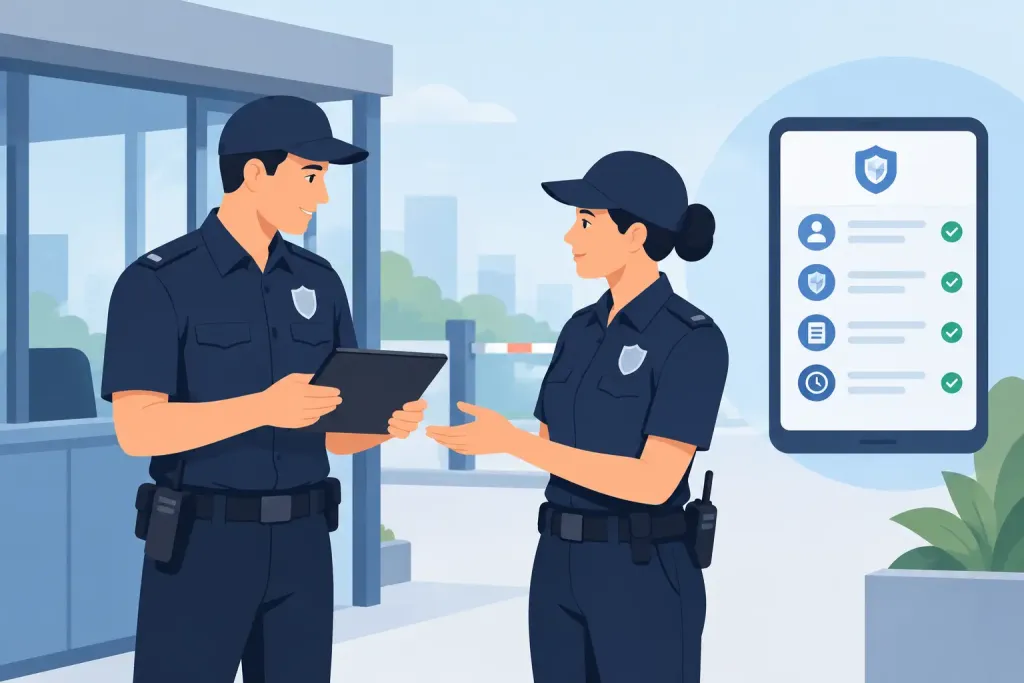
A guard arriving for a night shift should not have to piece together critical site risks from a notebook, a hurried conversation and an unread email. Yet that is exactly how information is lost: a damaged gate is not mentioned, a contractor is still on site, an alarm fault has been logged but not escalated, or keys have changed hands without a record. Knowing how to digitise guard handovers replaces this uncertainty with a live, time-stamped operational record that the incoming officer, supervisor and control room can trust.
For security providers and in-house teams, the objective is not simply to remove paper. It is to create absolute accountability at the point where one officer’s responsibility transfers to another. A properly configured digital handover process gives every shift a clear starting position, records what was communicated and creates evidence when a client, auditor or manager needs to understand what happened.
Why paper handovers leave operational gaps
A paper occurrence book can be useful as a local reference, but it has serious limits as a control system. It may be incomplete, difficult to read, unavailable to a remote manager and impossible to review until someone returns it to the office. Most importantly, it does not alert anyone when a high-priority issue is entered.
Verbal handovers have a different weakness. They depend on both officers being present, having enough time and remembering the same details. At busy sites, shift overlaps can be short. At lone-worker locations, there may be no face-to-face overlap at all. The result is inconsistent awareness of risks, open actions and site instructions.
Digital handovers establish one current version of the record. The outgoing guard records events, unresolved matters, patrol findings and assets handed over on a mobile device. The incoming guard reviews the record, acknowledges it and begins work with a traceable understanding of the site’s status. Managers can see whether that process happened on time, rather than discovering a missing entry after an incident.
Start by mapping the real handover process
Before selecting fields or issuing devices, examine how handovers actually take place across your estate. A corporate office with fixed day and night shifts needs a different workflow from a construction site, distribution warehouse or mobile patrol operation.
Identify who gives the handover, who receives it and who needs visibility. This may include an on-site officer, relief guard, mobile supervisor, control room and facilities manager. Then identify the moments that require formal acknowledgement. For example, a keysafe count, body-worn camera issue, fire panel fault or vulnerable-person welfare concern should not be treated in the same way as a routine note about deliveries.
A useful process separates information into three categories: matters completed during the shift, open actions for the next shift, and urgent exceptions requiring immediate management attention. If all notes sit in one free-text box, the important item is too easily buried.
Define what must be captured
The fields should reflect operational risks and contractual requirements, not every possible detail. Typical handover records include the shift start and finish time, officer identity, patrol status, incidents, outstanding tasks, visitors or contractors remaining on site, equipment condition, keys and assets, and health and safety observations.
Where an item needs action, the form should require an owner, priority and due time. A statement such as “rear gate issue” is not actionable. “Rear pedestrian gate will not lock, reported to facilities at 21:40, temporary patrol every 30 minutes until engineer attends” gives the next guard a clear instruction and gives management a defensible record.
Use structured choices for recurring issues such as alarm faults, access-control failures or lighting defects. This improves reporting consistency. Retain a narrative field for context, because security incidents rarely fit neatly into a tick box.
How to digitise guard handovers in a practical workflow
The strongest approach is to make the handover part of the guard’s normal mobile workflow, rather than a separate administrative task at the end of a shift. If officers already use a smartphone to complete patrols, scan checkpoints, record incidents and receive tasks, the handover should sit in the same application.
At the end of the outgoing shift, the officer opens the handover form and reviews automatically available activity. This can include completed patrols, missed checkpoints, open incidents and tasks not yet closed. They add the current site condition, attach photographs where evidence is needed and flag items that require follow-up.
The system should then route urgent entries immediately. A panic alarm, safeguarding concern, fire-system fault or unauthorised access issue cannot wait for the next guard to sign in. Configured notifications ensure the correct supervisor or control-room team receives an alert at the time the issue is recorded.
When the incoming guard starts duty, they review the live handover record and confirm receipt. A time-stamped acknowledgement shows that the key information was available and accepted. If no relief officer is present, the record remains accessible to the next scheduled guard and to management remotely.
This workflow is particularly valuable across multi-site contracts. Supervisors no longer need to chase paper books or telephone several locations simply to establish whether handovers were completed. They can identify overdue acknowledgements, recurring defects and sites where operational risk is increasing.
Build accountability without creating unnecessary friction
A digital process only works if guards can complete it quickly under real shift conditions. Long forms encourage rushed entries, generic wording and delayed completion. Keep the standard handover focused, then use conditional questions to reveal extra fields only when an officer reports an incident, equipment fault or welfare concern.
Photos, voice-to-text notes and predefined response options can reduce typing while improving detail. However, do not treat photographs as a substitute for a written explanation. An image of a damaged fence proves its condition, but the handover must still state the location, immediate risk, temporary controls and escalation route.
Sign-off should be proportionate to the risk. A simple acknowledgement may be sufficient for a routine handover. For high-risk sites or sensitive duties, require named outgoing and incoming officers, supervisor approval, and a record of critical assets or instructions. The right level depends on the site’s risk assessment, client SLA and operating procedures.
Connect handovers to patrols, incidents and lone-worker safety
A standalone digital form is an improvement on paper, but the greater value comes from connected operational data. If an officer reports a broken perimeter fence, the record should be visible alongside patrol activity, photos, incident reports and the task raised to resolve it. Managers should not have to reconcile four systems to understand one event.
Location-aware guard management platforms can also verify that the handover was completed at the correct site. QR codes, NFC tags, beacons and GPS checkpoints provide proof of presence where required. This matters for remote compounds, vacant properties and dispersed estates, where there may be little direct supervision.
Lone-worker protection should remain active during shift changes. A guard working alone may need to raise a panic alarm or man-down alert while attending a developing issue. The digital handover record provides context for the responder: who is on duty, what the officer had identified and whether a risk had already been reported.
QR-Patrol brings these controls together by combining digital occurrence books, patrol verification, incident reporting, task management and live notifications in one cloud-based platform. The operational benefit is straightforward: teams can act on the same current information, wherever they are.
Protect data and preserve an audit trail
Digitising records creates a clearer audit trail, but it also requires disciplined data handling. Handover forms can contain personal data about staff, visitors, contractors or members of the public. Collect only what is necessary, apply role-based access and set retention periods that reflect your legal obligations and client agreements.
Officers should understand what belongs in a handover and what should be recorded through a separate incident or safeguarding procedure. Sensitive information should not be copied into multiple free-text notes merely for convenience. Clear templates and training reduce this risk.
For BS 7499-aligned operations and client audits, the value of digital records is their traceability. A manager should be able to show when an entry was created, who submitted it, who acknowledged it, what action followed and whether the issue was closed. Avoid systems that allow critical records to be overwritten without a visible history.
Roll out in stages and measure the right results
Start with a pilot at one representative site. Choose a location with enough activity to test incidents, patrol exceptions and shift changes, but where a supervisor can support officers closely. Run the new process alongside existing arrangements briefly, then remove duplicate paperwork once the digital workflow is proven.
Train guards using real handover scenarios, not generic software demonstrations. Ask them to record a failed access door, an uncollected key, a contractor still working and a missed patrol. This exposes unclear wording and unnecessary form fields before the process reaches every contract.
Measure completion and acknowledgement rates, the time taken to escalate urgent issues, the number of recurring defects and the quality of client reporting. Do not judge success solely by the number of forms submitted. A short, accurate handover that prompts timely action is more valuable than a lengthy report nobody reviews.
The best digital handover is one that gives the incoming officer immediate clarity and gives managers the confidence to intervene before a small issue becomes a security failure. Make each shift responsible for leaving the site record clearer, not simply fuller, than they found it.
