
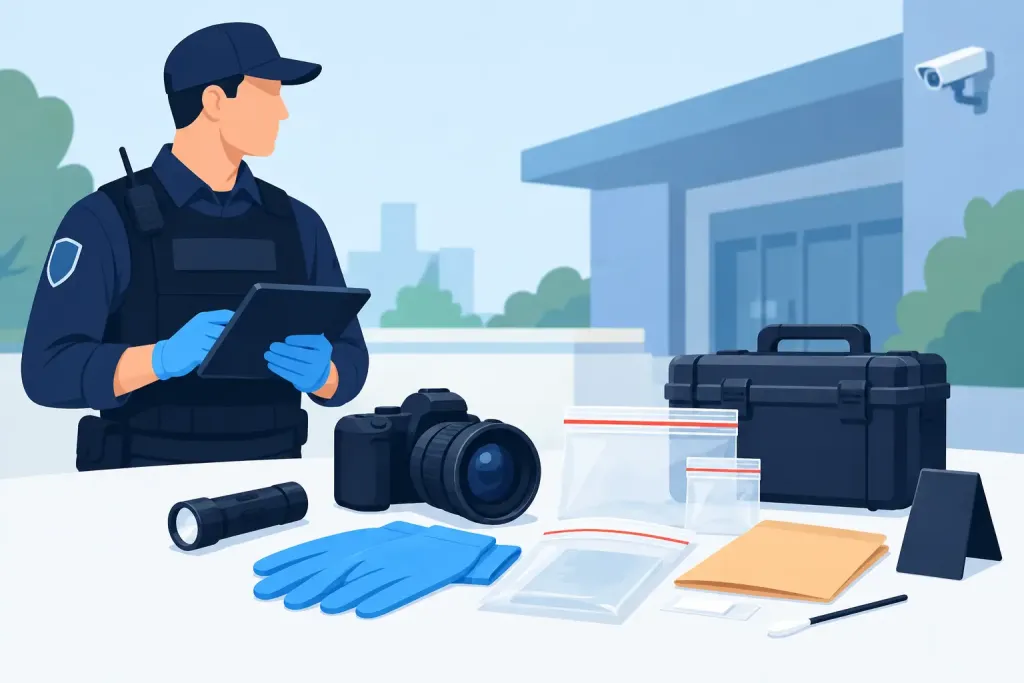
A disputed missed patrol, an injury near a loading bay or an allegation of poor response can become expensive very quickly when the only record is a handwritten note completed at the end of the shift. Essential guard evidence collection tools give security managers time-stamped, attributable proof of what happened, where it happened and what the officer did next.
For security providers and in-house teams, this is not about collecting data for its own sake. It is about giving supervisors the information to intervene while an incident is still developing, and giving clients, insurers and auditors a record they can trust afterwards. The best approach combines practical field tools with a clear workflow for review, escalation and retention.
What makes evidence defensible?
Evidence is most useful when it is captured at the point of activity, rather than reconstructed from memory. A useful record identifies the officer, location, date and time, describes the observation or action taken, and preserves supporting material such as photographs, voice notes or signatures where appropriate.
Context matters as much as the record itself. A photo of an unsecured gate is stronger when it is linked to a specific checkpoint, shows when it was submitted, identifies the reporting guard and includes the action taken. If the issue was passed to a control room, maintenance contractor or site manager, that escalation should be visible too.
Paper occurrence books can still have a place where connectivity is limited or as a contingency measure. However, they are difficult to search, easy to complete late and rarely give managers immediate visibility. Digital evidence collection reduces these weaknesses, provided the system has suitable access controls, reliable timestamps and an audit trail showing who created or amended a record.
Essential guard evidence collection tools for active sites
The right toolkit depends on the site risk assessment, workforce size and client obligations. A remote construction site has different requirements from a corporate office, while a hospital, airport or distribution centre may need faster escalation and more detailed incident categorisation. These are the core capabilities most operations should assess.
Mobile incident reporting with photographs
A smartphone-based guard app turns the device officers already carry into an evidence capture point. Guards can create an incident report as soon as they identify damaged perimeter fencing, suspicious behaviour, blocked fire exits, water leaks or unauthorised access.
Photographs provide useful visual detail, but they should not replace a clear written account. The report needs structured fields for the incident type, exact location, people involved, actions taken and whether further support was requested. This produces consistent reporting across officers and shifts, rather than a collection of vague free-text notes.
There is a trade-off. Requiring too many fields can slow reporting during a live situation. Use short, mandatory fields for critical facts and allow fuller information to be added once the immediate risk is controlled.
Time-stamped checkpoint verification
Checkpoint scans provide absolute proof of presence at vulnerable or high-value locations. QR codes, NFC tags, Bluetooth beacons and GPS-based virtual checkpoints can all confirm that a patrol route has been completed, with each scan recorded against the officer and time.
No single technology is right for every location. QR codes are simple and cost-effective but need a visible, scannable label. NFC tags are fast and discreet, though they require compatible mobile devices and careful placement. GPS checkpoints suit open estates and remote perimeters but may be less precise indoors or in areas with weak satellite coverage. Beacons can assist in indoor locations, but they need ongoing battery and equipment management.
The operational value comes from linking a missed, late or out-of-sequence checkpoint to an immediate response. A scan alone proves presence. A live exception alert gives a supervisor the chance to ask why the patrol was interrupted and decide whether support is required.
Location records that respect the task
Location data can provide valuable context for incidents, welfare checks and patrol verification, especially for officers working alone or covering wide estates. It can show whether an officer attended the reported area, help a control room direct support and establish a timeline after a serious event.
It should be proportionate. Continuous tracking may be justified for high-risk lone-working roles, but it is not automatically necessary for every duty. Security employers should document the purpose of location collection, explain it clearly to staff, limit access and retain data only for as long as the operational and legal need requires. This is essential for GDPR compliance and workforce trust.
Digital occurrence books and shift handovers
A well-managed occurrence book is more than a chronological diary. It is the operational memory of a site. Digital records make entries searchable by date, location, incident category, officer or client, allowing supervisors to identify repeat faults such as recurring door alarms, persistent anti-social behaviour or repeated delivery access issues.
Shift handovers benefit immediately. Instead of relying on a verbal update that may be incomplete, the incoming officer can see open incidents, outstanding patrol tasks, temporary access restrictions and instructions left by management. The result is fewer gaps between shifts and a cleaner chain of accountability.
Panic alarms and lone-worker welfare checks
Evidence collection is not solely retrospective. When an officer activates a panic alarm or fails a welfare check, the system should create a live event record and notify the appropriate people without delay. That record can include the officer’s last known location, the time of activation, acknowledgements by supervisors and the actions taken to protect the worker.
This is particularly relevant for empty commercial premises, isolated gatehouses, late-night hospitality venues and large industrial sites. A lone-worker function is only effective when response responsibilities are defined in advance. Decide who receives alerts, how quickly they must respond, when emergency services are contacted and how each step is recorded.
Build an evidence workflow, not a collection habit
More information does not automatically mean better security. Managers need a practical process that directs guards towards the right evidence and ensures reports lead to action.
Start with the risks that matter most at each site: perimeter breaches, fire safety failures, unauthorised entry, aggressive behaviour, asset loss, plant movement or missed welfare checks. For each risk, set the evidence required, who receives the notification and the expected response time. A report of an open fire door, for example, should trigger a different workflow from an observation about litter in a car park.
Next, standardise report categories and language across the contract or estate. If one officer records “door issue”, another enters “access fault” and a third writes “broken lock”, trend analysis becomes unreliable. Clear categories make it easier to report on recurring risks and demonstrate performance against client service level agreements.
Finally, give supervisors an exception-based view. They should not need to read every routine patrol entry to find a late checkpoint, an unanswered panic alarm or a repeated incident at the same location. Live dashboards and automated notifications allow management attention to move towards the issues requiring judgement.
Protect the integrity of the record
A defensible audit trail depends on more than a mobile app. Devices should be protected by individual user logins, appropriate permissions and screen locks. Officers should not share accounts, as this weakens attribution. Managers also need clear rules for correcting errors: the original entry should remain visible, with the amendment, author and time recorded.
Image and video evidence needs particular care. Avoid capturing irrelevant personal information where possible, restrict access to those with a genuine operational need and set documented retention periods. If police, insurers or a client request material, staff should know who is authorised to release it and how the disclosure is logged.
Connectivity is another practical consideration. Some sites have basements, rural perimeters or secure areas with poor signal. Choose tools that can capture records offline and synchronise when a connection returns, while making it clear to supervisors which entries are pending upload. An apparent absence of data should never be mistaken for proof that no patrol occurred.
Turn evidence into stronger site control
The real test of a collection system is what happens after a guard submits a report. QR-Patrol brings patrol verification, digital occurrence books, incident evidence, tasks and lone-worker alerts into one live operational view, so managers can respond before a small defect becomes a security failure.
Review evidence trends with site teams and clients at agreed intervals. Look for locations with repeated late patrols, alarms that occur at similar times, assets frequently reported unsecured or incidents that repeatedly require the same response. These patterns may point to a staffing issue, a poorly designed patrol route, a maintenance failure or a wider site risk that cannot be solved by asking guards to be more vigilant.
Good evidence collection should make officers’ work easier, not turn every patrol into administration. Give guards clear expectations, train them on when to record and escalate, and show them that well-captured reports lead to visible action. When a guard can prove presence, document risk and call for help from the same device, the security operation becomes easier to manage and much harder to dispute.
