
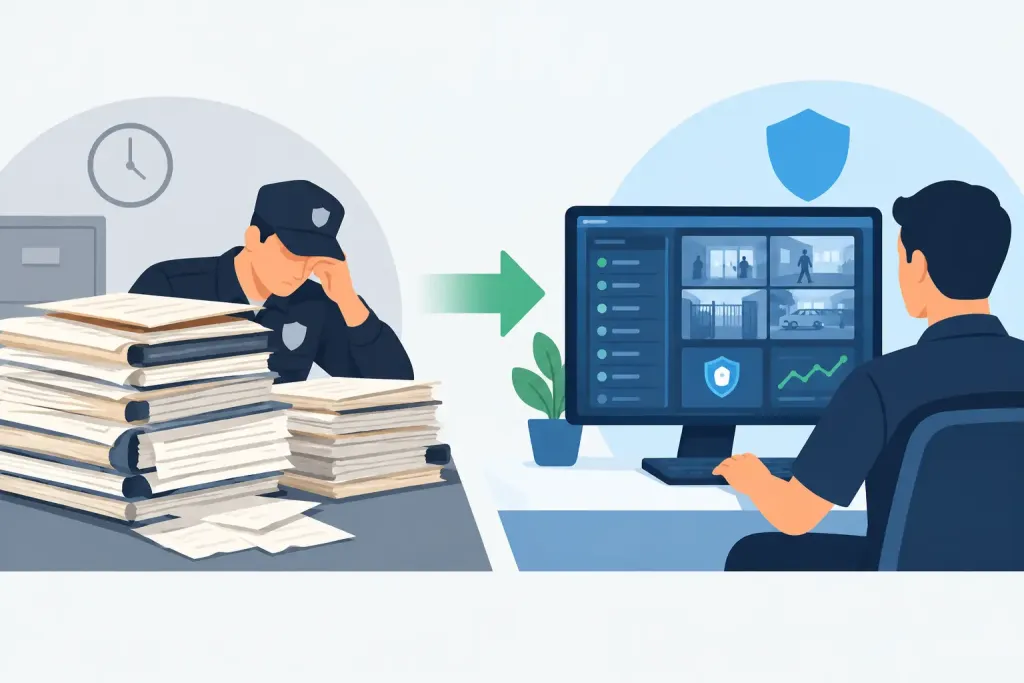
A patrol log completed at the end of a shift can look tidy, detailed and entirely credible. It can also conceal a missed checkpoint, an unattended access point or an incident that should have reached a supervisor an hour earlier. That gap between what happened on site and what management can prove is the real reason why replace paper logs is no longer simply an administrative question.
For security providers, facilities teams and in-house operations, paper records create a delay at the exact point where certainty matters most. A guard may be doing excellent work, but if patrol activity, hazards and incidents are only visible after a notebook is handed in, managers are operating from the past. Digital patrol records turn routine activity into live operational intelligence.
Why replace paper logs for security patrols?
Paper logs were designed for a simpler operating model: one site, one guard, one supervisor and a relatively predictable shift. Many security operations now cover dispersed estates, changing risk profiles, lone workers, strict client service levels and a need to evidence performance without delay. A handwritten occurrence book cannot reliably meet all of those demands.
The issue is not that every paper entry is inaccurate. Experienced officers often take careful notes. The weakness lies in the process around the note. Handwriting can be unclear, entries can be made retrospectively, pages can go missing, and information can remain in a gatehouse or patrol vehicle until someone collects it. Even when everything is recorded correctly, a supervisor has no immediate way to know whether a patrol is on schedule or whether an officer needs support.
Replacing paper logs gives managers time-stamped, attributable records that are captured while work is being carried out. When a guard scans a QR code or NFC tag, records a finding against a checkpoint or submits an incident report from a mobile device, the activity can be available to authorised managers immediately. This creates absolute proof of presence while giving the control room a chance to act before a small issue becomes a serious failure.
Live visibility changes how supervisors intervene
A paper patrol sheet proves little until it is reviewed. By then, the opportunity to redirect a guard, contact a site representative or escalate an emerging risk may have passed. Live reporting changes the supervisor’s role from checking completed paperwork to actively managing delivery.
Consider a warehouse perimeter patrol. A guard finds a damaged fence panel during an evening round. With a paper log, the finding may be written down, mentioned on handover and reviewed the next morning. With a digital form, the guard can record the location, add photographs, classify the risk and notify the relevant team immediately. The supervisor can confirm that temporary controls are in place and create a defensible record of the response.
This matters just as much for ordinary patrol completion. A missed checkpoint is not always misconduct. It may indicate an obstructed route, a malfunctioning tag, a welfare problem or a developing incident. Real-time exceptions allow managers to ask the right question while the guard is still on duty, rather than attempting to reconstruct the situation days later.
From reported activity to verified activity
Digital systems should not merely reproduce a paper log on a phone screen. Their value comes from verification. Location-aware checkpoints, QR codes, NFC tags, beacons and GPS-based points can confirm that a required task was completed at the expected location. Time stamps establish when it happened, while a named user record establishes who completed it.
There are sensible limits. GPS can be less precise indoors, and a QR label can be damaged or moved if it is poorly installed. That is why a multi-technology approach is useful. The right mix of checkpoints depends on the site layout, connectivity, environmental conditions and level of assurance required. What matters is that the evidence is more reliable than a tick on a sheet completed from a desk.
Stronger records support compliance and client confidence
Security teams are frequently asked to demonstrate more than good intentions. Clients may require evidence against service level agreements. Investigations may need a clear timeline. Health and safety duties require organisations to show that risks were identified, escalated and managed. For contracted guarding, records also support the operational discipline expected under standards such as BS 7499.
Paper makes this harder because records are fragmented. One detail may be in the occurrence book, another in a supervisor’s email, another in a photographic folder and another in a shift handover note. Pulling together a complete account takes time, and every manual transfer introduces the possibility of omission or error.
A centralised digital record creates a clearer audit trail. Patrols, incidents, tasks, welfare checks and supporting images can be associated with the same site and shift. Managers can produce consistent reports for a client without manually deciphering handwriting or collating multiple files. That improves professionalism, but it also protects the organisation when a complaint, claim or investigation requires evidence.
Data protection still needs proper attention. Replacing paper logs does not remove GDPR responsibilities. It requires defined access controls, retention rules, secure user management and a clear purpose for collecting location or incident data. In practice, a well-configured cloud platform can provide better governance than notebooks left in an unlocked office, provided the organisation applies those controls properly.
Faster incident reporting protects people and property
Security threats do not wait for the end of a round. If an officer discovers forced entry, fire damage, a vulnerable person or suspicious behaviour, the priority is rapid communication and a controlled response. Asking the officer to make a written note first adds no value.
Digital incident workflows can guide guards to capture the facts that matter: time, place, category, description, photographs and actions taken. Automatic alerts can then notify supervisors or designated contacts according to the incident type. This makes escalation more consistent, particularly across sites where supervisors cannot be physically present.
For lone workers, the operational benefit is even more direct. A patrol system can support scheduled check-ins, panic alarms and man-down alerts, helping the organisation identify when an officer may need assistance. These features do not replace training, radio procedures or emergency planning. They strengthen them by ensuring that welfare signals are visible to the right people without relying on a colleague noticing a missing entry in a logbook.
Less administration, better accountability
Paper processes consume management time in small, persistent ways. Logs must be collected, checked, stored, copied, corrected and searched. Supervisors chase incomplete forms. Administrators prepare reports from handwritten records. Guards can also lose valuable patrol time writing the same information in several places.
Digital forms reduce duplication by structuring what needs to be captured at the point of work. Mandatory fields can prevent critical information being omitted, while configurable task lists make site instructions clearer for new and relief officers. Standardised categories also make trends easier to identify. If several guards report poor lighting near the same entrance, a manager can see a repeated concern rather than treating each entry as an isolated note.
That said, digitisation should not create unnecessary friction. A form that demands excessive typing during a routine patrol will frustrate guards and weaken adoption. Build concise workflows around genuine decisions and evidence requirements. Routine confirmations should be fast; serious incidents should allow fuller detail, photographs and escalation.
A practical route away from paper logs
The most effective changeovers start with the operational problems, not the software features. Identify where paper records are causing delays, disputes or blind spots, then configure the digital workflow around those risks.
A controlled implementation usually covers four areas:
- Map patrol routes, checkpoints, critical assets and required site tasks.
- Define incident categories, escalation contacts and response expectations.
- Train officers and supervisors using real site scenarios, including poor connectivity and emergency procedures.
- Run a short review period to refine forms, reports and notification rules before removing paper duplication.
A temporary parallel process can be appropriate for high-risk sites or teams new to mobile reporting. It should have a clear end date, however. Keeping paper and digital logs indefinitely doubles administration and leaves uncertainty over which record is authoritative.
QR-Patrol supports this transition with smartphone-based patrol verification, digital occurrence records, configurable forms and live management visibility across single or multi-site operations. The objective is not to add technology for its own sake. It is to make every required patrol, task and incident easier to verify, manage and report.
Paper logs can still have a contingency role where connectivity, device availability or business continuity planning requires it. But they should be the fallback, not the primary control. When an incident occurs, the record that matters is the one that lets your team see the truth quickly, respond decisively and demonstrate exactly what was done.
