
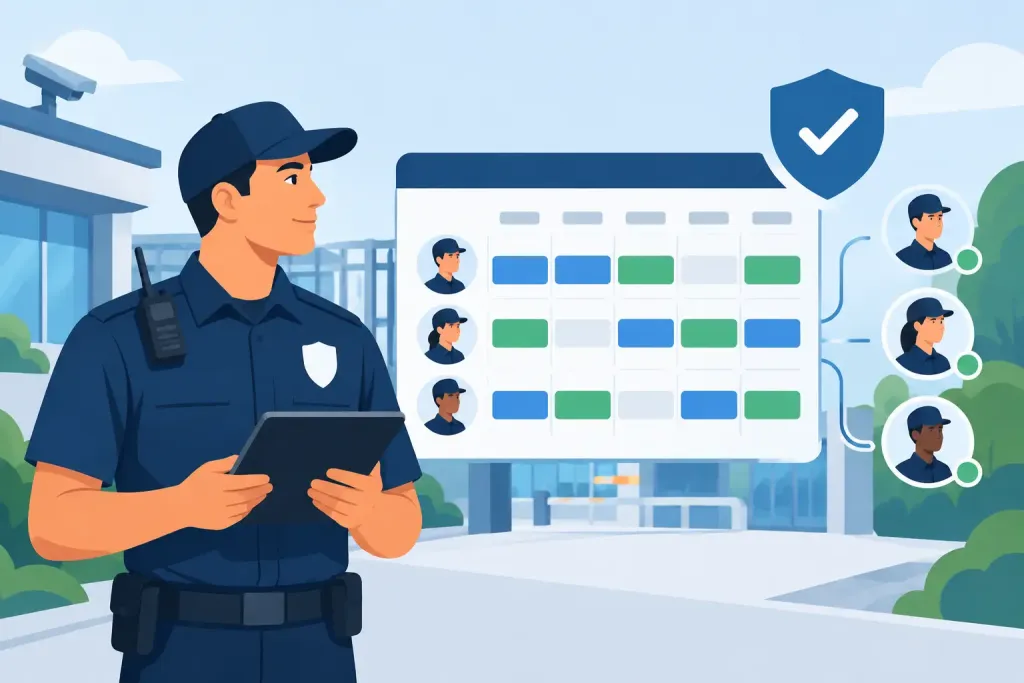
A vacant gatehouse at 06:00, an officer arriving without a proper briefing, or a night patrol missed during a busy handover can expose a site within minutes. Knowing how to manage guard shifts is therefore not simply an administrative task. It is a live operational control that determines whether every post is covered, every officer is fit to work, and every risk receives the response it requires.
For security providers, facilities teams and in-house departments, a workable shift plan must balance contractual coverage with legal obligations, fatigue management, site risk and the realities of last-minute absence. The strongest rotas are not just published in advance. They are actively monitored, evidenced and adjusted before a small staffing issue becomes a service failure.
Start with the security requirement, not the rota
The common mistake is to begin with available names and fill empty boxes. Start instead with the site’s required outcome. A logistics yard may need a mobile patrol officer overnight, a manned gatehouse during delivery hours and rapid alarm response. An office campus may require reception screening at peak entry times, scheduled patrols after hours and trained fire wardens at all times.
Define each post by its required coverage window, duties, competencies and escalation responsibilities. Separate roles that look similar but carry different risks. A guard authorised to manage access control may not be the right person to work alone at a remote compound or take responsibility for a high-value keyholding response.
This creates a clear baseline for the rota. Managers can then see whether they are scheduling genuine capability, rather than merely placing a person on site. It also provides an auditable link between the client’s SLA, assignment instructions and the shifts delivered.
Build a post profile for every location
A concise post profile should state the location, start and finish time, patrol frequency, mandatory equipment, lone-worker status, required licences or training, and who the officer reports to. Include the site-specific hazards: vehicle movements, public contact, confined areas, isolated buildings or known incident patterns.
Keep these instructions accessible in the field. If a relief officer is sent to cover a shift, they need more than an address and start time. They need the information to take control safely from the first minute.
How to manage guard shifts with a realistic rota
Publish rotas early enough for officers to plan their travel, rest and personal commitments. Predictability supports retention, punctuality and better service. It also gives supervisors time to identify gaps before they become urgent.
However, a rota is only reliable when it accounts for the constraints behind it. Check contracted hours, rest periods, consecutive night shifts, travel time between sites, holiday, training, medical restrictions and competency requirements. A technically filled shift can still be unsafe or non-compliant if the officer has worked excessive hours or cannot realistically reach the next location.
Avoid assigning the same dependable people to every difficult vacancy. Regular overtime may solve a short-term gap but can lead to fatigue, lower vigilance and absence later. The right balance depends on the site and workforce, but repeated extended shifts should prompt a resourcing review rather than become normal practice.
Use a clear approval process for swaps and overtime. Informal arrangements arranged by text message often leave supervisors unaware of who is actually on duty. Every change should update the central schedule, confirm that the replacement is authorised for the assignment, and notify the relevant control room or site contact.
Verify attendance and proof of presence in real time
A signed paper timesheet proves very little while a shift is underway. It may be completed late, inaccurately or only after a concern has been raised. For critical posts, managers need to know whether the officer has arrived, started patrols and completed required checks.
Mobile guard tour technology provides this visibility without creating unnecessary administration. Officers can check in at designated locations and scan QR codes, NFC tags or other checkpoints as they complete patrols. GPS-based checkpoints can support larger or remote estates where fixed tags are not practical.
The operational advantage is immediate. If a guard does not report at the expected time, the supervisor can investigate while there is still time to deploy relief cover. If a patrol is missed, the event can be assessed against the site conditions rather than discovered in a monthly report.
QR-Patrol brings schedules, checkpoint activity, incidents and officer status into one cloud-based view. This allows managers to distinguish between a late scan, a delayed patrol caused by an incident, and a post that has not been attended at all. The record is also valuable when clients need defensible proof that agreed services were delivered.
Set sensible alerts, not constant noise
Alerts should reflect the seriousness of the post. A missed checkpoint at a high-risk perimeter may need an immediate supervisor notification. A delayed check at a low-risk internal area may warrant a short tolerance window, particularly where patrol routes vary.
Review alert thresholds with site managers and officers. Too many non-critical notifications cause alert fatigue, while overly broad timing windows weaken accountability. The purpose is timely intervention, not a stream of avoidable alarms.
Make handovers a controlled security process
Many coverage failures happen when two shifts overlap but information does not transfer. The outgoing officer may know that a contractor has been given temporary access, a camera is faulty or a delivery vehicle remains on site. If this is not handed over, the incoming officer starts blind.
Schedule a short overlap where the risk justifies it, particularly at busy access points, control rooms and sites with frequent incidents. The handover should cover outstanding incidents, keys and equipment, visitor or contractor status, defects, restricted areas, planned works, expected deliveries and any welfare concerns.
Digital occurrence books and shift reports make this process more reliable. The incoming officer can review entries, photographs and outstanding tasks before taking responsibility. Supervisors can then see whether an issue was acknowledged and followed through, rather than relying on verbal messages that cannot be verified later.
Do not treat handovers as a box-ticking exercise. A poor handover can compromise the entire next shift, even when staffing levels are technically correct.
Prepare for absence before it happens
Sickness, transport disruption and no-shows cannot be eliminated. The control is how quickly and consistently your organisation responds. Maintain a vetted relief pool, identify officers trained for specific sites, and record their availability accurately. A generic list of names is not enough if the nearest available officer lacks the correct licence, clearance or site induction.
Create an escalation path for every unfilled shift. It should state who contacts the officer, when a supervisor is deployed, when the client is informed, and what temporary control applies while relief is travelling. At an unmanned gate, for example, remote monitoring, restricted access or a mobile supervisor may reduce exposure until cover arrives.
For lone workers, absence and welfare response deserve additional attention. If an officer misses scheduled check-ins, stops moving unexpectedly or activates a panic alarm, there must be a defined response team and a current location record. Speed matters, but so does avoiding assumptions about what the alert means.
Use shift data to improve the next rota
The value of digital scheduling and patrol data is not limited to proving that officers attended. It reveals patterns that should change how work is planned. Look for late starts by location, repeated overtime, missed checkpoints by time of night, recurring incident hotspots, frequent relief deployments and posts that generate excessive false alarms.
A pattern of missed patrols near shift end may indicate an unrealistic route, inadequate overlap or a reporting task that takes too long. Regular last-minute cover at one site may point to poor travel arrangements, unsuitable shift hours or weak local supervision. Data should lead to practical action: change the route, adjust the staffing model, retrain officers or revise the client agreement where the original requirement is no longer realistic.
Report these findings clearly. Clients need transparent records, but they also need to see that their security provider is actively reducing risk. A concise monthly review that connects evidence to corrective action is more valuable than pages of unexamined patrol logs.
Protect fairness, welfare and compliance
Effective shift management protects officers as well as premises. Fair allocation of nights, weekends and overtime improves morale and reduces the likelihood that experienced staff leave. Give officers a clear way to raise fatigue, welfare or scheduling concerns without fear of being seen as uncooperative.
Managers should also retain accurate records of working time, training, qualifications and site authorisations. For UK security operations, this supports the duty to manage health and safety, helps demonstrate alignment with BS 7499 expectations where applicable, and strengthens the evidence available during client or internal audits. Personal data used for scheduling and location monitoring must be handled responsibly, with clear purpose, access controls and retention practices consistent with GDPR.
The goal is not to monitor people for its own sake. It is to ensure that a lone officer can be protected, a client site is covered, and decisions can be evidenced when scrutiny follows.
A well-managed guard shift is one in which the right officer arrives prepared, completes the required work, can call for help immediately and leaves a clear record for the next person. Build your process around that standard, then use live information to act the moment reality differs from the plan.
