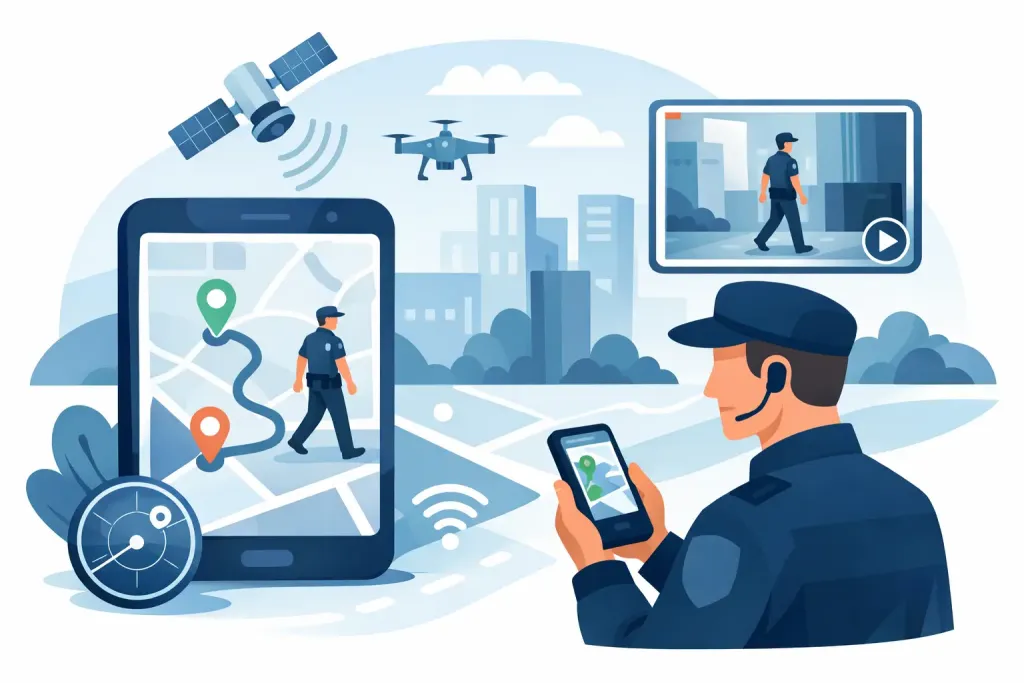
A patrol marked complete at 02:00 is of little value if a supervisor cannot establish where the officer was, what they found, or whether an incident was escalated at the time. GPS guard tracking replaces assumption with a live, time-stamped operational record. For security providers and in-house teams, it gives control room staff and managers a practical way to verify patrol activity while there is still time to intervene.
This is not simply about viewing a dot on a map. Used correctly, location data connects a guard’s route, checkpoint visits, welfare status, incident reports and shift activity into evidence that can be reviewed by a client, manager or auditor. It helps expose missed areas, delayed patrols and lone-worker risks before they become a service failure.
What GPS guard tracking proves in practice
GPS tracking records a guard device’s location at defined intervals or during selected activities. Within a patrol management platform, that information can show whether an officer attended the expected area, followed an appropriate route and remained active during a shift. Managers can see the operational picture from a central web application rather than waiting for an end-of-shift paper report.
The strongest value comes from combining GPS with a defined patrol plan. A route can be assessed against scheduled checkpoints, expected visit windows and site-specific instructions. If a patrol is late, a checkpoint is missed, or a guard remains stationary in an unexpected location, the system can trigger an alert for review.
For a facilities manager, this creates verifiable evidence that agreed security coverage took place. For a security company, it supports more transparent client reporting and gives supervisors facts to work from when coaching teams or investigating a complaint. For the officer on the ground, it provides a clear record that they attended the areas they were assigned to protect.
GPS guard tracking works best with checkpoints
GPS is highly useful for wide estates, perimeter patrols, car parks, construction projects, campuses and remote locations. It is less precise inside some buildings, underground spaces or areas with poor satellite reception. A location trace alone should therefore not be treated as absolute proof that a guard inspected a particular door, fire exit or plant room.
This is why effective guard tour operations use the right verification method for each environment. GPS-based virtual checkpoints can confirm attendance within a defined outdoor zone, while QR codes, NFC tags and Bluetooth beacons provide a more precise confirmation at fixed points. The guard scans or detects the checkpoint through their smartphone, creating a time-stamped record that can include GPS context.
That combined approach reduces blind spots. A warehouse perimeter may be monitored through GPS checkpoints, while loading bays, access gates and high-value storage areas use NFC or QR checkpoints. In a multi-storey office building, QR or NFC tags can confirm visits where satellite positioning is unreliable. Managers retain one patrol record, rather than piecing together evidence from separate systems.
Set tolerances that reflect the site
A virtual checkpoint needs a sensible geofence radius. Make it too wide and a guard may register a visit from outside the relevant area. Make it too narrow and normal GPS variation may create false exceptions. The correct setting depends on the location, the task and the level of proof required.
For example, a 30-metre radius may be suitable for a large external gate or a perimeter point. A smaller, tag-based verification method is more appropriate for a specific control panel or emergency exit. The goal is not to collect the most location data possible. It is to collect dependable evidence that matches the security risk.
From live location to faster intervention
A delayed patrol is often an early warning, not merely a reporting issue. The guard may be dealing with an incident, unable to access an area, facing a welfare concern or simply following an incorrect route. Without live visibility, a supervisor may only discover the problem after the shift has ended.
Live GPS activity allows the control room to assess the situation quickly. If an officer has stopped moving during a perimeter patrol and has not checked in, staff can call them, review recent activity and deploy support where necessary. If a patrol is running late because a gate is blocked or a contractor is on site, the officer can submit an occurrence or incident report from the same mobile device.
This workflow matters particularly for lone workers. A panic alarm, man-down alert or scheduled welfare check becomes more actionable when the responding team can see the officer’s last known position. At isolated industrial sites, vacant properties or large outdoor estates, minutes matter. Location information should support a defined escalation process, including who receives the alert, who contacts the officer and when emergency services or site management must be involved.
Build GPS tracking around accountable patrol operations
Technology cannot repair an unclear patrol brief. Before deployment, define what each route is intended to achieve: deterrence, fire and safety checks, access control, asset protection, opening and closing duties, or response to known risks. Then configure schedules, checkpoints, tasks and escalation rules around that purpose.
A practical implementation should establish four controls:
- Clear patrol windows that distinguish a genuinely late visit from a reasonable operational delay.
- Checkpoint methods suited to each location, including GPS for open areas and QR, NFC or beacon verification where precision is required.
- Exception alerts that go to a named supervisor or control room, with an agreed response process.
- Reporting standards for incidents, defects and missed checkpoints, so every exception receives an outcome rather than a tick-box review.
Supervisors should also review routes after the first weeks of operation. Repeated missed points may indicate poor checkpoint placement, unrealistic timings, a physical access issue or inadequate officer training. A good system identifies the exception; competent management determines the cause and acts on it.
Privacy, GDPR and fair workforce use
GPS data is personal data when it can identify an individual officer. Security organisations should be clear about why tracking is used, when it is active, who can access it and how long records are retained. The lawful basis and retention period will depend on the organisation’s specific circumstances, contracts and policies, so appropriate data protection advice should be taken where needed.
The operational case should be communicated plainly: location tracking is used to verify patrol delivery, protect lone workers, support incident response and meet contractual obligations. It should not become a vague tool for unnecessary surveillance outside working duties. Tracking should be configured for shifts and assignments, not used to monitor a guard’s private time.
Access controls matter as much as policy. Managers should only see the information necessary for their role, while audit logs should show who accessed or changed records. These measures help security teams demonstrate that they are balancing workforce privacy with legitimate safety and service requirements.
Evidence clients and auditors can use
Clients do not need pages of raw coordinates. They need a clear record of whether security duties were completed, what exceptions occurred and how those exceptions were resolved. GPS-enabled patrol reports can present shift activity, route history, checkpoint attendance, incident photographs, officer notes and timestamps in a format that supports service reviews.
This is particularly valuable where contracts include patrol frequencies, response expectations or compliance obligations. A defensible digital audit trail supports discussions about SLA performance and can help demonstrate the control measures behind BS 7499-aligned guard services, health and safety procedures and site instructions.
Evidence must still be interpreted carefully. A recorded location proves a device was at or near a place, not automatically that every required observation was made. Pair location verification with task prompts, mandatory observations, photographs where appropriate and incident reporting. That gives managers a fuller account of what happened on site.
Choosing the right platform for the operation
When assessing a GPS patrol solution, focus on whether it supports the real working conditions of your sites. Can managers view live activity and exceptions without delay? Can the app continue collecting records when mobile coverage is weak and synchronise when it returns? Does it support multiple checkpoint technologies, schedules, incidents, lone-worker alerts and branded compliance reports from one system?
QR-Patrol brings these functions together through a smartphone-first guard app and central cloud platform. That allows teams to use GPS where it delivers meaningful route visibility, while maintaining precise proof of presence through QR codes, NFC tags and beacons where required.
The most effective deployment starts with one question: if a patrol is missed, an officer needs help or a client challenges the service, can your team see the facts quickly enough to act? Configure GPS tracking to answer that question clearly, and every shift becomes easier to manage, safer to deliver and simpler to evidence.