
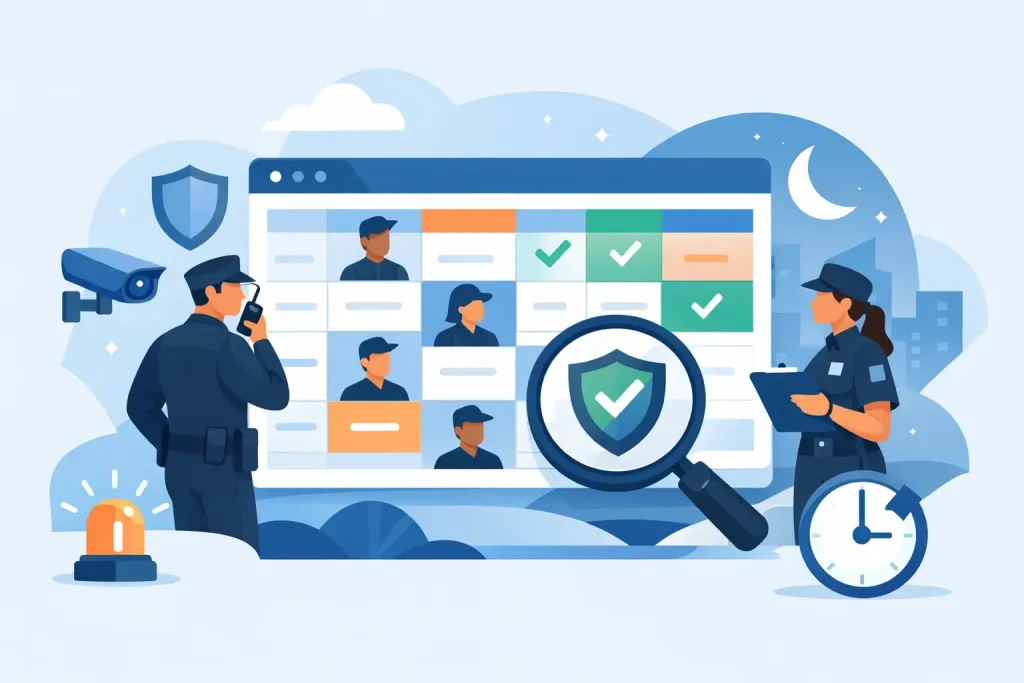
A security shift can look fully covered on a spreadsheet at 16:00 and become a live risk by 18:00. A guard calls in sick, relief has not arrived, a keyholder request extends the patrol, and the supervisor is left chasing messages while the site is exposed. Guard rota software gives operations teams a controlled way to plan cover, confirm attendance and act on changes before they become missed patrols or breached client commitments.
For security providers and in-house teams, a rota is not simply an employee timetable. It is evidence that the right trained person was allocated to the right site, for the right hours, with clear responsibility for handover and patrol duties. When that record is disconnected from what happens in the field, managers lose visibility at the point it matters most.
Why paper rotas and spreadsheets leave operational gaps
Spreadsheets can be useful for basic planning, particularly for a small and stable team. The problem begins when schedules change frequently, sites have different access requirements, or managers need to prove that a planned shift was actually fulfilled. A revised spreadsheet may sit in an inbox while a guard works from an older version. A last-minute swap may be agreed by telephone but never recorded properly. By the time a discrepancy is found, the opportunity to intervene has passed.
Paper sign-in sheets have similar limits. They record what someone wrote at a location, but they do not reliably show whether the person completed required patrols, reported an issue promptly or remained safe while working alone. They also create a slow, fragmented audit trail when a client, insurer or investigator asks what happened during a specific shift.
The cost is not only administrative. Uncovered posts, fatigued guards, poor handovers and unclear responsibilities can affect site safety, service quality and contractual performance. Where security officers are deployed across multiple properties, construction projects or remote facilities, these gaps multiply quickly.
What guard rota software should control
Effective guard rota software brings planning and field execution closer together. The rota should show who is due to work, where they must be and what qualifications or instructions apply. It should also make absence, open shifts and schedule changes immediately visible to the people responsible for resolving them.
That does not mean every operation needs the same level of automation. A single office site may need straightforward shift allocation and attendance confirmation. A national contract with mobile patrols, static guarding and relief officers may need role-based permissions, recurring schedules, client-specific instructions and a clear approval process for amendments. The right system should reflect the complexity of the operation without making supervisors spend their shifts maintaining software.
At a minimum, managers should be able to control four connected areas:
- Shift allocation, including site, post, start and finish times, and the officer assigned.
- Availability and exceptions, so sickness, leave, lateness and vacant duties are visible rather than buried in messages.
- Instructions and handovers, giving officers access to current assignment details and site requirements.
- Evidence of execution, connecting the planned shift with attendance, patrol activity, tasks and occurrence records.
The fourth point is where a security-specific platform has a clear advantage over a general workforce calendar. Scheduling is necessary, but it is not proof of service.
Connect the rota to proof of presence
A scheduled guard is not necessarily a guard on site. For client-facing contracts and high-risk locations, managers need to distinguish between planned coverage and verified activity.
Mobile patrol technology can provide that verification through QR codes, NFC tags, Bluetooth beacons or GPS-based checkpoints. When an officer scans a checkpoint or completes a required task, the record is time-stamped and synchronised to the management platform. Supervisors can see whether rounds are being completed as expected, whether a checkpoint has been missed and whether a deviation needs attention.
This approach creates a more useful operational picture. If a guard is allocated to a warehouse night shift but has not started the first perimeter patrol, a supervisor can contact them while the issue is still recoverable. If an officer finds an unsecured gate, the incident can be recorded with notes, photographs and the precise time of discovery, rather than reconstructed from memory at the end of the week.
QR-Patrol combines rota and workforce visibility with live patrol monitoring, giving managers one working record rather than separate scheduling, patrol and incident systems. That matters when a client asks for evidence of a particular shift: the response should be a defensible record, not a search through paper books and WhatsApp messages.
Build rotas around competence, not just availability
The fastest way to fill an open shift is not always the safest. Some posts require officers with site induction, first-aid training, keyholding authority, SIA licence, vehicle access or knowledge of a particular emergency procedure. If these requirements sit outside the rota process, an apparently covered shift can still be non-compliant.
A better workflow starts with the post. Define its hours, duties, lone-worker risk, patrol frequency, access constraints and competency requirements. The rota can then be built around suitably authorised personnel, rather than relying on supervisors to remember every condition under pressure.
This is particularly valuable in mixed estates. A guard suitable for reception cover in an office park may not be authorised for a remote industrial compound, while an experienced mobile officer may need a specific vehicle or key set before taking a call-out. Clear allocation rules reduce avoidable errors and make handovers more reliable.
There is a practical balance to strike. Overly rigid rules can make it hard to respond to genuine last-minute absence. The system should flag exceptions and require informed approval, rather than blocking a manager from making a necessary decision. The key is that the exception is visible, recorded and reviewed.
Make schedule changes visible to the right people
Shift changes are normal in security operations. The risk comes from informal changes that are not communicated consistently. An officer believes they have swapped a shift, control room has not updated the schedule, and the original guard is marked absent. The client sees uncertainty at the gate.
A controlled rota process should record who changed the assignment, when it changed and whether the replacement has acknowledged it. Supervisors also need a clear view of unfilled duties, overtime pressure and recurring attendance issues. These are not just payroll concerns. They can reveal fatigue risk, understaffed contracts or a dependency on the same small group of relief officers.
Notifications should support action, not create noise. A useful alert is one that identifies a genuinely uncovered post, a late start, a missed critical patrol or an unacknowledged emergency. If every minor event produces an alert, important warnings will be ignored. Set thresholds according to site risk and ensure there is a defined escalation path.
Use the rota to strengthen lone-worker safety
For lone guards, knowing who should be working, where and when is part of the safety control. A schedule provides the expected pattern of activity. Patrol checkpoints, welfare checks and man-down or panic alarms then provide evidence that the officer is following that pattern or needs assistance.
If an officer fails to check in at an expected point, the response should not depend on someone noticing a blank cell in a spreadsheet. The system should support a prompt check by the supervisor or monitoring team, followed by escalation in line with the organisation’s lone-working procedure.
Technology does not remove the need for sound risk assessments, trained supervisors or clear emergency arrangements. It does, however, give those procedures live data and a reliable record of the action taken. For remote sites, out-of-hours work and isolated patrol routes, that distinction can be critical.
Turn daily scheduling data into defensible reporting
A rota is also the starting point for better client reporting. When planned duties, attendance, patrol scans, incidents and corrective actions are captured in one environment, managers can show more than a list of hours worked. They can demonstrate whether contractual patrol frequencies were met, where exceptions occurred and how they were resolved.
This supports stronger management against SLAs and helps identify patterns that are easy to miss day to day. Repeated late starts at one site may indicate an unrealistic relief arrangement. Frequent patrol exceptions may point to a route that needs redesigning. A cluster of incidents during a particular time window may justify changes to staffing or security measures.
For organisations working to BS 7499 expectations, health and safety duties and GDPR requirements, records must be relevant, controlled and retained appropriately. Software can support this discipline through time-stamped records, access controls and consistent reporting. It cannot make an operation compliant on its own. Managers still need appropriate policies, training, data handling practices and oversight.
Choosing a system that fits the operation
When assessing guard rota software, ask how it will work during a difficult shift, not just during a tidy demonstration. Can a supervisor identify an uncovered post immediately? Can a guard see current instructions on a mobile device? Can the control room verify patrol activity and respond to an incident without switching between systems? Can the organisation produce accurate records for a client dispute or audit?
Implementation also deserves attention. Start with site data, post requirements, reporting lines and escalation rules. Pilot the workflow at a representative location, including a shift swap, missed checkpoint, incident report and lone-worker alert. This reveals whether the configuration supports real operations and gives officers practical confidence before wider rollout.
The most valuable rota is not the one that merely fills every cell. It is the one that gives managers time to see a developing gap, verify what is happening on site and put the right response in place before security coverage is compromised.
