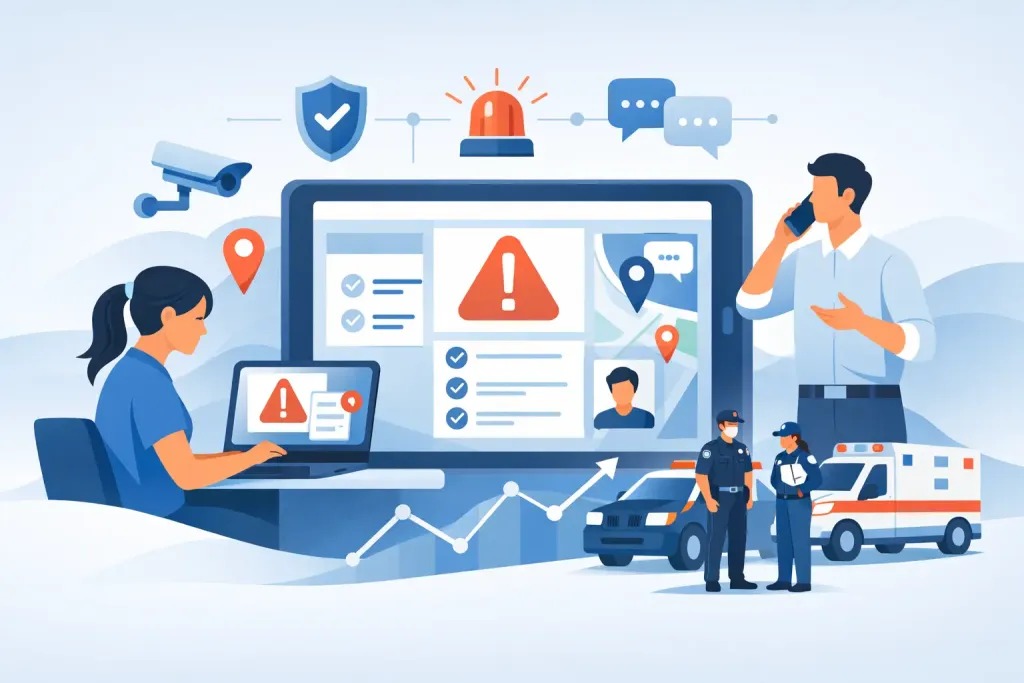
A slipped delivery driver at 02:15, a damaged perimeter fence at 04:40, a fire door wedged open during a busy shift – each event becomes harder to manage when the first record is a handwritten note discovered hours later. Incident reporting platforms give security managers a live, traceable account of what happened, who responded and what action followed while the detail is still accurate.
For security companies, facilities teams and in-house departments, reporting is not an administrative afterthought. It is a control point. A clear record supports faster decisions, protects staff, demonstrates service delivery and provides evidence when a client, insurer or regulator asks difficult questions.
Why paper incident reports create operational blind spots
Paper occurrence books and end-of-shift reports have a familiar weakness: they show managers what has already happened, often long after the opportunity to intervene has passed. A supervisor may not know that a guard has found a failed access-control door until the next handover. By then, the risk may have continued unchecked for several hours.
Manual reporting also produces inconsistent records. One officer may provide times, locations, photographs and a full account of actions taken. Another may write only, “Door damaged, informed control.” Neither necessarily reflects poor intent. Under pressure, guards need a reporting process that guides them towards the information the organisation needs.
This matters across multi-site contracts especially. When each site uses its own spreadsheets, notebooks or email chains, management cannot easily identify recurring issues such as repeated trespass attempts, frequent equipment faults or patterns of lone-worker welfare concerns. The evidence exists, but it is fragmented.
What incident reporting platforms should deliver
The right platform should make it straightforward for officers to report an event in the field and give managers immediate visibility without creating unnecessary steps. That means a mobile-first process, supported by central oversight rather than a digital version of a paper form.
Capture the facts at the point of discovery
A guard should be able to open an incident form from a smartphone, select the incident type, record a description, attach photographs and submit the report from the patrol location. The system should automatically preserve the date, time, user and, where appropriate, location data.
That time-stamped record strengthens accountability. It helps establish whether an issue was identified promptly, whether the correct escalation process was followed and whether a later account matches the original report. For incidents involving damage, health and safety hazards, visitor disputes or suspected criminal activity, these details can become critical.
Forms should be configurable rather than fixed. A construction site may need prompts for unsafe excavations, plant checks and perimeter breaches. A hotel may require categories for guest welfare, lost property and unauthorised access. A warehouse may focus on loading-bay safety, fire exits and stock-related incidents. Relevant fields improve reporting quality because they ask officers for the information that genuinely matters at that site.
Escalate before a small issue becomes a serious one
A submitted report has limited value if it sits unread until the morning. Effective incident reporting platforms can notify the appropriate people immediately, based on the type and severity of the event. A failed light in a low-risk area may create a maintenance task for the next working day. A forced door, welfare alarm or intruder sighting should alert the control room, supervisor or nominated contact at once.
The escalation route must reflect the organisation’s operating procedures. Not every event needs the same response, and excessive alerts soon lead to alert fatigue. Define what counts as urgent, who owns each category and how out-of-hours escalation works. The platform supports that process, but it cannot replace clear decision-making rules.
For lone workers, speed is even more important. A panic alarm or man-down alert should sit alongside incident reporting, not in a separate system that requires staff to switch between tools. Managers need a complete view of the officer’s last known location, welfare status, patrol activity and incident history when assessing a potential emergency.
Connect incidents to patrol evidence
An incident report becomes more useful when it is linked to the patrol activity around it. Did the officer scan the checkpoint near the reported issue? Was the location visited on schedule? Were previous defects recorded at the same point? This context turns a single report into operational intelligence.
Mobile patrol systems can combine QR codes, NFC tags, Bluetooth beacons and GPS-based checkpoints to create proof of presence across different environments. QR and NFC may suit fixed internal points. GPS checkpoints may be appropriate for large external grounds or remote locations. The best approach depends on site conditions, signal availability, the risk profile and the level of verification required.
QR-Patrol brings those patrol records, incident forms, alerts and reporting controls into one cloud-based operational view. For a manager, that means less time reconciling separate records and a clearer picture of whether a reported issue was found during a planned patrol, a reactive call-out or a routine site activity.
A practical incident reporting workflow
A dependable workflow is simple enough to use under pressure but detailed enough to withstand scrutiny later. It should begin when an officer identifies an issue, not at the end of the shift.
First, the officer makes the area safe where it is within their training and authority to do so. They contact emergency services or site control if the situation requires it. The digital report then records the incident category, location, observations, immediate actions and supporting evidence such as photographs or witness details.
Next, the system routes the report to the designated manager or response team. The responsible person reviews it, assigns follow-up work and records what was done. This may include arranging a contractor, notifying the client, updating a risk assessment or briefing the next shift.
Finally, the incident is closed only when the action is evidenced. That distinction matters. “Reported to maintenance” is not the same as “fire door repaired, tested and verified at 11:20.” A proper close-out record shows that the risk was managed rather than merely passed on.
Choosing incident reporting platforms for your operation
The platform with the longest feature list is not always the right choice. Start with the operational failures you need to eliminate: delayed escalation, incomplete reports, missed patrols, weak client evidence or a lack of welfare visibility. Then assess whether the system can fit the way your teams actually work.
Look closely at mobile usability. Officers should be able to complete an incident report quickly on a site-issued or approved personal device, including in low-light, noisy or time-sensitive conditions. Overly complex forms encourage shortcuts. On the other hand, a form with too few fields may leave managers unable to investigate or demonstrate compliance.
Cloud visibility is equally important for dispersed operations. Regional managers, contract managers and supervisors need controlled access to current information without waiting for reports to be emailed between sites. Permission settings should ensure people see only the sites and data relevant to their role.
Data protection must be part of the evaluation. Incident reports can contain personal information, images, visitor details and sensitive welfare records. UK organisations should consider GDPR obligations, retention periods, access controls and the lawful handling of information before rolling out a system. A detailed audit trail is valuable, but keeping data indefinitely is not automatically compliant.
Also consider reporting output. Security providers need professional, consistent records to demonstrate contractual performance. In-house teams need evidence for internal governance, health and safety reviews and risk meetings. The system should make it practical to produce reports by site, period, incident category, officer or status without manually compiling information from several sources.
Turn reports into preventive action
The strongest operational benefit appears after reporting becomes routine. Review trends regularly: which sites produce repeated access-control defects, where do incidents cluster by time, which categories remain open too long, and where do patrol findings suggest a deteriorating condition? These questions move the team from documenting problems to reducing them.
Do not judge performance solely by a fall in incident numbers. A sudden reduction may indicate improved conditions, but it can also mean officers are not reporting. Compare incident data with patrol completion, training records, site changes and supervisor checks before drawing conclusions.
Clear reporting should never be treated as a burden placed on guards. It is the evidence that allows supervisors to act, clients to see the service delivered and organisations to show that risks were recognised and managed. When the next call comes at 02:15, the right record should already be moving the response forward.