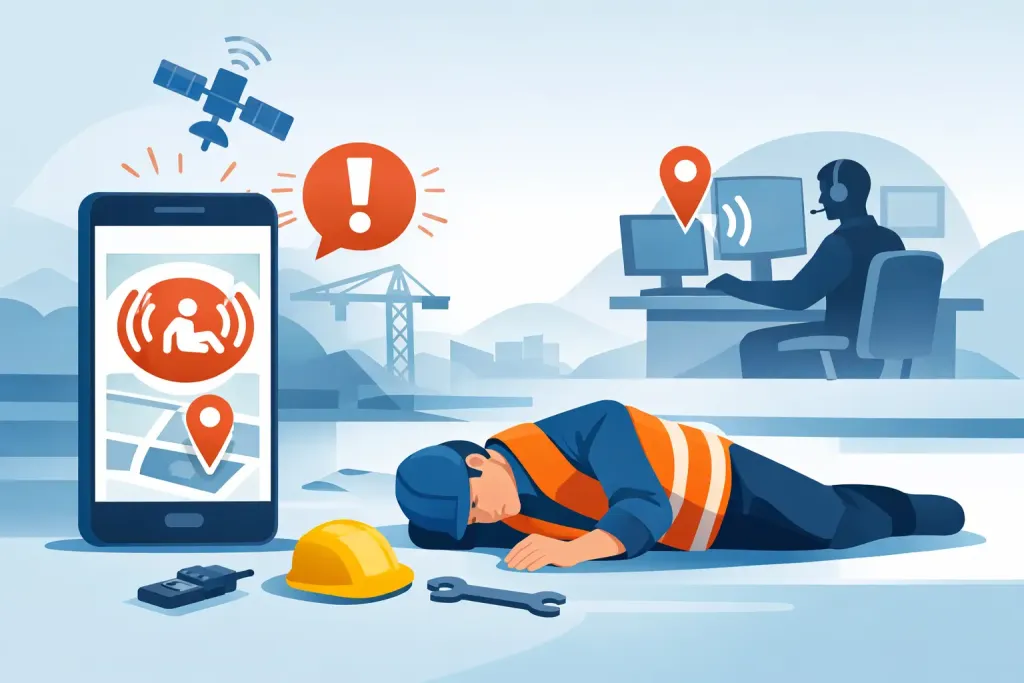
A lone guard makes a routine round of a vacant warehouse, slips on a loading-bay step and cannot reach the panic button. This is the moment a man down alert app must do more than display a notification. It must identify a possible incapacitation event, send the right information to the right people, and support a response before a minor incident becomes a serious one.
For security providers, facilities teams and site supervisors, lone-worker safety is not a separate administrative task. It sits alongside patrol completion, incident reporting, shift management and client accountability. The right system creates a live safety control around staff who work out of sight, often across large, quiet or high-risk premises.
What a man down alert app does
A man down alert app is a mobile safety tool designed to raise an alarm when a worker may be unconscious, injured, immobilised or otherwise unable to ask for help. Depending on the device and configuration, it can detect an extended lack of movement, an unusual tilt or fall, or trigger an alert after a timed welfare check is missed. It should also provide an accessible panic alarm for situations where the user can call for urgent assistance.
The operational value is in the escalation path. A useful alert includes the worker’s identity, the time, their last known or current location, and the site or shift context. Managers or control-room staff can then verify the event, contact the worker and deploy a nearby responder or emergency services where required.
This is fundamentally different from asking a lone worker to phone in periodically. A call-in process relies on someone remembering, being able to use their mobile phone and a supervisor spotting a missed check promptly. Mobile automation adds another layer of protection, particularly when a worker is unable to act.
Why lone-worker alerts need live operational context
An alert without context can still leave a response team asking basic questions: Who is involved? Which building are they in? What hazards are present? Who else has access to the site? Those minutes matter.
A well-configured man down alert app should sit within the wider patrol operation. If a guard has scanned checkpoints during a round, completed a fire-door inspection or logged an issue in a plant room, the control team has a clearer picture of where they were working and what they encountered. GPS can help outdoors, while QR codes, NFC tags, beacons and virtual checkpoints can provide more dependable location evidence inside complex buildings where satellite positioning is less precise.
For example, an alert from a guard at a construction site is more actionable when the supervisor can see that the guard’s last verified checkpoint was at the north compound gate at 02:14, rather than simply a broad pin somewhere on the estate. That information helps responders choose the fastest safe route and gives managers a record of what happened.
Detection is useful, but it is not infallible
Man-down technology must be configured to suit the work. A cleaner moving slowly through an office block, a guard seated in a gatehouse and an engineer working in a noisy plant area do not have the same movement pattern or exposure to risk. An overly sensitive setting can create false alarms; a setting that waits too long can delay intervention.
This is why organisations should test the alert logic during real shifts, not only during a demonstration. Establish how long the device should remain still before prompting the user, how long they have to cancel a false alert, and who receives the alarm first. Consider poor mobile signal areas, battery management, device permissions and whether workers carry mobile phones securely enough for motion detection to be meaningful.
A man down alert is also not a substitute for a suitable risk assessment. It cannot remove risks such as working at height, aggressive confrontation, isolated access routes or hazardous machinery. It provides a faster route to assistance when preventative controls have not been enough.
Build an escalation process people can follow
Technology can identify an event, but people and procedures determine whether the response is effective. Every site needs a clear, tested escalation plan that matches its operating hours, risk profile and staffing arrangement.
At a minimum, the process should establish who receives alerts, who attempts first contact, who can attend the location, and when to call emergency services. It should also define what happens if there is no response from the worker or the nominated contacts. For a 24-hour logistics site, that may involve a control room and an on-site supervisor. For a remote property portfolio, it may require a contracted response officer, a manager on call and clearly documented emergency access arrangements.
The following controls make the workflow more dependable:
- Set alert recipients by site and shift so alarms do not go to people who cannot act.
- Use escalation rules that notify a second contact if the first does not acknowledge the event.
- Record acknowledgement, calls, attendance and outcomes against the incident.
- Test the process regularly, including out-of-hours scenarios and areas with limited signal.
- Review false alarms without blaming staff, then adjust training, device placement or settings where needed.
The aim is not simply to prove that an alert was sent. It is to prove that an organisation acted reasonably, promptly and consistently once a worker may have been at risk.
Make the app part of the guard’s working routine
Adoption is strongest when the safety function supports work guards already perform. If a mobile app handles patrol checkpoints, tasks, occurrence-book entries and incident reports, the guard is more likely to have the device charged, signed in and with them throughout the shift. That makes lone-worker protection a practical operational control rather than an application opened only for compliance purposes.
QR-Patrol brings these records into one cloud-based view, allowing managers to connect patrol activity, live location evidence, panic alarms and man-down events. For multi-site contracts, that matters because a central operations team can monitor consistent processes while site managers retain visibility of the incidents affecting their own locations.
Training should remain practical. Guards need to know what triggers an alert, how to cancel one safely, how to activate a panic alarm, and what response they should expect. Supervisors need equivalent clarity on receiving, acknowledging and documenting alarms. A short scenario exercise is usually more valuable than a policy document alone: simulate an unmoving worker, verify who receives the notification and measure how quickly the team can locate them.
Protect personal data while improving safety
Location and safety data should be handled with the same discipline as any other security record. Employers have legitimate health and safety reasons to monitor lone workers during a shift, but that does not justify excessive or unclear surveillance. Staff should understand what data is collected, when it is collected, who can access it and how long it is retained.
For UK organisations, the approach should align with GDPR principles, internal retention rules and the purpose of the monitoring. Limit access to authorised managers, retain incident data only for as long as operational, legal or contractual requirements demand, and maintain an audit trail of significant actions. Clear communication is essential: workers are more likely to trust the system when it is positioned as a safety measure with defined boundaries, not a tool for indiscriminate monitoring.
Security companies also need to consider client reporting. A timestamped record showing the alert, location, acknowledgement and response can provide defensible evidence that agreed procedures were followed. That is valuable when reviewing service performance, investigating an incident or demonstrating control under a client SLA.
Questions to ask before selecting a system
Before choosing a man-down solution, assess the real environment rather than buying on a feature list alone. Ask whether alerts work reliably across your buildings and outdoor areas, whether the system identifies a meaningful location, and whether it can continue to capture events when coverage is intermittent. Confirm how alert escalation works, how easily managers can configure site-specific contacts, and whether records can be exported for investigations and compliance reporting.
Also consider scale. A single remote guard may need a straightforward welfare-check and panic process. A national security provider may need permissions by contract, central monitoring, local responders, branded reports and a complete audit trail across hundreds of workers. The appropriate solution depends on the risk, the response capability and the evidence the organisation must produce.
A man down alert app earns its place when it makes the next decision clear: who needs help, where they are, what has happened so far and who is taking responsibility for the response. Test that chain before an emergency tests it for you.