Under incident reporting, the capturing and documentation of information with regard to incidents takes place. The information will include who, what, when, where, causes, and any other relevant details related to the incident. This reporting is an important responsibility of your security guards because it will help in protecting your clients, help in investigations, improve accountability, and reduce future risks.
Imagine this scenario.
A security guard is doing their night duty at a warehouse and observes a side entrance slightly open during the patrol. The guard assumes nothing is stolen and closes the entrance gate and continues with the patrol without filing an incident report.
A few days later, the client finds out that a certain stock is missing. CCTV footage confirms suspicious activities at the same entrance. But because the incident report was not filed, there is no documentation of the timeline, no escalation trail, and no proof that the issue was identified earlier.
With compliance requirements across the UK security industry rising, modern security firms no longer rely on handwritten notebooks, memory, or verbal updates. They are investing in
- Real-time reporting
- Digital accountability
- Audit-ready records
- Faster incident response
- Complete patrol visibility
Turning incident reporting from normal paperwork into an operational protection.
In this complete guide, we’ll explain:
- What does incident reporting mean?
- What your guards should document
- Common mistakes you make
- And how tools like PLM QR-Patrol help security firms modernise incident management.
What is Incident Reporting?
Incident reporting is a method of recording details related to incidents like fights, accidents or near misses taking place within the premises protected by your firm’s security guards. It helps you in identifying the causes of the incidents, taking corrective action, and improving measures so that it does not happen again.
In a law-and-order or security situation, these incident reports often become:
- Legal evidence
- Insurance documentation
- Compliance records
- Client performance reports
Without an incident report, it will be very difficult to prove what has happened.
Types of Incidents Security Guards Should Report
Doing incident reporting in real-time is important for the safety of the people in the premises, maintaining accountability of the people involved and maintaining compliance. Your guards must know when to file a report so that everything is documented.
Below are key situations that warrant filing an incident report:
Adverse Events
Sudden accidents that result in harm or injury to the people inside the premises guarded by your guards are considered adverse events. In such situations, the incident should be documented in an incident log with details such as:
- Date, time, and location of the incident
- Description of what happened
- Type and severity of harm or injury sustained
- Medical treatments were administered to address the incident
These details will help in further investigation and help in taking corrective actions so that similar incidents do not happen again.
Near Misses
Near misses are those incidents that could have caused harm but fortunately did not lead to any serious consequences.
In this situation, a near-miss incident report must be prepared and must include:
- Information on the security guard’s duties when the incident occurred
- Describing what had happened
- Any near-miss conditions or safety violations that were present
- Any safety violations
- Corrective action was taken to prevent similar events
By collecting these data in an incident report, your clients will be able to identify risks and develop solutions to prevent them from happening again.
Property Damage
Damage to your client’s property or their equipment can take place during a security situation or an accident. Such damage must be duly recorded in the incident report and must include:
- List down the properties or equipment damaged
- Reasons for the damage
- Action taken to prevent it
Security Breaches
All unauthorised access, theft or vandalism must be documented in the incident report, no matter how small the breach is. The report must include the following information:
- Kind of security breaches like unauthorised access, forced entry attempts, and tailgating incidents that took place
- Whether alarm activation happened
- Any theft or damage to the property or equipment that took place during these breaches
Such security incident reports help in safeguarding assets, preventing future breaches, and supporting investigations.
Exposure to Hazards
When employees are exposed to harmful substances or hazardous conditions, reporting is vital for medical follow-up, hazard mitigation, and compliance with safety regulations.
When your security guards are securing warehouses or factories that work with hazardous chemicals, then chances are your clients’ employees will be exposed to them. In such situations, it must be reported in an incident report.
Incident report for this type of incident must contain:
- The kinds of hazards that have taken place, like slips and falls or fire hazards
- Any injuries to employees or people on the premises
- Medical follow-up done
- Compliance with safety regulations followed or not
Why Accurate Incident Reporting Matters
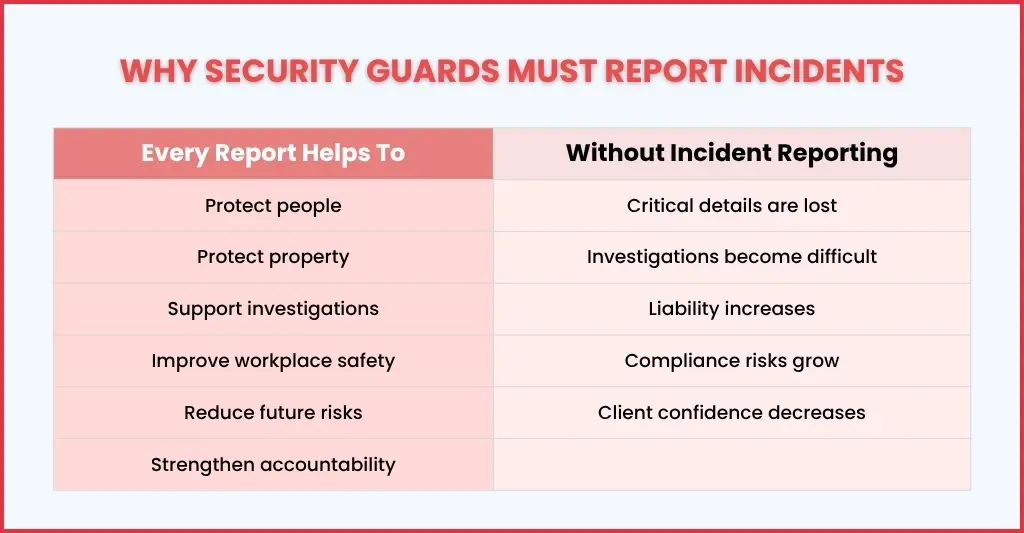
The importance of accurate incident reporting will help your security firm to identify patterns or incidents that will compromise the safety and security of the people in the premises. The awareness generated through incident reporting will help you implement safety measures, ensuring security quality, accountability, compliance, and client trust.
Here’s why accurate incident reporting matters:
Provides Legal Evidence
In case an incident takes place, you and your clients will have to face:
- Injury claims
- Theft investigations
- Insurance disputes
- Police involvement
In such situations, the incident report becomes critical legal evidence because it contains each and every detail about the incident, who is involved, and its time-stamped. This reduces the chances of false claims and helps law enforcement agencies perform their work well.
Regulatory Compliance
Most of the industries are regulated by various regulators, and as per most of them, they are mandated to perform incident reporting. Through meticulous incident reporting, compliance with safety regulations by your clients will be maintained, saving your clients from potential fines or legal issues.
Proactive Risk Management
Information gained from the incident reports will help your clients in identifying risks before they cause big issues. Such proactive risk management will save their resources, their reputation, and, more importantly, their lives.
Protects Your Reputation
When you implement proactive incident reporting, you are showing your clients your commitment to their safety. Such proactiveness will create a good impression among your clients and in the wider security market, thus enhancing your reputation.
How to Write an Effective Incident Report
Incident reports are supposed to be to the point; a poorly or loosely written incident report will create confusion, delay investigations, and weaken accountability.
To avoid this, you must know how to write an effective incident report:
Clear Wordings
Avoid writing unclear statements like “something suspicious has happened”; instead, write “At 22:00, an unknown person wearing a blue jacket attempted to access through gate number 5”.
Only Facts
An incident report does not need a story to explain an incident or the measures taken; you need to be precise by presenting:
- Facts
- Observations
- And action taken
- Avoid making:
- Assumptions
- Emotions
- Personal opinions
Accurate Details
Incident reports are developed in real-time so that accurate details of an incident are recorded. These details are:
- The exact time of the incident taking place
- Precise locations of the incident
- Names if known
- Evidence/photos
Timely
All incident reports must be done in real-time because the longer your guard waits to report:
- The more details get forgotten
- The harder investigations become
Common Challenges in Incident Reporting
Incident reporting is a critical aspect when it comes to maintaining safety and accountability, but it comes with its share of challenges. Overcoming these challenges is important for building a strong incident management system.
Here are some of those challenges you must worry about:
Underreporting of Incidents
The most significant challenge while doing incident reporting is the reluctance among your security guards to report an incident, due to fear of blame or disciplinary action. They might even downplay certain incidents as minor ones, leading to missed opportunities for improvement and prevention.
Lack of Training
Without adequate training, your guards will be unable to understand what an incident is and how to file a report. This will result in incomplete, delayed and inaccurate incident reports, reducing your clients’ ability to address the root causes effectively.
Complex Reporting Processes
If the incident reporting system is too complicated or time-consuming, then your guards will avoid filing reports in real-time. Unclear procedures, lengthy forms and lack of accessibility will discourage your guards from filing incidents in real-time, thus reducing the chances of capturing important data.
No Follow-Up
No visible action on previous incident reports will demotivate your security guards from continuing to report in real-time. When issues are not resolved, it creates an impression that things are taken for granted, thus weakening accountability and safety.
Insufficient Resources
Incident reporting will be done by your security guards in real-time, but analysing the data requires resources in the form of personnel, technology and time from you and from your clients. Lack of resources to analyse will lead to lack of insights, no corrective actions, and repetition of the same incidents.
Modernising Incident Reporting with QR Patrol
This is where digital patrol and reporting systems come in when it comes to tackling challenges in incident reporting and transforming the security industry. Modern platforms like QR-Patrol will allow you to digitise incident reporting completely.
Here’s how it will do it:
Real-Time Incident Logging
Incident reporting is valuable only when the incidents are recorded in real-time, and QR-Patrol will enable your guards to do just that by:
- Logging incidents instantly
- Attaching photos/videos
- Recording notes on-site
- Submitting reports immediately
GPS & Time-stamp Verification
The more credible your incident report, the more trust your clients will place in you, and QR-Patrol will help you in that by generating incident reports that have:
- Exact time
- Location verification
- Guard activity records
Automated Alerts
In case of an incident getting out of hand, your security guard armed with QR-Patrol solutions (mobile devices or gadgets) will trigger:
- Instant notifications to their supervisors
- Faster escalation
- Improved response times
Centralised Reporting Dashboard
Armed with QR-Patrol’s centralised reporting dashboard, your managers will be able to monitor in real-time:
- Patrol activity
- Incident frequency
- High-risk sites
- Unresolved issues
Audit-Ready Documentation
QR-Patrols will enable your guards to note down an incident that has taken place and store it in digital form. These digital records will simplify:
- Compliance reviews
- Client reporting
- Insurance claims
- Internal audits
What Happens After an Incident is Reported?
Once an incident is reported through incident reporting, a thorough investigation is launched to identify the root cause behind it. Evidence is gathered from the report to determine who is at fault.
Relevant stakeholders are informed about it, and necessary support is offered to those involved. The result of the investigation could affect your clients in many ways, such as:
- Fines, if applicable
- Changes in procedures
- Increased safety protocols
Monitoring the changes in procedures and safety protocols is important to ensure proper implementation and to conduct audits of them to check their effectiveness.
Having robust incident reporting systems is critical for any organisation’s success. It helps them comply with regulations, maintain a safe working environment for employees, and minimise disruptions caused by unexpected incidents.
Best Practices for Security Incident Reporting
To improve reporting quality, you should follow these best practices:
- Standardise your reporting procedures by fixing on reporting requirements, incident categories, and escalation levels.
- Train your guard’s on documentation standards, evidence collection, and precise report making.
- Use digital reporting tools like QR-Patrol to improve accuracy, speed, accountability, and compliance.
- Attach supporting evidence, photos, time-stamps, and log checkpoint scans.
- Audit the reports regularly for identifying trends, missing information, and operational patterns.
FAQs: Frequently Asked Questions
What is meant by incident reporting?
Incident reporting is the systematic process of documenting unexpected events, accidents, or near-misses that impact safety, operations, or compliance.
What are the five rules of incident reporting?
The five rules to follow while creating an incident report are:
Be prompt
Be clear and accurate
Be thorough
Be sensitive to privacy
Be objective
What kind of incidents must be reported?
You must report serious workplace accidents, specified injuries, diseases, and dangerous occurrences (near-misses) that pose a risk to health and safety.
Can incident reporting be automated?
Yes. Modern systems like QR-Patrol allow guards to submit incidents digitally using mobile devices with time-stamps, GPS tracking, and photo uploads.
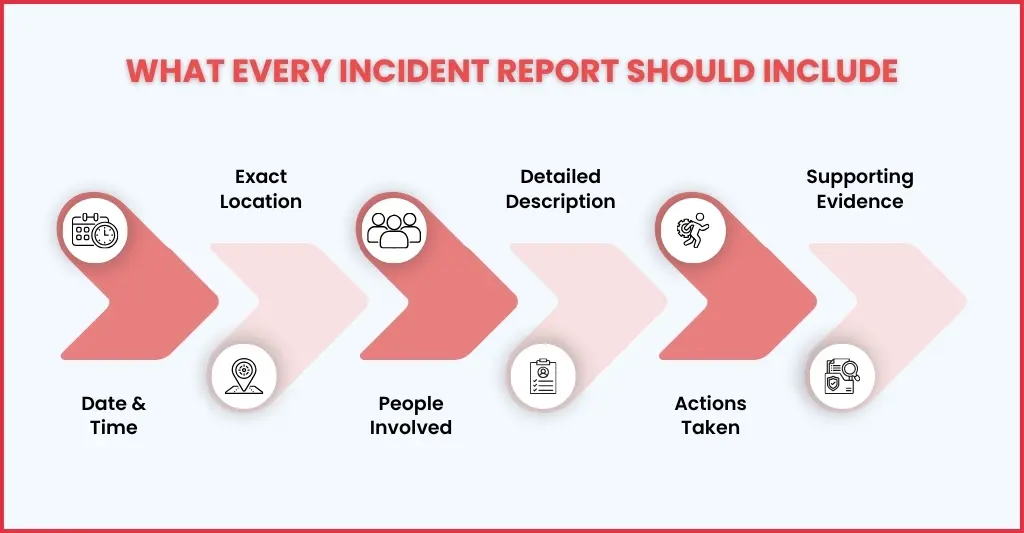
What should be included in an incident report?
A report should include:
Date and time
Exact location
Detailed description
People involved
Actions taken
Supporting evidence
Conclusion
Lack of attention to your incident reporting system will cost your reliability among your clients, making it an important responsibility in modern security operations. Without proper reporting:
Incidents become harder to investigate
- Accountability disappears
- Compliance risks increase
- Client trust weakens
Today’s clients expect:
- Real-time visibility
- Accurate reporting
- Audit-ready records
- Measurable security performance
And security firms that continue relying on manual systems risk falling behind.
That’s why many UK security companies are now adopting digital patrol and incident reporting solutions like QR-Patrol to improve accountability, streamline operations, and deliver better client confidence.
Are you ready to take your security operations to the next level? Get QR-Patrol Guard Tour solutions now by contacting us.