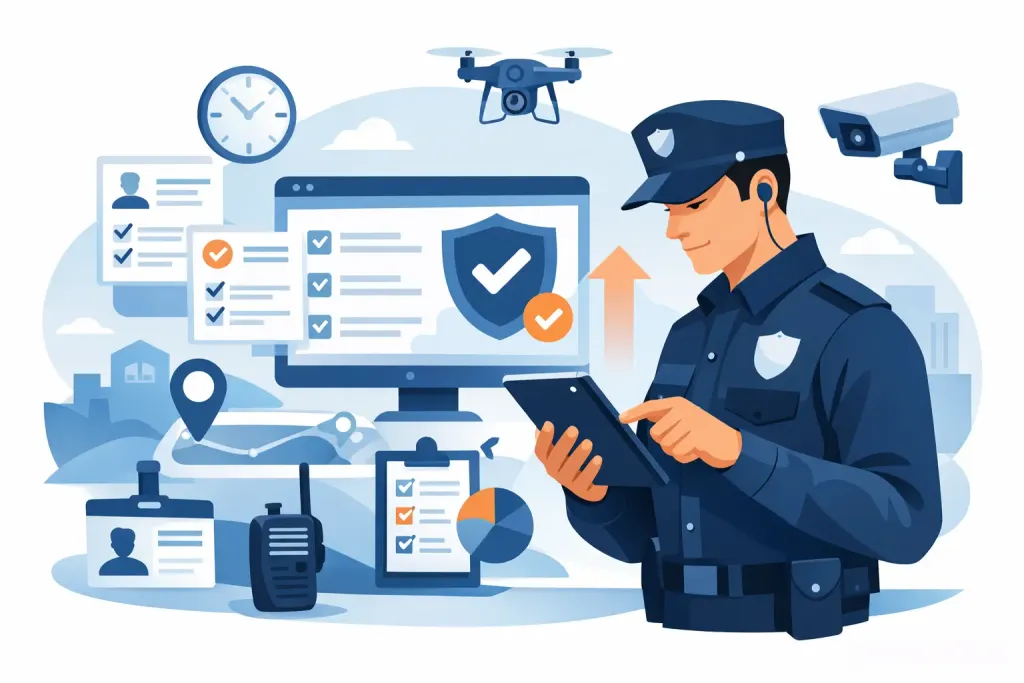
A missed patrol is rarely just a missed patrol. It may mean an unsecured access point, a delayed welfare check, an unreported hazard or a client questioning whether contracted services were delivered. Effective security guard task management turns daily instructions into verified field activity, giving supervisors clear evidence of what happened, where it happened and when action was taken.
For security providers and in-house teams, the objective is not to create more administration for guards. It is to make the right work impossible to overlook, simple to record and visible to the people responsible for the site. That requires more than a static list of duties at the start of a shift.
Why paper task lists leave operational blind spots
Paper occurrence books, printed patrol schedules and radio updates can still have a place in contingency planning, but they are weak as the primary control method. A supervisor may know that a guard was rostered at a location, yet have no immediate proof that a fire exit was checked, a contractor was challenged or a welfare patrol was completed at the required time.
The issue becomes more serious across multi-site operations. A control room or operations manager cannot wait until the end of a shift to learn that a checkpoint was missed three hours earlier. By then, the opportunity to intervene has passed and the audit trail is incomplete.
Task management must therefore connect three things: the instruction, the evidence of completion and the response when completion is late, missed or raises a concern. When these records sit in separate systems, accountability becomes slower to establish and harder to defend.
What effective security guard task management looks like
A practical system assigns work against a specific person, location, time window or patrol route. Guards receive clear instructions on a mobile device, complete the required action in the field and submit supporting information where needed. Managers can then see progress live rather than relying on retrospective reports.
The best workflows distinguish between routine activity and exception handling. A routine task might be a perimeter inspection at 22:00. An exception might be finding a damaged fence panel during that inspection. The guard should be able to turn the finding into an incident report immediately, add photographs or notes, alert the appropriate contact and continue with a record of the action taken.
This matters because a completed task does not always mean a secure outcome. A guard may confirm that a gate was inspected, but the real management value comes from knowing whether it was locked, damaged, obstructed or left open by an authorised delivery. Good task design captures the condition that matters, not simply a tick in a box.
Start with site risks, not generic duties
Generic instructions such as “check the premises” are difficult to verify and open to inconsistent interpretation. Tasks should instead reflect the risks and service requirements of each site.
At a warehouse, that may mean checking loading-bay doors, visitor access, high-value stock areas and lorry movements. At an office park, the priority may be out-of-hours access, fire-door integrity, lone-worker welfare and suspicious activity in car parks. On a construction site, tasks may focus on perimeter breaches, plant security, temporary power supplies and unauthorised entry.
Each task needs a clear expected result. For example, “inspect north pedestrian gate and confirm locking mechanism is secure” gives the guard a defined action and gives the supervisor a meaningful record. Where a standard cannot be met, the task should direct the guard towards the correct escalation route.
Use proof of presence where it adds control
Checkpoint technology is most valuable when it verifies activity at critical locations. QR codes, NFC tags, Bluetooth beacons and GPS-based virtual checkpoints each suit different environments. A fixed QR or NFC checkpoint can provide clear proof at a gate, plant room or fire exit. GPS may be more practical for open estates, remote patrols or vehicle-based checks.
There is a trade-off. Too many checkpoints can encourage guards to chase scans rather than assess risks. Too few can leave important areas unverified. The right setup follows the patrol route, risk assessment and client SLA, with checkpoints positioned at locations where presence genuinely matters.
A scan should also support the task rather than replace it. A checkpoint confirms a guard reached a location. A form, observation or photo may be necessary to show what they found and what they did next.
Build escalation into the task, not after it
Security threats do not wait for the end-of-shift handover. If a task identifies an unlocked door, aggressive behaviour, a fire safety issue or a lone-worker concern, the response must be immediate and proportionate.
Set clear escalation rules before deployment. Low-risk issues may create a maintenance request for the next working day. Higher-risk findings may require a live notification to a supervisor, control room, facilities contact or emergency services. The guard needs to know who is responsible, what evidence to collect and whether the task remains open until the issue is resolved.
Mobile incident reporting is particularly valuable here. It creates a time-stamped account while details are fresh, with photographs, descriptions, location data and witness information captured in one record. That improves handovers and gives managers a defensible basis for reviewing decisions after the event.
For lone workers, task workflows should also include welfare checks and clear panic or man-down procedures. A missed welfare task should trigger attention, not disappear among ordinary patrol exceptions. The appropriate response depends on the site, shift pattern and risk level, but the absence of contact must be visible quickly.
Give supervisors an exception-led view
Managers do not need to watch every completed task. They need a fast view of the activity that requires action: overdue duties, missed checkpoints, unacknowledged incidents, repeated failures and guards who may need support or retraining.
An exception-led dashboard changes the role of supervision. Instead of chasing paper records and calling sites for updates, the supervisor can identify a developing issue during the shift. If a patrol is running late because a guard is dealing with an incident, the record should explain the delay. If there is no explanation, intervention can happen before the next task is missed.
This approach also helps prevent unfair conclusions. A missed scan is not automatically poor performance. The tag may be damaged, the guard may have been responding to a genuine emergency, or the route may be impractical during a busy period. Live records allow managers to investigate context while it is still available.
Make reporting useful to clients and auditors
Client reports should demonstrate service delivery without burying the reader in raw data. The most useful reporting shows patrol completion, exceptions, incidents, response times and outstanding actions, alongside the evidence that supports those figures.
For contract security companies, this can strengthen SLA conversations. Rather than assuring a client that checks were performed, managers can show time-stamped completion records and the action taken when an issue arose. For in-house teams, the same information supports facilities, health and safety and senior management decisions.
Records also matter for compliance. Task histories, incident reports and digital occurrence books can support obligations under BS 7499, health and safety duties, GDPR controls and site-specific procedures. Technology does not create compliance by itself, however. Instructions must be appropriate, data access must be controlled and teams must be trained to record information accurately and proportionately.
Introduce mobile workflows without disrupting the shift
Adoption succeeds when the system makes a guard’s work clearer, not more cumbersome. Start by mapping the current shift: patrols, access checks, welfare calls, key inspections, incident handling and handover. Identify the points where information is currently delayed, duplicated or lost.
Then pilot a limited set of high-value tasks at one site or shift pattern. Test the checkpoint locations, task wording, mobile connectivity and escalation rules with the guards who will use them. Their practical feedback often exposes issues that are invisible on a desktop plan, such as a QR code placed in poor lighting or an instruction that does not reflect the actual route.
Training should cover both the process and the reason behind it. Guards need to understand that accurate records protect them as well as the organisation. A verified task history can demonstrate that instructions were followed, risks were reported and support was requested at the right time.
Platforms such as QR-Patrol bring tasks, patrol verification, incident reporting and live notifications into one operational record. The value is not simply fewer paper forms. It is the ability to identify exceptions as they happen and provide credible evidence after the shift ends.
Measure what improves site security
Completion rates are useful, but they should not be the only measure. A site with 100 per cent task completion may still have recurring access failures or slow escalation. Review missed and late tasks, incident categories, repeat locations, acknowledgement times and the age of unresolved actions.
Patterns should lead to practical changes. Repeated late patrols may mean the route is unrealistic. Frequent damaged tags may point to poor checkpoint placement. A rise in incidents at one entrance may justify changes to lighting, staffing or access controls. This is where security guard task management becomes a management discipline rather than a digital checklist.
The most effective next step is simple: take one critical duty that currently relies on trust or paperwork, define what good completion looks like, and make its evidence visible before the risk has time to grow.