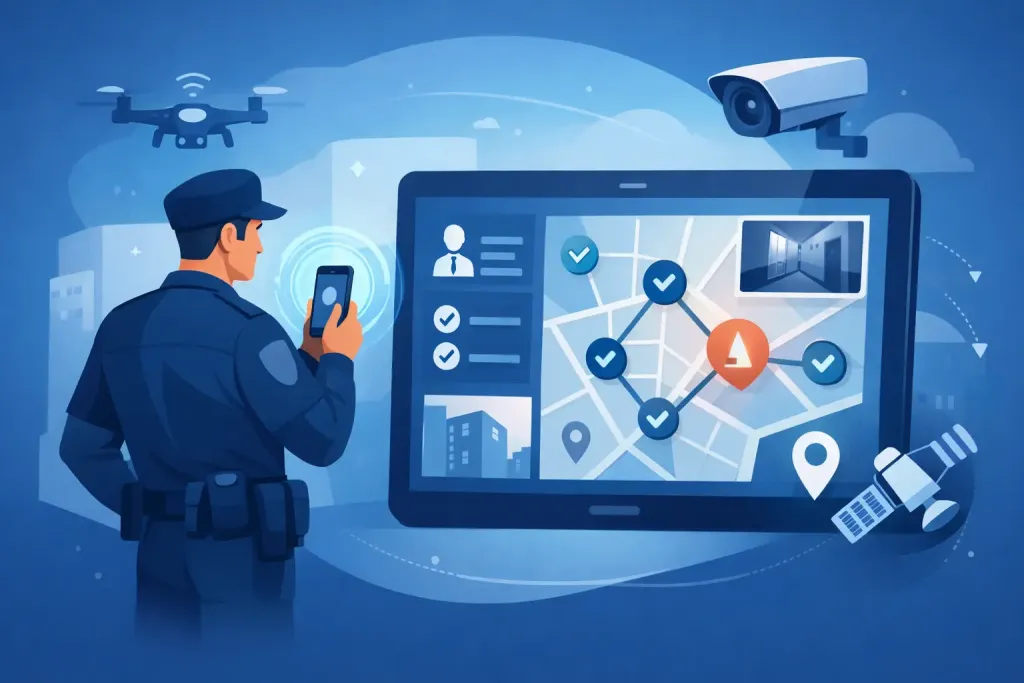
A patrol can look complete on a paper log while a critical perimeter, plant room or fire exit has never been checked. Virtual checkpoint software closes that gap by recording where a guard is, when a task is completed and what happened at the location – with evidence available to supervisors as the shift unfolds.
For security companies and in-house teams managing large estates, remote sites or changing work patterns, this is more than a replacement for a traditional checkpoint tag. It is a live operational control that helps managers detect missed activity, respond to incidents sooner and demonstrate that contracted or statutory duties have been carried out.
What is virtual checkpoint software?
Virtual checkpoint software is a patrol management capability that uses a smartphone’s location services to create digital checkpoints without requiring a physical QR code, NFC tag or beacon at every location. A guard reaches a defined GPS location, confirms attendance through the mobile app and can complete instructions, observations or a site-specific form at the same time.
The system sends the record to a central cloud platform, allowing authorised managers to see patrol progress, exceptions and incidents in near real time. Each checkpoint event can include the guard identity, date and time, location coordinates, notes, photographs and task responses. The result is a traceable record of service delivery rather than a manually completed statement after the fact.
Virtual checkpoints are particularly useful where fitting hardware is impractical, temporary or unsuitable. Construction compounds change shape. Rural assets may be spread across extensive ground. Mobile patrols may visit vacant properties, utility infrastructure or outlying gates that have no reliable place to mount a tag. In these environments, a GPS-based checkpoint provides a practical way to verify attendance.
Where virtual checkpoints add operational value
A virtual checkpoint should not be treated as a generic dot on a map. It works best when each location represents a control point with a clear security purpose: inspect an access gate, verify a lone worker welfare check, check a vulnerable area after hours or confirm that a fire route remains unobstructed.
Temporary and changing sites
For construction, events, seasonal facilities and refurbishment projects, physical checkpoints can quickly become obsolete or get removed during works. Supervisors can create, amend or retire virtual locations in the web platform as site conditions change. Guards receive the updated route through their mobile application instead of waiting for replacement hardware or revised printed instructions.
This reduces the risk of patrol procedures drifting away from the real layout of the site. It also gives managers a clearer record when a route has changed due to new access restrictions, changing risk assessments or client requirements.
Wide-area and remote patrols
A large industrial estate, campus, quarry or rural location may involve long distances between patrol points. Virtual checkpoint software can verify that guards have reached defined areas while avoiding unnecessary installation work at every point. Managers can see whether the patrol is progressing as expected and investigate late or missed checkpoints before the end-of-shift report is submitted.
The trade-off is accuracy. GPS can be affected by building structure, poor satellite visibility, dense urban areas and device settings. A virtual checkpoint should therefore use a sensible geofence radius that reflects the job being verified. A narrow radius may create false exceptions; a radius that is too wide may weaken proof of presence. The right setting depends on the environment and the importance of the checkpoint.
Mobile response and keyholding work
Security operations do not always follow a fixed route. Mobile response officers may be dispatched to alarms, vacant sites or client call-outs at short notice. A supervisor can assign a virtual location for the attendance point, then require the officer to record arrival, actions taken, photographs and departure. This creates a clear timeline for the client and supports internal oversight of response performance.
For keyholding providers, that evidence is especially valuable when attendance is questioned. It can show when an officer arrived, what was found and when the site was secured, rather than relying on a later recollection or a handwritten occurrence book.
Virtual checkpoints are strongest in a mixed system
GPS should not replace every physical checkpoint. The most dependable patrol strategy often combines technologies according to site risk and layout. QR codes and NFC tags are well suited to precise indoor points such as electrical cupboards, server rooms, doors and fire panels. Beacons can support indoor positioning where satellite signals are limited. Virtual checkpoints provide flexibility for outdoor, remote, temporary and mobile locations.
This mixed approach gives operations managers better coverage without installing hardware where it adds little value. It also allows patrol routes to remain consistent across varied client sites while preserving the appropriate level of evidence at each point.
The key question is not whether GPS or a physical tag is better in isolation. It is what evidence is required for this location, what conditions can affect verification and how quickly the route may need to change.
Turning attendance into accountable patrol execution
Presence alone does not prove that a guard completed the intended task. A useful virtual checkpoint workflow links arrival to action. At a checkpoint, the guard should see clear instructions and be able to record exceptions immediately, rather than retaining details until later in the shift.
For example, an officer attending a loading yard can confirm the gate condition, record a damaged fence with photographs, log an unauthorised vehicle and trigger an escalation to the duty manager. The attendance record, observations and response then remain connected in one auditable event.
This matters when security teams are working to client SLAs, site assignment instructions or internal procedures. If an issue is identified, managers can establish what was checked, what was found, who was notified and whether the matter was resolved. That is far more defensible than scattered WhatsApp messages, paper logs and verbal handovers.
A well-configured system should support:
- scheduled patrol routes and task instructions;
- live notifications for missed, late or failed checkpoints;
- incident reports with photos, notes and classification fields;
- digital occurrence books and shift handover records;
- exportable reports for clients, audits and internal review.
Supporting lone-worker safety and immediate response
Virtual checkpoints can also serve as welfare touchpoints for officers working alone. At isolated gates, remote buildings or perimeter areas, an expected checkpoint confirms that the guard is continuing their route. If a check-in is overdue, supervisors can investigate promptly rather than discovering the gap at the end of a shift.
This should sit alongside active lone-worker controls, not replace them. Panic alarms, man-down detection, escalation procedures and reliable communication remain essential where a risk assessment identifies elevated danger. Technology provides visibility, but the organisation must still define who receives alerts, how quickly they respond and what happens if contact cannot be made.
For operations managers, this distinction is critical. Installing an app is not the same as establishing a safety process. Alarm ownership, escalation paths, training and testing need to be clear before the system is relied upon in a live incident.
Compliance, privacy and defensible records
Location data can strengthen evidence of patrol delivery, but it must be managed responsibly. UK employers and security providers should be transparent with staff about what is collected, why it is needed, who can access it and how long records are retained. Policies should be aligned with GDPR principles, employment obligations and the organisation’s legitimate security requirements.
Managers should configure tracking to support operational need rather than collect excessive data. For many businesses, location verification during an active shift is appropriate; continuous monitoring outside assigned working time is unlikely to be. Access controls also matter. Supervisors may need live visibility, while clients may only require approved reports relevant to their site.
Clear records support compliance with BS 7499 expectations, health and safety duties and client audit requirements. They also protect guards. When an officer has followed the assigned route, raised an issue correctly and recorded the evidence, the system provides an objective account of their work.
Choosing software that will work in the field
The best virtual checkpoint software is simple enough for guards to use under pressure and detailed enough for managers to act on exceptions. Before selecting a platform, test it against real site conditions: weak signal areas, indoor locations, changing routes, shared devices and emergency procedures. A feature list is less useful than a live demonstration of how an actual patrol is configured, completed and reviewed.
Look for a platform that combines virtual checkpoints with QR, NFC and beacon options, rather than forcing every site into one method. It should provide central control across multiple locations, configurable forms and alerts, offline capability where coverage is limited, and reporting that can be presented confidently to clients.
QR-Patrol brings these controls into a smartphone-first system, connecting live guard activity, incident reporting, lone-worker safeguards and compliance evidence in one operational view. The value is not simply knowing that a guard reached a location. It is having the information needed to intervene when they do not, and to prove what happened when it matters.