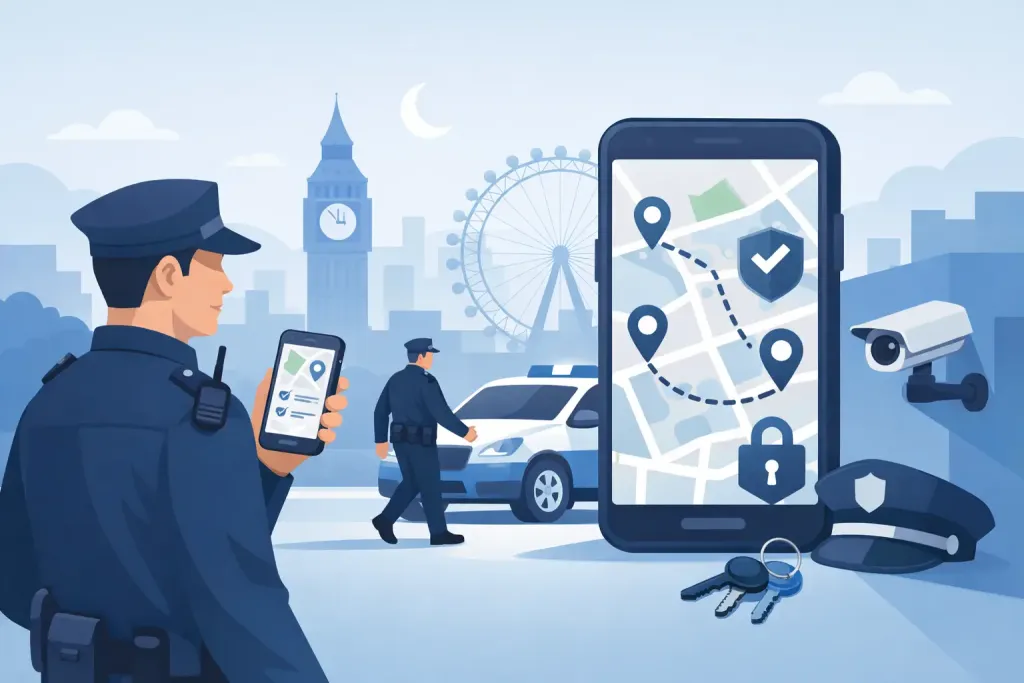
A missed checkpoint at 02:15 is not just a gap in a patrol route. It may mean a fire door was left unsecured, an isolated officer needed help, or a client has no proof that contracted activity took place. A useful security patrol app review must therefore go beyond attractive dashboards and simple scan counts. It should establish whether the system gives managers immediate operational control and creates evidence that stands up to client scrutiny, incident investigation and audit.
For UK security companies, facilities teams and in-house security departments, the best app is not necessarily the one with the longest feature list. It is the one that works consistently on the ground, supports officers under pressure and turns field activity into clear, defensible records.
What a security patrol app review should test
A patrol application sits at the point where people, premises and risk meet. Review it against a real shift, not a polished sales demonstration. Map a night patrol through a warehouse, a lone-worker round at a construction site, or a multi-building corporate estate with changing access requirements. Consider what a supervisor can see while the patrol is underway, what happens when connectivity drops, and how quickly an incident reaches the right person.
The core test is straightforward: can the platform prove presence, identify exceptions and support a fast response without making the guard’s job harder? The following areas determine whether the answer is yes.
1. Prove patrol completion without creating loopholes
Traditional guard tour equipment often depends on one checkpoint technology and requires data to be collected after the shift. That can leave managers blind during the period when intervention matters most. A modern app should record activity as it happens and show the time, location, officer and checkpoint involved.
Checkpoint choice matters
QR codes are quick to deploy and inexpensive, making them suitable for offices, hospitality venues and short-term contracts. NFC tags are discreet and durable, while Bluetooth beacons can help where contactless confirmation is preferable. GPS-based virtual checkpoints are useful for perimeter patrols, car parks and remote assets where fitting physical tags is impractical.
There is no single best method. GPS alone can be too broad for proving that an officer inspected a specific plant room or fire exit. QR codes can be damaged or photographed if they are poorly positioned. NFC requires compatible devices and sensible tag placement. A strong platform supports more than one checkpoint type, so the route can match the risk at each location rather than forcing every site into the same model.
Ask to see how the system handles missed, early and late checkpoints. A completed route total is not enough. Supervisors need exceptions presented clearly, with automatic alerts where a missed patrol could expose the site or breach a client SLA.
2. Assess live visibility, not just end-of-shift reports
A report delivered the next morning may demonstrate what happened, but it cannot help a control room intervene at the time. Live monitoring is where a patrol app becomes an operational control system rather than a digital replacement for paper logbooks.
Managers should be able to view patrol progress, outstanding tasks, open incidents and officer status from a central web application. This matters particularly across multi-site portfolios, where a mobile supervisor cannot physically verify every round. If an officer fails to start a critical patrol, takes too long at a checkpoint or triggers an alarm, the relevant manager should receive a notification immediately.
Review the alert logic in detail. Too many generic notifications create alert fatigue and encourage teams to ignore the system. The useful configuration is role-based and risk-led: a missed high-risk perimeter check might go to the duty manager at once, while a low-priority task delay can appear in a shift review. Escalation paths should reflect the site’s agreed operating procedures.
Connectivity also deserves practical scrutiny. Mobile signal is unreliable in basements, large industrial buildings and remote estates. Establish whether officers can continue scanning, recording incidents and completing forms offline, and whether data synchronises accurately once service returns. A live system that fails when the environment becomes difficult creates false confidence.
3. Treat lone-worker protection as a live requirement
For many teams, officer safety is the deciding factor in a security patrol app review. A guard working alone in a vacant building, on a large distribution site or at a remote gatehouse needs a direct way to request help. The application should support panic alarms, man-down detection and configurable welfare checks, with clear escalation to designated responders.
The operational detail matters more than the feature label. Test what happens after a panic alarm: who receives it, what location information is available, whether the alert is acknowledged, and how the response is recorded. A safety function that only sends a message without proving follow-up is incomplete.
Man-down alerts should also be configured carefully. Sensitivity that is too high can create false alarms during normal work; sensitivity that is too low may delay a genuine response. Teams should define thresholds based on the environment, shift pattern and officer activity, then review alarm data during the first weeks of deployment.
4. Examine incident records and compliance evidence
When an incident occurs, the quality of the record often determines how effectively the organisation can investigate, respond and report. The app should let officers capture structured incident details, photographs, notes, timestamps and location information at the point of occurrence. Digital occurrence books and custom forms reduce the risk of illegible handwriting, omitted details and reports completed from memory at the end of a shift.
For contract security providers, reporting should also be client-ready. A professional report needs more than a list of scans. It should show patrol completion, exceptions, incident activity, response actions and trends over the reporting period. Branded reports can reduce administration while giving clients visible proof of service.
Compliance should be approached with care. A patrol platform can help support BS 7499 procedures, health and safety duties and client requirements, but software does not create compliance on its own. The organisation still needs documented processes, officer training, supervision and appropriate retention policies.
Data protection requires the same discipline. Location data, images and occurrence records may be personal data. Review user permissions, audit trails, data retention controls and the ability to restrict access by site or role. For GDPR purposes, collect what is necessary for the stated security purpose and ensure staff understand how their data is used.
5. Measure deployment effort against operational value
The strongest technology is of little value if officers resist using it or supervisors cannot configure it without specialist support. A review should cover deployment as seriously as functionality. How long does it take to create a site, assign officers, build routes, position checkpoints and train a new supervisor? Can the system accommodate temporary sites, changing patrol frequencies and seasonal workforce changes?
Smartphone-first deployment can reduce the capital cost and delay associated with dedicated readers, especially for organisations expanding across several sites. However, it introduces practical decisions around device ownership, charging, mobile data, protective cases and mobile device management. Bring-your-own-device arrangements may suit some teams, while high-risk environments may require company-managed handsets.
Subscription tiers should be assessed against genuine requirements rather than bought on headline price alone. A basic package may work for straightforward checkpoint verification. Operations with lone workers, advanced forms, live control-room monitoring, asset checks and detailed client reporting may need a higher level of capability. Calculate the cost of missed patrols, manual report writing and delayed escalation alongside licence fees.
QR-Patrol is designed around this operational model, combining mobile checkpoint verification with live monitoring, incident management, lone-worker safeguards and centralised reporting. The practical question for any buyer is whether the selected configuration matches its sites, staffing model and risk profile.
Run a controlled site trial before committing
A controlled trial reveals more than a feature comparison. Choose a representative location with genuine operational complexity and involve guards, supervisors, control room staff and the person responsible for client reporting. Set clear measures: missed patrol visibility, time to raise an incident, report preparation time, alert response and officer adoption.
Use the trial to test awkward conditions deliberately. Scan in poor signal areas, submit an incident with photographs, trigger the escalation process, amend a route during a shift and produce a report for a client review. If the workflow remains clear in those moments, it is far more likely to hold up during a real security event.
The right patrol app should leave no uncertainty about who was where, what was found and what happened next. That clarity gives officers better support, managers earlier warning and clients the evidence they expect when security threats cannot wait.