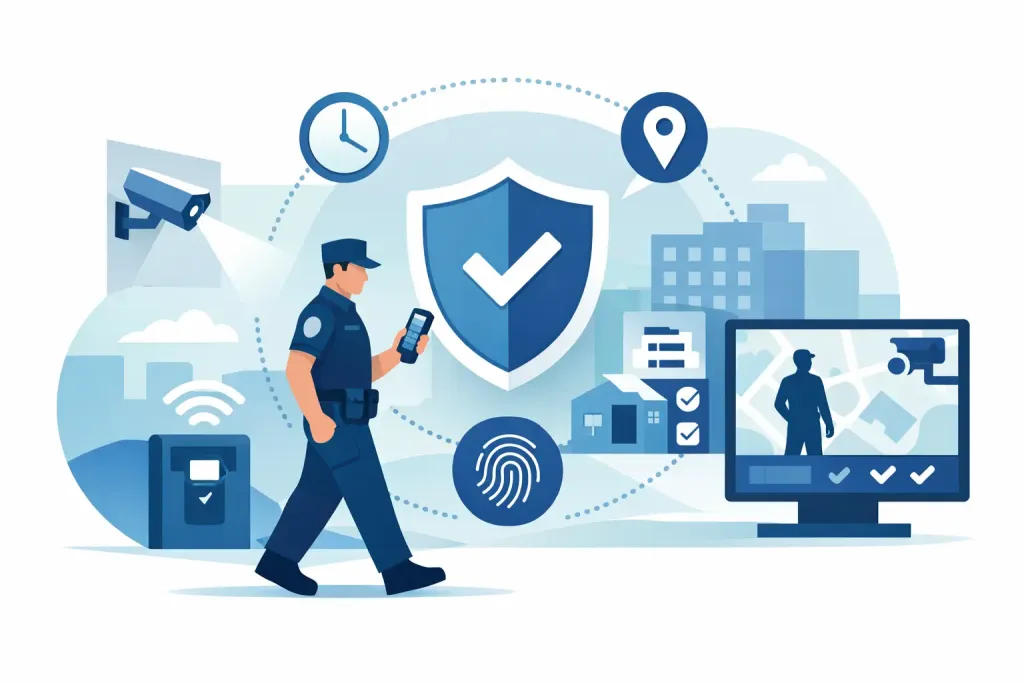
A missed checkpoint is rarely just a missed checkpoint. It can mean an unsecured access point, an unreported hazard, a lone worker without support, or a client asking why there is no evidence that a contracted patrol took place. A guard tour system replaces assumptions with live, time-stamped proof of activity, giving security managers the information needed to act while an issue can still be contained.
For security companies, facilities teams and in-house security departments, the value is not simply knowing that a guard reached a location. It is knowing whether the right patrol was completed, on time, in the correct sequence, with any exceptions documented and escalated without delay.
What a guard tour system should control
At its simplest, a guard tour system records a guard’s presence at designated checkpoints. Modern systems go much further. Using a smartphone app and a central web platform, they connect patrol execution, incident reporting, task management, scheduling and workforce safety in one operational record.
A guard scans a QR code or NFC tag, detects a beacon, or reaches a GPS-based virtual checkpoint. The scan creates a record of who attended, where they were and when the action occurred. If the guard finds a fault, suspicious activity or health and safety risk, they can submit an incident report with photographs, notes and supporting information from the same device.
Managers are then able to see patrol progress in real time, rather than waiting until the end of a shift for a handwritten occurrence book or an offline reader to be returned. That distinction matters when a patrol is late, a location is missed or an incident requires immediate intervention.
From proof of presence to operational visibility
Traditional guard tour equipment can demonstrate that a tag was scanned, but it may leave managers waiting for data to be downloaded. That delay creates a blind spot. By the time a missed patrol becomes visible, the shift may be over and the opportunity to correct the problem has passed.
Cloud-based patrol management changes the workflow. Activity synchronises as it happens, subject to the device’s available connection, so supervisors can monitor tours across one building, a national estate or remote locations from a central dashboard. Automated notifications can flag late scans, missed checkpoints, failed tasks or panic alarms to the people responsible for responding.
This is particularly useful where teams are stretched across multiple sites. A facilities manager does not need to telephone every location to establish whether opening checks are complete. A control room can identify an exception, contact the officer and direct support before a routine failure turns into a wider security exposure.
The strongest systems also avoid forcing every site into one rigid setup. QR codes may be the practical option for a temporary construction site. NFC tags can suit fixed internal routes. GPS checkpoints help verify perimeter patrols or large, open areas where physical tags are unsuitable. The right combination depends on the environment, signal availability, site risks and how easily a checkpoint could be tampered with or bypassed.
The patrol workflow that creates defensible evidence
Reliable reporting starts before the first patrol. Each checkpoint should have a clear operational purpose. A tag at a fire exit, for example, should be linked to the inspection required at that point, not treated as a meaningless scan. If the door is obstructed, unsecured or damaged, the officer needs a defined action and a simple way to record the result.
A well-configured system typically supports this sequence:
- The manager builds patrol routes, schedules, checkpoints and assignment rules for each site.
- The guard receives the route and completes scans or task instructions through the mobile app.
- Exceptions, incidents and observations are recorded at the point of discovery, with time, location and supporting media where appropriate.
- Supervisors receive alerts, review live activity and document actions taken.
- Managers produce client-facing and internal reports from the same underlying audit trail.
This approach reduces the gap between an event occurring and the organisation having a usable record of it. It also makes reporting more credible. A report that shows the checkpoint, scan time, officer identity, incident details and follow-up action is far more useful than a vague end-of-shift statement.
For contract security providers, that evidence protects both service quality and commercial relationships. It gives clients clear proof that agreed patrols and checks have been delivered, while highlighting where a site’s changing conditions require an amended route, extra staffing or a revised SLA.
Faster response when routine patrols uncover risk
Security threats do not follow reporting cycles. An officer who discovers forced entry, a fuel leak, a vulnerable person or a fire door failure needs to raise the alarm immediately. A guard tour system should therefore be treated as part of the incident response process, not as a standalone attendance tool.
Panic alarms and man-down functions add an important layer of protection for lone workers. If a guard faces aggression, experiences a medical emergency or becomes unresponsive, the platform can alert nominated managers or control room personnel with relevant location information. The effectiveness of this capability depends on having defined response procedures, trained recipients and regular testing. Technology can trigger an alert, but it cannot replace a properly staffed response plan.
Digital occurrence books and custom forms also improve the quality of everyday escalation. Instead of asking staff to remember which paper form applies, managers can require the information needed for a particular event: photographs of damage, a contractor reference, a hazard category, witness details or a corrective action. Mandatory fields should be used carefully. They improve consistency, but an overlong form can slow an officer who is managing a live situation.
Compliance needs evidence, not paperwork alone
Security operations often need to demonstrate compliance with client requirements, health and safety duties, GDPR obligations and standards such as BS 7499. A digital patrol platform can provide a much stronger evidence base by preserving chronological records of patrols, instructions, incidents, acknowledgements and follow-up actions.
It does not, by itself, make an organisation compliant. Compliance relies on the policies behind the system: appropriate staff training, controlled access to data, retention rules, clear lawful grounds for processing location data and regular review of performance. Managers should be transparent with officers about what is tracked, why it is collected and who can access it.
The practical gain is traceability. When a client, auditor or insurer asks what happened on a particular date, managers should not have to search through paper folders, spreadsheets and personal messages. They should be able to retrieve a clear record that shows the event, the response and whether the issue was closed.
Choosing the right system for your sites
The most suitable platform is not always the one with the longest feature list. A warehouse with a small team may prioritise rapid deployment, straightforward QR checkpoints and clear exception alerts. An airport, campus or multi-site property portfolio may need more detailed scheduling, role-based access, branded reporting, asset tracking and different checkpoint technologies across diverse environments.
Ask practical questions during evaluation. Can guards use their existing smartphones, and are managed devices required for higher-risk sites? Does the system continue to capture activity if connectivity drops temporarily? Can it support both routine patrols and ad hoc tasks? Are reports easy for a client to understand? Can supervisors distinguish a genuine operational exception from a guard who simply forgot to scan?
Implementation quality is equally important. Begin with a site survey that identifies critical assets, vulnerable areas, mandatory checks and escalation points. Keep initial routes focused on meaningful controls rather than placing tags solely to generate data. Train officers on the reason behind each scan, how to submit an incident and what to do if the device, tag or connection fails.
A phased rollout often works best for larger estates. Start with one or two representative locations, test notification rules and report formats, then apply the lessons before expanding. This prevents a common failure: deploying technology quickly but retaining unclear patrol standards and inconsistent supervisor follow-up.
QR-Patrol brings mobile patrol verification, live oversight, lone-worker safeguards and compliance reporting into one cloud-based operation. The result is a clearer line between a guard’s action on site and a manager’s ability to verify, support and improve it.
The most useful question is not whether every patrol was scanned. It is whether your team can see an exception early enough to protect people, property and service commitments. Configure your patrol process around that answer, and every checkpoint becomes a meaningful control rather than another box to tick.