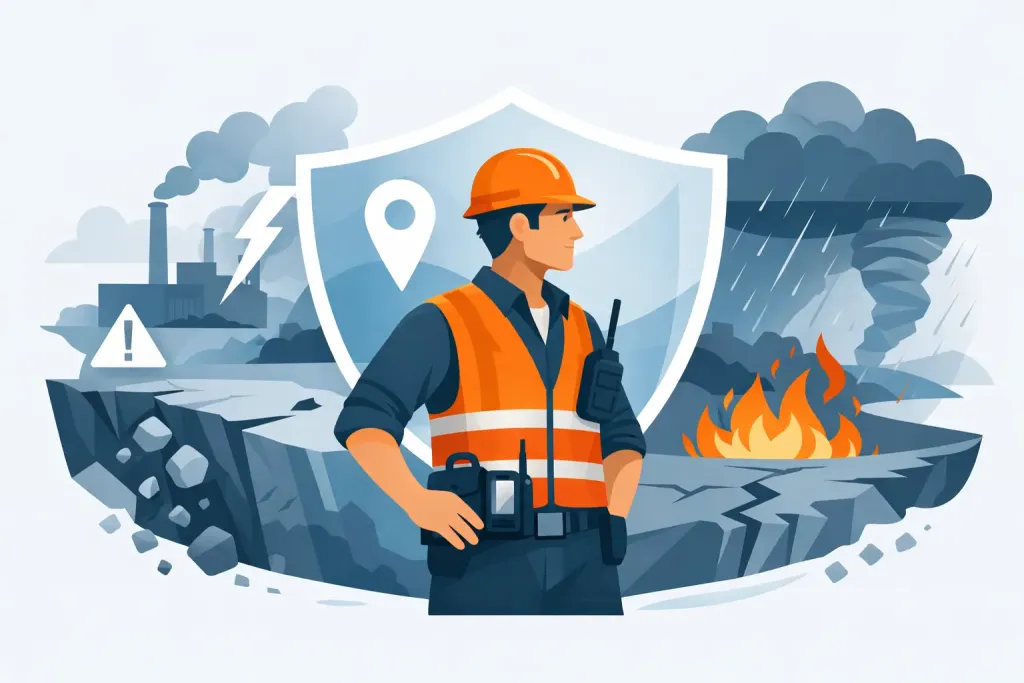
A missed check-in at a remote plant room is not an administrative problem. If the person inside has fallen, been threatened or become unwell, every minute without visibility changes the outcome. Effective lone worker safety gives supervisors the information and escalation routes needed to act before an isolated incident becomes a serious emergency.
For security providers, facilities teams and in-house operations departments, the challenge is rarely a lack of policy. It is proving that risk controls are being followed across changing shifts, dispersed sites and unpredictable conditions. Paper welfare calls, radio messages and end-of-shift reports leave too much room for delay, uncertainty and disputed records.
What Lone Worker Safety Must Achieve
A lone worker is not simply someone working off-site. They may be a night guard completing patrols alone, a facilities engineer entering a restricted area, a concierge covering an isolated building, or a supervisor walking a large estate after hours. The risk level depends on the task, environment, time of day, public access, communication coverage and the worker’s ability to summon help.
A credible safety arrangement must do three things: identify when someone may be at risk, give them a practical way to request immediate help, and show managers what happened afterwards. If any one of those elements is missing, the process becomes dependent on assumptions.
This is why lone-worker protection should sit within daily operational controls rather than operate as a separate emergency tool that is only considered after an incident. Patrol schedules, site instructions, access points, task completion and welfare status all provide useful context. Combined, they allow control room staff or supervisors to distinguish a late patrol from a potential welfare concern.
Start With the Real Risk, Not a Generic Checklist
Risk assessments are necessary, but their value depends on the detail behind them. A generic statement that a guard works alone does not tell a manager whether they are exposed to aggression, slips and falls, machinery hazards, confined spaces, poor lighting, extreme weather or delayed access to assistance.
Assess each role by looking at the task and the location together. A guard carrying out perimeter checks at a warehouse may face different risks from a receptionist locking down an office park or an engineer visiting an unmanned pumping station. Consider whether the worker can maintain mobile signal, whether there are known blind spots, how quickly another person could reach them, and whether they may need to enter areas where a phone cannot be safely used.
The assessment should also account for changing conditions. Construction sites evolve, vacant properties attract unauthorised access, and busy hospitality venues can become high-risk after closing time. A risk assessment that is reviewed only annually may not reflect how the site is actually being operated.
Build Safety Into Every Shift
The strongest process is easy for staff to follow during a busy shift. It should not require guards to remember multiple numbers, handwritten forms and separate reporting systems. Clear expectations at the start of each shift help establish accountability: who is on duty, where they are expected to be, which tasks are higher risk, and who is responsible for responding if contact is lost.
Scheduled check-ins remain useful, particularly for static posts or remote visits, but they should not be the only safeguard. A worker can be in difficulty between calls. Location-aware patrol activity gives operations teams a more continuous picture by confirming progress through designated checkpoints or GPS-based zones.
This is particularly valuable where service delivery and safety overlap. If a guard has not reached a checkpoint within the expected window, the system can flag an exception while the event is still actionable. The supervisor can check the relevant location, contact the guard and escalate according to the site procedure. That is materially different from discovering a missed patrol in a report the next morning.
Make emergency action simple
Under stress, the worker must not need to navigate a complicated process. A panic alarm should be immediate, obvious and available from the device they already carry where appropriate. The alert needs to reach named responders with enough information to act: the worker’s identity, time, location and last known activity.
Man-down detection can add another layer of protection for roles where falls, collapses or immobilisation are credible hazards. It should be configured carefully. Settings that are too sensitive can create false alarms and alarm fatigue; settings that are too lenient may fail to trigger when support is needed. Test the configuration in real working conditions, including vehicle use, stairwells and areas with inconsistent signal.
An alarm is only as effective as the response behind it. Define who receives it, the order in which they act, when emergency services are contacted, and what happens if the first responder cannot reach the worker. These decisions should not be made for the first time during an incident.
Give Supervisors Live, Useful Information
Lone worker safety depends on operational visibility, not surveillance for its own sake. Managers need enough live data to make proportionate decisions without creating unnecessary monitoring or a flood of alerts.
A cloud-based guard management platform can connect patrol verification, task status, incident records and lone-worker alerts in one operational view. For example, a supervisor can see that a guard has entered a scheduled patrol zone, scanned checkpoints as expected, logged a hazard, and then triggered an SOS alert from a specific area. This context makes the response faster and gives the organisation a defensible account of events.
QR-Patrol supports this approach by combining mobile patrol activity with panic alarms, man-down alerts, GPS-based locations and immediate cloud synchronisation. For managers responsible for several sites, the practical advantage is not simply receiving more data. It is being able to identify exceptions quickly and direct support with confidence.
There is a balance to maintain. GPS tracking should be relevant to the work, communicated clearly to employees and governed by a documented policy. Staff need to understand when location information is collected, why it is needed, who can access it and how long it is retained. This supports GDPR compliance while reinforcing that the purpose is safety and service assurance, not indiscriminate observation.
Turn Alerts Into a Tested Response Workflow
Technology cannot replace competent supervision, but it can remove dangerous gaps from the response chain. Every alert type should have a documented workflow, supported by training and regular tests.
For a missed check-in, the first action may be a call through the approved contact method, followed by a control room review of the worker’s last recorded position and recent activity. For a panic alarm, the response may require immediate deployment of nearby staff, escalation to emergency services, preservation of incident evidence and notification of the client contact. The right sequence depends on the site risk assessment, but it must be unambiguous.
Use incident forms to capture the facts while they are fresh: time, exact location, persons involved, actions taken, injuries, damage, witness details and follow-up requirements. Digital occurrence records reduce the risk of illegible or incomplete notes and create a time-stamped audit trail for internal review, clients and insurers.
Test the workflow at planned intervals. Run scenarios such as a guard who does not answer a welfare call, a false man-down alert, a device with low battery, and an SOS activation in an area with weak connectivity. Exercises often reveal small operational weaknesses – outdated contact lists, unclear handovers or responders who have not been trained on the escalation process – before they cause harm.
Control the Practical Details That Cause Failures
Even a well-designed system can fail if day-to-day basics are neglected. Devices must be charged, assigned to the correct worker and checked at handover. Staff need to know how to confirm signal, use the alarm feature and report faults immediately. Site instructions should identify alternative communication methods for basements, remote land or buildings with poor coverage.
Managers should also avoid treating lone working as a fixed category. A normally low-risk task can become unsuitable for one-person attendance when there is a known threat, severe weather, a critical equipment fault or work in a confined space. The right control may be additional supervision, a buddy arrangement, a delayed task or a change to the method of work.
Regular reporting turns individual alerts into better risk management. Look for repeated late check-ins, recurring hazards at the same location, frequent false alarms, areas with poor connectivity and shifts where incidents cluster. These patterns can inform staffing, patrol design, client conversations and targeted training.
Safety Evidence Is Part of Service Delivery
Security teams are often asked to demonstrate that patrols happened, hazards were reported and incidents were handled correctly. Lone-worker records should support that requirement without creating an administrative burden that keeps officers away from their duties.
Time-stamped patrol data, alert logs, incident records and escalation actions create a clear evidential chain. They help organisations demonstrate that controls were in place, that concerns were acted upon and that lessons were applied. This is valuable for health and safety obligations, client SLAs, internal investigations and standards such as BS 7499.
Most importantly, evidence should lead to action. When an alert identifies a weakness, use it to improve the site instruction, revise the risk assessment or strengthen the response plan. The purpose of a lone-worker system is not to document that something went wrong. It is to give every isolated worker a reliable route to help when it matters most.