
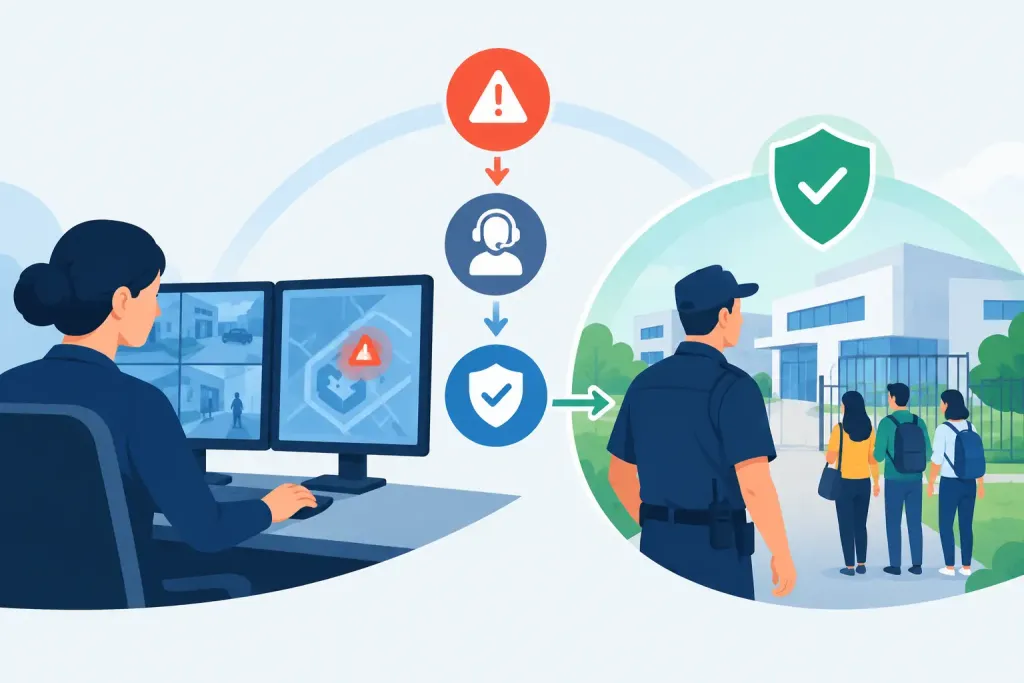
At 02:14, a lone guard finds a forced fire exit at an otherwise quiet distribution centre. The issue is not whether they can write an occurrence report before the end of the shift. The issue is whether the right person can assess the risk, authorise action and protect the site within minutes. Effective incident escalation turns that first observation into a controlled response, with clear ownership and a record that stands up to scrutiny.
For security providers, facilities teams and in-house security departments, delayed escalation creates more than an operational inconvenience. It can leave people exposed, allow property damage to worsen, compromise an investigation and put client service levels at risk. A dependable process must work when supervisors are managing several sites, when mobile signal is poor, and when an incident develops outside normal office hours.
What incident escalation means in security operations
Incident escalation is the structured process of raising an event from the person who identifies it to the people authorised to make decisions and take action. It defines what must be reported, how quickly it must be communicated, who receives it and what evidence accompanies the alert.
This is different from simply submitting an incident report. A report records what has happened. Escalation initiates a response. In a well-run operation, the two are connected: the guard captures the facts at the point of discovery, the relevant manager receives an immediate notification, and every decision or update is recorded against the same event.
The required response depends on the incident. A damaged perimeter fence may need a maintenance contractor and increased patrol frequency. An aggressive intruder may require police contact, support for the officer on duty and a site lockdown decision. A missed welfare check for a lone worker demands immediate action, even if there is no confirmed emergency.
The process should therefore be proportionate. Escalating every minor observation as a critical event causes alert fatigue. Treating significant warning signs as routine creates blind spots. The objective is not more notifications. It is faster, more appropriate intervention.
Why delays in incident escalation create risk
The first few minutes after an incident are often the most valuable. Site conditions can change quickly, witnesses can leave and physical evidence can be disturbed. A supervisor who learns about a serious issue at the end of a shift cannot meaningfully direct the initial response.
Paper occurrence books and end-of-shift phone calls introduce gaps at exactly the wrong moment. Information may be incomplete, difficult to read or unavailable to managers working remotely. The guard may be unsure which duty manager to contact, while the person contacted may lack the site context to judge severity. Meanwhile, a client may receive an update late, after the incident has already affected their operations.
Delayed escalation also weakens accountability. If an insurer, client, regulator or internal investigator asks what was known and when, organisations need more than a recollection of events. They need a time-stamped record showing the original observation, supporting images or notes, acknowledgements, instructions and follow-up actions.
For organisations working to BS 7499 requirements, health and safety responsibilities, GDPR obligations and contractual SLAs, this evidence matters. It demonstrates that staff were not only deployed, but supported by a defined system of supervision and response.
Build an escalation pathway guards can follow under pressure
A guard facing a safety or security concern should not have to interpret a lengthy policy document. The escalation pathway must be clear enough to use under pressure and specific enough to prevent inconsistent decisions between sites and shifts.
Define incident levels by consequence, not vague labels
Terms such as low, medium and high priority are only useful when they are tied to clear actions. Define levels according to the potential impact on life safety, site security, business continuity, assets and legal obligations.
For example, a routine defect such as poor lighting in a car park may require a logged maintenance task and supervisor review. A vulnerable door or missing key may require an immediate call to the control room, an additional patrol and a temporary physical control. Violence, fire, suspected criminal activity, a panic alarm or a failed lone-worker welfare check should trigger urgent escalation to nominated contacts and, where required, emergency services.
Local conditions matter. An unsecured gate at an office park may be manageable until morning. The same issue at an airport-adjacent site, construction project or chemical facility may demand an immediate response. Site instructions should reflect these differences rather than applying a generic category to every location.
Set ownership at every stage
An escalation policy fails when a notification reaches several people but no one knows who must act. Each incident level needs a named primary recipient, a backup contact and a defined route if neither acknowledges the alert.
The guard’s responsibility is to make the area safe where it is safe to do so, report factual information and remain available for instruction. The supervisor or control room should assess, direct the immediate response and decide whether further escalation is necessary. Operations management may need to notify the client, arrange specialist support or approve changes to deployment.
This distinction is especially important for contract security teams. Guards should not be expected to make decisions outside their authority, but managers must receive enough live detail to make informed decisions without delay.
Specify what a useful first report contains
Speed should not mean vague reporting. A first report should establish the location, time, nature of the incident, immediate risk, people involved, action already taken and whether emergency services have been contacted. Photographs, voice notes and supporting forms can add valuable context when they can be captured safely.
The wording should remain factual. “Rear loading-bay door found open at 02:14. No visible damage. Area checked from a safe distance. No persons seen. Door secured at 02:18” is more useful than “Possible break-in.” Clear facts allow the next person to assess the situation properly and preserve an accurate audit trail.
Use live technology to close the communication gap
A smartphone-based guard patrol platform gives escalation a practical operational advantage: the guard can report from the point of discovery, rather than waiting to return to a desk or control room. Time, location and user identity can be captured alongside the incident, creating immediate visibility for authorised managers.
QR-Patrol supports this approach by bringing patrol verification, incident reporting, custom forms, panic alarms and lone-worker safeguards into one cloud-based system. A guard can scan a checkpoint, identify a concern and submit a report while the supervisor sees activity as it happens. That link between proof of presence and the incident record is valuable when establishing exactly where an event was identified.
Automated notifications should follow the agreed escalation matrix. The right recipients can be alerted according to incident type, site, severity or shift, avoiding the delays of manual call trees. If a notification is not acknowledged within the agreed time, the system should route it to the next responsible person.
Technology does not replace judgement. A panic alarm still requires a trained response, and an image cannot tell a manager everything about a developing confrontation. Its value is in removing avoidable uncertainty: who reported the issue, where it occurred, when it was submitted and whether someone has acted.
Make escalation part of the patrol workflow
The strongest procedures are built into daily activity, not stored in a folder for emergencies. Guards should encounter the same escalation logic during routine patrols, maintenance observations, access-control checks and welfare tasks. Familiarity makes correct action more likely when the pressure rises.
Use site-specific forms to prompt the information required for recurring risks. A water leak form might ask for the affected area, severity, isolation action and photographs. A suspicious-person report might prompt the guard to record description, direction of travel, vehicle details and whether police were contacted. This creates consistent records without forcing every incident into a generic free-text entry.
Managers should also review trends, not just individual events. Repeated door faults, recurring trespass attempts, frequent alarm activations or late welfare responses may indicate a wider control failure. Live data supports immediate intervention, while historical reporting helps teams adjust patrol routes, staffing, site instructions and client recommendations.
Test the process before a real emergency
An escalation process is only dependable if people understand it and it functions outside office hours. Test it through realistic scenarios such as an unresponsive lone worker, fire alarm, unauthorised entry or serious accident. Check whether alerts reach the right people, whether backups are current and whether guards receive clear instructions.
Review response times, not simply whether a report was created. Was the incident acknowledged within the target period? Did the supervisor have enough information to make a decision? Was the client informed according to the contract? Did follow-up actions close the risk, or was the report filed without resolution?
Staff turnover, changing phone numbers, new client contacts and altered site risks can quietly undermine a once-effective procedure. Escalation matrices should be reviewed routinely and after every significant event. The learning should be practical: update a contact route, improve a form, change a patrol checkpoint or clarify authority levels.
When a guard raises a concern, the organisation is making a promise that someone will see it, own it and act on it. A clear incident escalation process makes that promise visible in real time – and gives teams the evidence to show it was kept.
