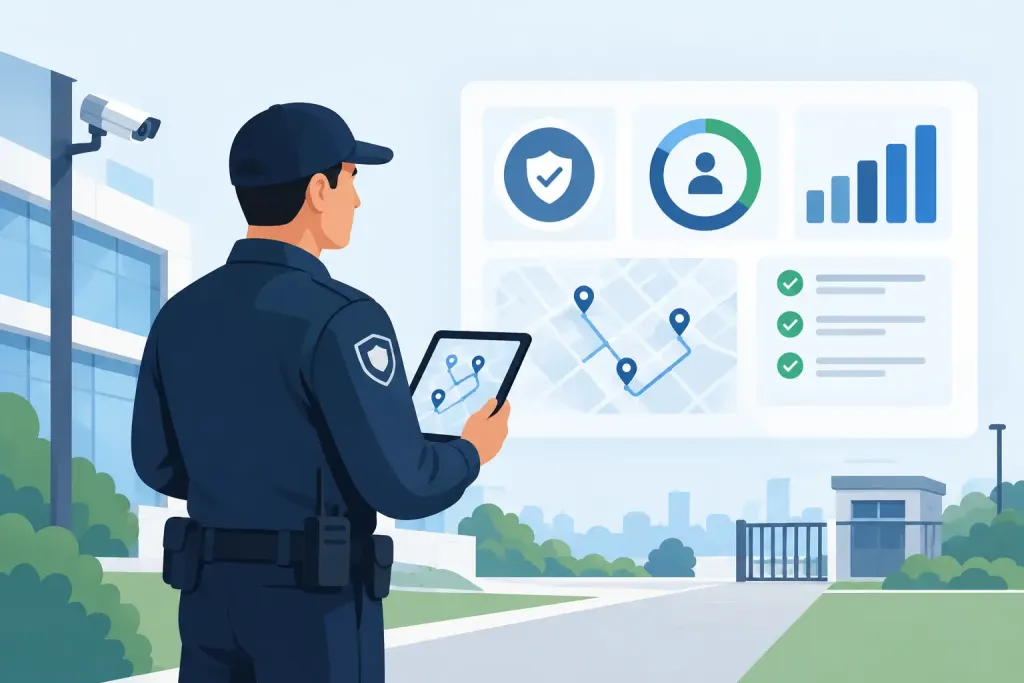
A patrol marked as complete tells only part of the story. If a guard reached the required checkpoint 25 minutes late, skipped a high-risk route, or raised an incident without prompt escalation, the site remains exposed. Effective patrol metrics turn activity in the field into evidence that managers can act on while the shift is still under way.
For security providers, facilities teams and in-house departments, the objective is not to collect more data for its own sake. It is to establish whether patrols are being completed as planned, whether exceptions are being handled properly, and whether security resources are being deployed where the risk is greatest. The right measures create absolute proof of presence, clearer client reporting and a defensible record when performance or compliance is questioned.
What patrol metrics should measure
The most useful measures follow the operational journey of a patrol: scheduled work, attendance at checkpoints, exceptions, incidents and management response. They should be simple enough for supervisors to review during a busy shift, but detailed enough to reveal a recurring weakness at a specific site, route or time of day.
Completion rate and proof of presence
Patrol completion rate compares the number of completed patrols or checkpoints against those scheduled. It is a vital starting point, but it must be supported by reliable proof of presence. A timestamp alone does not show that a guard attended the correct location.
QR codes, NFC tags, Bluetooth beacons and GPS-based virtual checkpoints each provide different forms of verification. The right choice depends on the environment. A multi-storey office may benefit from physical tags at critical points, while a large perimeter or remote estate may need GPS checkpoints. Using more than one method can reduce blind spots, particularly where GPS accuracy is limited indoors.
Managers should monitor missed checkpoints separately from deliberately excused ones. A checkpoint missed because a guard was dealing with a genuine emergency should not be treated in the same way as an unexplained omission. Both need a record, but the operational response is different.
Timeliness and route adherence
A patrol can be completed but still fail to provide the intended protection. Measuring the time between checkpoint scans shows whether patrols are conducted within the required window and whether the route is being followed in a credible sequence.
Late starts, unusually rapid tours and repeated gaps between scans deserve attention. A very short patrol may indicate that a route has been rushed. A patrol that consistently runs late may point to an unrealistic schedule, poor handover arrangements or insufficient staffing rather than individual guard performance.
This is where target ranges are more useful than a single rigid number. A night patrol of a warehouse may need a strict maximum interval between perimeter checks. A concierge-led corporate site may require greater flexibility because guards are also handling visitors, deliveries and access-control queries.
Incident volume, type and escalation time
Incident counts are not automatically a sign of poor security. In some cases, more reported incidents show that guards are observant, supported and using the reporting process properly. The more revealing measures are incident type, location, severity, repeat occurrence and the time taken to notify the right person.
Track how long it takes from incident discovery to report submission, acknowledgement and escalation. For urgent events, such as an intrusion, fire safety concern or lone-worker alarm, minutes matter. Live notifications allow supervisors to intervene before a local issue becomes a wider operational failure.
Reports should also identify patterns. Repeated access breaches at one door, frequent lighting faults along a route or recurring anti-social behaviour around a car park are risk indicators. They should lead to a practical control decision: change the route, repair the fault, adjust patrol frequency or strengthen physical protection.
Guard welfare and lone-worker events
Patrol performance cannot be separated from guard safety. A guard working alone at a remote industrial site may face medical risk, confrontation or a fall with no colleague nearby. Lone-worker check-ins, man-down alerts and panic alarms should therefore form part of the operational dashboard.
Measure alarm activations, acknowledgement times, welfare-check compliance and the outcome of each event. False alarms should be reviewed rather than dismissed. A high false-alert rate may indicate poor device configuration, inadequate training or a process that guards do not trust. Equally, a low number of alarms is not proof that staff are safe if check-ins are routinely missed.
Turning patrol data into management action
Metrics have value only when someone owns the response. A weekly spreadsheet sent after the fact will not help a supervisor recover a missed patrol or support a guard who has failed to check in. Security operations need two review rhythms: live exception management during the shift, and trend analysis over longer periods.
During the shift, supervisors should focus on exceptions. These include overdue checkpoints, unstarted tours, missed welfare checks, emergency alarms and high-priority incidents. The aim is immediate verification and intervention, with a clear record of who responded and what happened next.
At the end of each week or month, managers can look for trends across sites, teams and contracts. A useful performance review asks whether exceptions are isolated or repeated, whether controls are working, and whether the service level promised to the client is being delivered. It should result in an assigned action, not simply a red or green score.
QR-Patrol brings checkpoint activity, occurrence records, schedules, alerts and reports into one cloud-based view, so managers can investigate a deviation without chasing paper logbooks or waiting for a device to return to base.
A practical patrol scorecard
Avoid a dashboard packed with dozens of indicators. Start with a scorecard that answers the questions a contract manager or site supervisor needs to ask every day:
- What proportion of scheduled patrols and checkpoints were completed with verified proof of presence?
- Which patrols were late, missed or completed outside the authorised time window?
- How quickly were incidents, alarms and exceptions acknowledged and escalated?
- Where are repeat incidents, missed checkpoints or route deviations occurring?
- Are lone workers completing required check-ins, and were safety alerts handled within target times?
Set targets by site risk, not by convenience. A construction project with changing hazards may require tighter exception controls than a low-risk daytime office. An airport, logistics hub or healthcare environment may have contractual and regulatory requirements that make response time more significant than the raw number of completed scans.
It is also sensible to segment results. Combining all sites into one average can hide serious failures. A 98% completion rate may look strong until it becomes clear that the missing 2% occurred at a vulnerable perimeter, during the quietest hours, or on the client’s most sensitive site.
Use patrol metrics fairly and consistently
Metrics should improve control, not encourage unhelpful behaviour. If guards believe they are judged only on speed, they may scan checkpoints quickly without carrying out meaningful observations. If every incident report is treated as a negative mark, under-reporting becomes more likely. The measures must reinforce the behaviour the operation actually needs: thorough patrols, accurate reporting and timely escalation.
This requires clear operating instructions. Guards need to know the expected route, acceptable time windows, what to do when a checkpoint cannot be accessed, and when an incident requires immediate escalation. Supervisors need the authority to record legitimate exceptions and alter schedules when the site situation changes.
The data must also be handled responsibly. Location records, patrol histories and incident details may contain personal data, so access permissions, retention periods and audit trails should align with GDPR obligations. For organisations working to BS 7499 requirements or client SLAs, reliable digital records can support compliance evidence, but the system must be backed by competent procedures and trained personnel.
A well-designed patrol measurement programme gives managers more than a monthly report. It creates a live operational control: one that shows where guards are, where risk is building and where a timely decision can protect people, property and service standards.