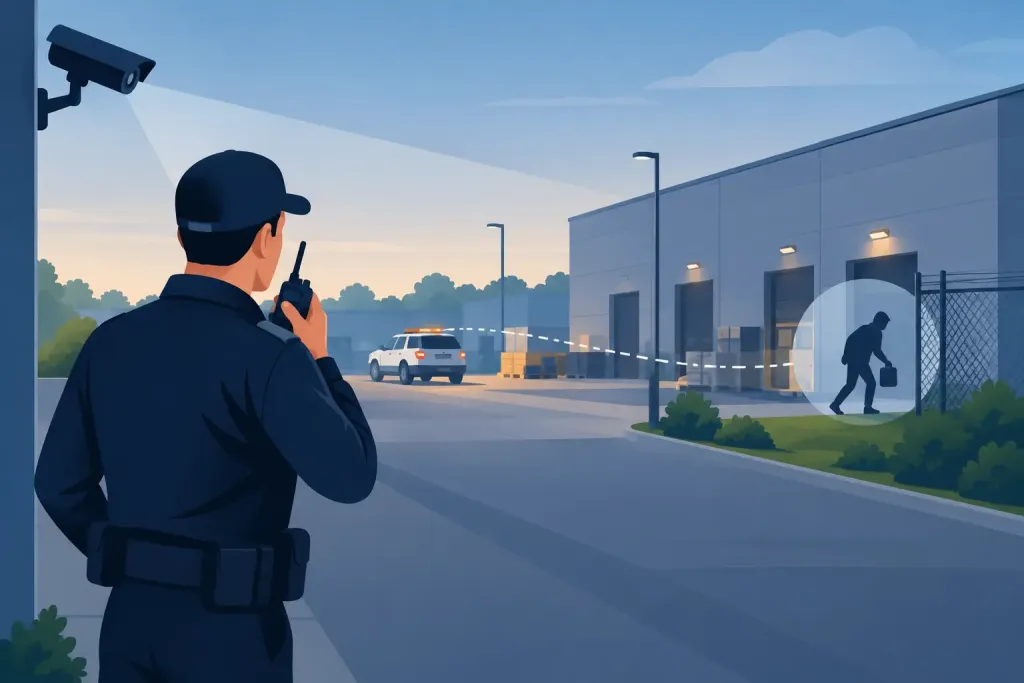
A patrol can appear complete on a paper log while a fire door has been propped open, an access point is unsecured, or a lone guard has stopped responding. That gap between reported activity and what happened on site explains why security patrols fail in so many otherwise well-managed operations. The issue is rarely that teams do not care. More often, the control process cannot prove presence, expose exceptions quickly, or support the person carrying out the work.
Why Security Patrols Fail: The Operational Reality
Security patrols fail when managers receive information too late to influence the outcome. A supervisor may discover missed checkpoints at the end of a shift, read an incident report the following morning, or only learn of a recurring defect after a client complaint. By then, the patrol has become a record of failure rather than an active security control.
This matters across warehouses, construction sites, office parks, hospitality venues and remote estates. Every site has different risks, but the operational requirement is consistent: the right person must complete the right check, at the right location, within the required time window, with a clear record of anything found.
A visible guard presence still has value. It deters opportunistic behaviour, reassures staff and visitors, and identifies conditions that cameras or access systems may not reveal. But presence alone is not enough. Without verified execution and live oversight, there is no dependable way to distinguish a completed patrol from an assumed one.
The Main Reasons Patrol Programmes Break Down
Paper records create a delayed and fragile audit trail
Paper occurrence books and handwritten patrol sheets are familiar, but they rely on memory, honesty and later transcription. A guard can record a patrol after the event, omit the exact time of a check, or write a vague note that gives a manager little basis for action. Records may be misplaced, damaged or unavailable when a client, insurer or investigator requests evidence.
The problem is not simply administration. When a defect is logged on paper, escalation depends on somebody seeing it, interpreting its significance and passing it on. That introduces delay at the point where rapid action matters most. A damaged perimeter fence or failed emergency exit should trigger a response immediately, not wait for a shift handover.
Checkpoints do not prove a meaningful patrol
Traditional guard tour systems can confirm that a device reached a point, but that alone does not always demonstrate an effective inspection. A checkpoint scan is valuable evidence of presence, yet patrol quality depends on what the guard was required to observe, what they found and whether the result was reported correctly.
If patrol instructions are unclear, staff may scan points mechanically without checking the surrounding area. If a site layout has changed, checkpoints may no longer reflect the highest-risk routes. And if tags are placed too close together or poorly positioned, a scan can be completed without inspecting the intended location.
A stronger patrol design combines proof of presence with task-specific prompts. At a loading bay, that might mean checking vehicle access, gate condition and unauthorised entry. At a residential block, it could mean inspecting fire doors, communal areas and signs of antisocial behaviour. The required evidence should match the risk, rather than treating every checkpoint as identical.
Schedules fail to reflect real site conditions
A patrol route that works on a quiet weekday may be ineffective during a night delivery, a public event, severe weather or construction activity. Static schedules can also create predictable patterns. Where a patrol happens at precisely the same time each night, it becomes easier for unwanted activity to avoid it.
This does not mean that every patrol should be random. Critical checks, such as fire exits or high-value asset areas, often need fixed frequencies to meet policy or client requirements. The better approach is to preserve mandatory checks while allowing supervisors to add dynamic tasks, amend routes and increase coverage when risk changes.
Managers also need to account for the practical workload. An unrealistic route encourages rushing, skipped checks and retrospective reporting. When one officer is expected to cover too much ground, the failure is in the plan, not only in the individual.
Incident reporting is disconnected from patrol activity
Many operations treat patrols and incident reporting as separate processes. The guard completes a route, then opens another system, sends a message or waits until later to report an issue. That separation loses context and slows escalation.
An effective process lets the guard report an incident at the point of discovery, attaching photographs, notes, location and time. The control room or supervisor should be notified according to severity, with a clear record of acknowledgement and follow-up. This turns a patrol from a passive observation exercise into a live response workflow.
The detail matters. A report stating “damage found” may be insufficient for a client dispute or health and safety review. A report showing the exact patrol point, timestamp, photographs, category, corrective action and escalation history is far more defensible.
Lone workers are unsupported when communication fails
Patrol officers frequently work alone, particularly overnight or across large, isolated sites. A missed welfare call, medical emergency or confrontation can quickly become serious if there is no reliable way to raise an alarm or identify the guard’s last confirmed location.
Radio check-ins remain useful, but they can be missed during busy periods and offer limited evidence of activity between calls. Mobile patrol technology can add scheduled welfare checks, panic alarms, man-down alerts and location-based confirmation. These tools do not replace competent supervision or emergency procedures. They provide a faster signal when normal communication stops.
For employers, this is both a safety and compliance issue. A lone-working arrangement must be assessed against the site, task, environment and individual worker. A system should support that assessment with evidence, not create a false sense of security.
Why Security Patrols Fail Even With Good Guards
It is tempting to attribute missed patrols to poor performance. Occasionally, that is the right finding. Repeated non-compliance, falsified records or failure to follow instructions requires firm management action. But blaming guards as the default response overlooks the wider operating environment.
Guards are more likely to perform consistently when routes are achievable, instructions are clear, equipment works, supervisors can answer questions, and incident reporting is straightforward. They also need feedback. If officers never hear whether their reports led to a repair, a client decision or a change in site procedure, reporting can become a box-ticking exercise.
Training should cover more than how to scan a checkpoint. Officers need to understand why a particular check exists, what abnormal conditions look like, which issues require immediate escalation and how to preserve accurate evidence. This is especially important where staff move between multiple sites with different risks and client requirements.
Building Patrol Control That Works in Real Time
The most effective patrol operation connects planning, field execution and management oversight in one process. Supervisors create routes and tasks around the actual risk profile. Guards receive clear instructions on a mobile device and confirm attendance through QR codes, NFC tags, beacons or GPS-based virtual checkpoints. Managers can see completed, missed and overdue activity while there is still time to intervene.
There is a trade-off to manage. GPS is useful for wide outdoor areas, vehicle patrols and remote locations, but it may be less precise indoors or around dense structures. Physical QR or NFC checkpoints provide a specific point of confirmation, though they require sensible placement and periodic inspection. A multi-technology approach allows the method to suit the environment rather than forcing every site into the same model.
Exception management should be at the centre of the workflow. A perfect patrol should require little attention. The priority is an overdue checkpoint, an unanswered welfare alert, a high-priority incident or a repeated defect. Automated notifications can bring those events to the correct person immediately, while dashboards and reports reveal patterns that need a management response.
For multi-site operators, standardisation is equally valuable. A central platform can apply consistent reporting categories, patrol templates and escalation rules while still allowing each location to retain its own routes, risks and client requirements. This makes it easier to compare performance, identify recurring failures and demonstrate service delivery across an estate.
QR-Patrol supports this model by bringing patrol verification, task management, incident reporting, lone-worker safeguards and cloud-based reporting into a single operational record. The outcome is not simply more data. It is timely, usable evidence that gives supervisors the chance to act before a missed patrol becomes an exposed site, a safety incident or a difficult client conversation.
Start With the Gaps You Cannot See
Review the last month of patrol records and ask a direct question: could you prove where a guard was, what they checked, what they found and who acted on it? If the answer depends on paper logs, end-of-shift recollection or several disconnected systems, the operation has blind spots.
The strongest improvement is often not adding more patrols. It is making each patrol visible, purposeful and actionable while it is happening. When the field team has clear tasks and managers have live exceptions, security control becomes something you can manage rather than something you hope was completed.