Missed patrols, incomplete reports, and compliance issues are problems many UK businesses and security providers face daily. Property managers struggle to prove checks were done, and security firms need to keep clients confident, but paper logbooks often leave risky gaps.
In today’s tech-driven environment, organisations need smarter, faster, and more flexible ways to keep people and places safe. Virtual Checkpoints are transforming guard tracking with real-time data, remote setup, and smart reporting, offering a completely digital, hardware-free approach to patrol management.
With Virtual Checkpoints, businesses gain verifiable proof of presence, faster incident response, and improved safety, all while saving time and controlling costs. This guide explains what Virtual Checkpoints are, how they work, and why more UK companies are adopting this smarter way to manage security operations.
What Are Virtual Checkpoints?
Virtual Checkpoints in QR Patrol are digital locations defined by GPS coordinates that security guards can “scan” simply by entering or approaching a designated area. Unlike traditional checkpoints that rely on physical QR codes or NFC tags, Virtual Checkpoints exist entirely in the cloud.
That means:
• No installation of physical devices
• No need to attend the site for setup or updates
• No risk of damage, wear, or weather interference
Security managers can easily create, move, or remove checkpoints from their computer. This makes it perfect for managing many sites, starting new jobs quickly, or updating patrol routes when things change.
How Virtual Checkpoints Work?
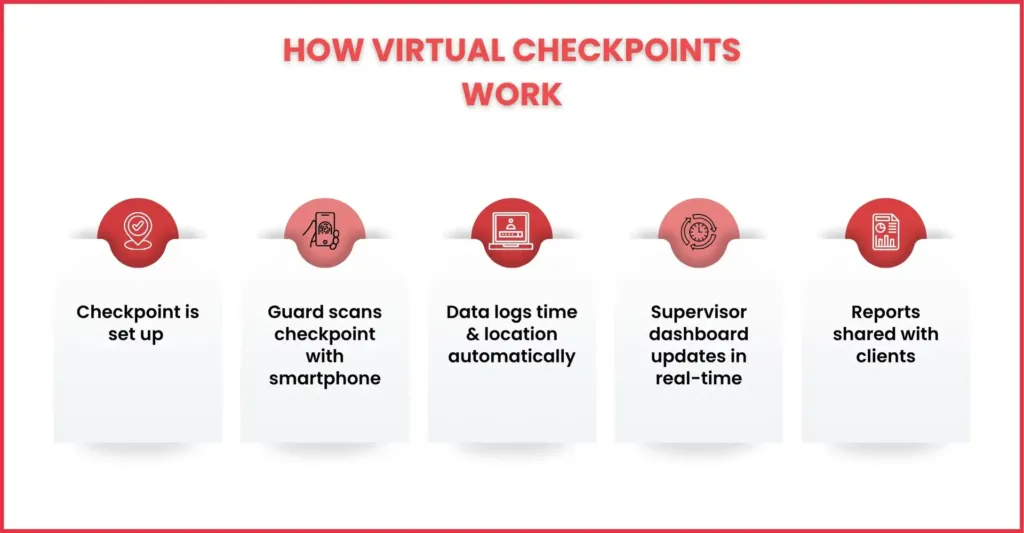
1. Setup
Security managers define checkpoint locations digitally within QR Patrol’s cloud dashboard. Each checkpoint can represent an entry point, boundary area, or high-risk zone.
2. Patrol Execution
Guards use the QR Patrol mobile app while on duty. As they enter a defined GPS area, the checkpoint is automatically registered — no scanning required.
3. Real-Time Data Logging
Every action is recorded with time, date, and location accuracy, then uploaded instantly to the cloud. If a device is offline, the data syncs automatically once reconnected.
4. Supervisor Oversight
Supervisors can track patrol progress live, review missed checkpoints, and receive automatic alerts if any area is skipped or a route change unexpectedly.
5. Smart Reporting
Detailed, automated reports prove patrol completion and compliance. Clients and managers can review patrol logs anytime for full transparency and peace of mind.
7 Key Advantages of Virtual Checkpoints for Security Patrols
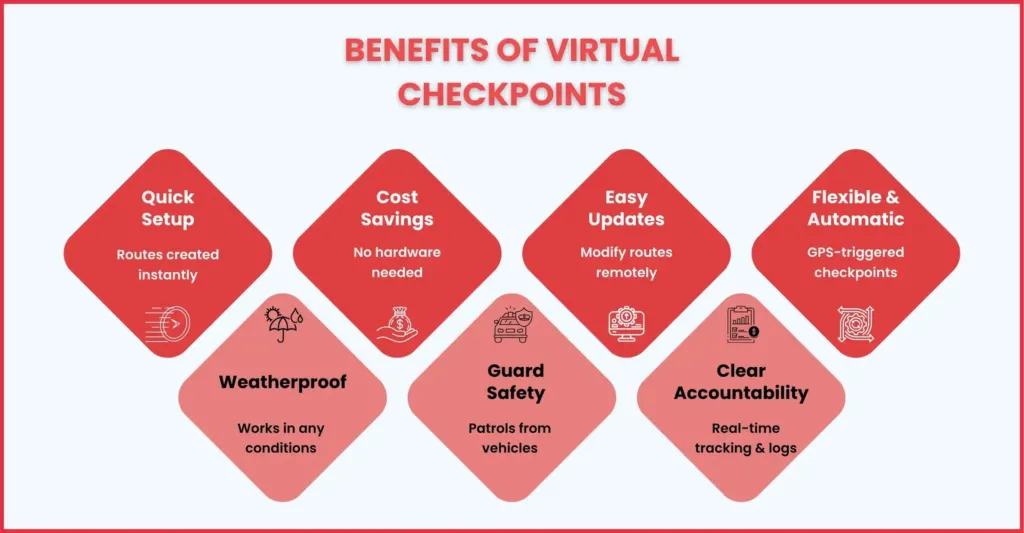
1. Quick Setup
Patrol routes can be created and shared online right away. Guards can start their rounds immediately without waiting to install any physical devices.
2. Saves Money
Unlike traditional methods, which require ongoing hardware costs for NFC tags and QR codes, Virtual Checkpoints rely solely on cloud-based technology, significantly reducing operational costs and increasing overall efficiency
3. Easy to Update
If a site layout changes because of repairs or new construction, routes can be updated instantly from the control panel — no one needs to visit the site.
4. Flexible and Automatic
You can adjust how far the checkpoint works or set it to activate automatically when a guard enters the area. This works well for patrols done by vehicle or along large boundaries.
5. Weatherproof and Reliable
Since there’s nothing physical to damage, Virtual Checkpoints work smoothly in any weather — rain, heat, or snow.
6. Safer for Guards
In bad weather or dangerous areas, guards can complete patrols from their vehicles, keeping them safe while still doing their job properly.
7. Clear Tracking and Accountability
Every patrol is recorded and shown in real time. This provides a clear record of activity, builds client trust, and ensures full transparency.
Use Cases and Applications
Virtual Checkpoints are ideal for any environment where flexibility, speed, and safety are priorities:
- Corporate Buildings: Enable instant updates to patrol routes during renovations or security reconfigurations.
- Healthcare Facilities: Protect restricted zones and sensitive areas without installing hardware in sterile environments.
- Construction & Industrial Sites: Set up patrol routes for temporary projects or quickly changing layouts.
- Transport & Infrastructure: Manage large or remote areas such as airports, stations, or utilities from a central office.
- Outdoor & Perimeter Patrols: Define GPS-based checkpoints along fences or access roads for vehicle patrols.
Wherever traditional checkpoints face physical or logistical limits, Virtual Checkpoints offer a smarter, faster, and safer solution.
Reimagine Guard Tracking with QR Patrol — Explore Virtual Checkpoints Today!
Virtual Checkpoints vs Traditional Methods
| Aspect | Traditional Checkpoints | Virtual Checkpoints |
| Setup | Requires physical tags or labels on-site | Fully digital, created remotely |
| Cost | Hardware and installation expenses | No hardware or travel costs |
| Flexibility | Limited by physical locations | Easily updated anytime from the dashboard |
| Scanning Range | Short, manual scanning required | Customisable or automatic via GPS |
| Weather Resistance | Can be affected by extreme conditions | 100% weatherproof and digital |
| Deployment Speed | Requires site visits | Instant — live within minutes |
Traditional guard tour systems rely on physical devices that can be prone to wear and tear. QR Patrol’s cloud-based patrol management solutions remove the need for such equipment, ensuring real-time data tracking and storage in the cloud for easier management and access.
Implementation Tips for Security Teams
- Start Small: Starting small with Virtual Checkpoints is not only easy, but it’s also cost-effective. You can start implementing digital checkpoints across your security sites without the need for expensive hardware or installation
- Train Guards: Ensure guards understand how GPS-based scanning works and how to confirm checkpoint completion.
- Monitor and Adjust: Use reports to identify missed areas or improve patrol efficiency.
- Share Results: Give clients access to live dashboards or reports to demonstrate transparency and build trust.
The Future of Patrol Management
Virtual Checkpoints are the next step in security guard tracking. They are fully digital, flexible, and easy to scale. With QR Patrol, security teams can set up new patrols instantly, monitor compliance from anywhere, and protect both guards and property more effectively.
As technology continues to improve, features like AI analytics, IoT integration, and smart automation will make Virtual Checkpoints even more powerful. These advances will help increase efficiency and transparency in modern security operations.
FAQs: Frequently Asked Questions
Do virtual checkpoints work offline?
Yes, Guards can still complete patrols even when they don’t have an Internet connection. The system automatically stores data right on the device, & once they get reconnected to the internet, it uploads all that data to the cloud. This offline functionality is designed to keep patrol tracking going even in areas with really bad or no internet access, so you don’t have to worry about that.
Can clients see reports directly?
Yes. Clients can easily log into a custom portal at any time to view up-to-date patrol reports, including patrol completion, incident reports, and compliance tracking, all from the comfort of their own office. QR Patrol provides cloud-based reporting for easy access and makes it super easy to keep tabs on what’s going on between security providers and clients, with full transparency all the way.
Is QR Patrol suitable for small businesses?
Absolutely, QR Patrol is a super cost-effective security solution for small business owners, offering scalable patrol management that will grow with you. Whether you’re managing a small operation or a bunch of different locations, QR Patrol is flexible enough to be tailored to suit your specific needs.
How secure is the system?
QR Patrol ensures that all data is fully encrypted, so you don’t have to worry about security breaches. All that data is securely stored in the cloud and is fully compliant with GDPR regulations and any other industry standards that are relevant, so you can be confident that sensitive info is totally safe & sound. And just to make sure, regular security audits are carried out to keep the highest level of protection in place.
Can it integrate with other systems?
Yes. QR Patrol offers solid API integration, which makes it super easy to link up with compatible third-party systems like alarm monitoring software, access control systems, and central control systems. This integration makes sure that data exchange is seamless, improves communication, and overall makes security management a whole lot easier.
How accurate is the GPS tracking for Virtual Checkpoints?
QR Patrol provides super-accurate GPS tracking for all Virtual Checkpoints. The system makes sure that guards are always logged at the right locations with minimal deviation. This accuracy is a big help for patrol reporting and incident tracking, giving you clear, reliable data when you need it.
Can Virtual Checkpoints be used for Perimeter Patrols?
Yes. Virtual Checkpoints are perfect for managing perimeter patrols, especially in places like big industrial facilities, transport hubs, and construction sites. The GPS-based system allows guards to keep track of their location along fences, roads, or large boundaries without needing any physical tags or devices.
How easy is it to set up Virtual Checkpoints?
Setting up Virtual Checkpoints with QR Patrol is quick, simple & easy. Security managers can define digital checkpoints right from the cloud-based dashboard in no time at all. And the best part is, you don’t need to have anyone physically on-site to install it, so it’s great for remote security management and rapid deployment across multiple sites.
Conclusion
QR Patrol Virtual Checkpoints eliminate the need for physical infrastructure while delivering unmatched flexibility, safety, and real-time visibility. They allow security teams to set up, monitor, and adapt patrols from anywhere, saving time, reducing costs, and improving overall service quality.
For businesses seeking a modern, remote-ready patrol management solution, Virtual Checkpoints are the smartest way forward.