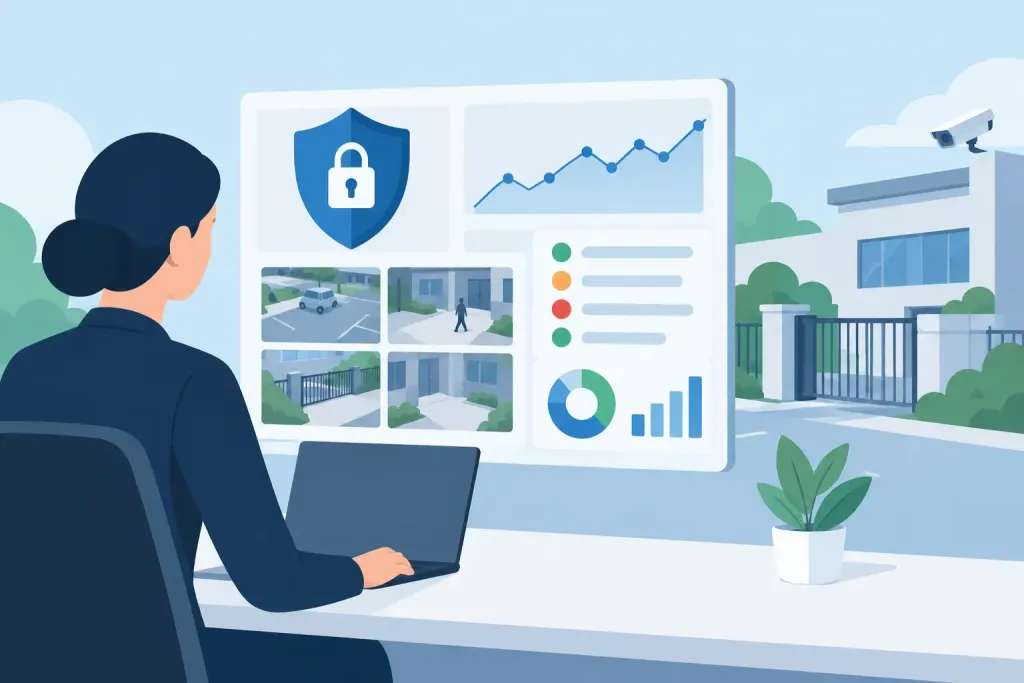
A missed patrol is one problem. Being unable to prove when it was missed, who was responsible, what risk existed and what action followed is a far more serious one. This security reporting guide sets out how security companies, facilities teams and in-house departments can turn patrol activity and incidents into reliable operational evidence.
Good reporting is not an administrative task completed at the end of a shift. It is the control record behind service delivery, incident response, health and safety decisions and client confidence. When a manager can see activity as it happens, investigate exceptions quickly and produce a clear record afterwards, they can manage the site rather than reconstruct events from memory.
What Effective Security Reporting Must Achieve
Security reports should answer practical questions without forcing a supervisor to chase paper occurrence books, call individual guards or compare separate spreadsheets. Was the patrol completed at the required checkpoints? Was an issue identified? Who received the escalation? What action was taken? Has the problem been closed, handed over or left as an outstanding risk?
A useful reporting process creates a continuous chain of evidence from the guard’s action in the field to the manager’s review and the client’s final report. That chain matters when a customer challenges an SLA, when an incident becomes an insurance matter, or when management needs to demonstrate reasonable precautions following a health and safety event.
The best reports combine time-stamped, location-aware patrol data with clear human context. A scan at a checkpoint proves presence at a defined point, but it does not explain a damaged perimeter fence or an unlocked fire exit. An incident report supplies the detail, photographs, observations and response history. Together, these records show both that the service was delivered and how risks were managed.
Build Your Security Reporting Process Around Events
Paper-based reporting tends to fail because it relies on recall. Guards may complete occurrence books hours later, handwriting can be unclear, and a supervisor may not see an issue until the next morning. A stronger process captures information at the point of activity, then directs it to the people who need to act.
Start by mapping the events that need evidence on each site. Most operations will need patrol completion, missed or late checkpoints, incidents, hazards, welfare checks, access issues, equipment defects, visitor or contractor activity, and shift handovers. A warehouse with vehicle movements may need loading-bay checks and seal records. A vacant property may prioritise signs of intrusion, water leaks and perimeter integrity. The reporting design should reflect the site risk assessment, not a generic template copied across every contract.
For each event, define four things: what the guard must record, who is notified, the required response time, and how closure is confirmed. This keeps reports purposeful. Asking a guard to complete twenty optional fields during an urgent incident will slow the response and reduce report quality. Conversely, collecting only a free-text description may leave managers without the evidence needed for follow-up.
Capture facts first, narrative second
Incident forms should make the essential facts easy to record under pressure: date and time, exact location, incident category, people involved, immediate risk, action taken and escalation route. Where appropriate, allow photographs, signatures, voice notes or attachments.
The narrative still matters, particularly where the record may be reviewed by a client, insurer, investigator or court. Guards should write what they saw, heard and did, avoiding speculation and unsupported conclusions. “Rear service door found open at 22:14; door secured; control room informed at 22:16” is more useful than “possible break-in”. If a conclusion is necessary, it should be clearly identified as an assessment and supported by observations.
Record patrol proof without creating blind spots
Checkpoint technology is valuable because it turns a claimed patrol into verified activity. QR codes, NFC tags, beacons and GPS-based checkpoints can all provide evidence of attendance, depending on the location and operational need. The right choice depends on the environment.
Fixed QR or NFC checkpoints are practical for internal routes, plant rooms and defined perimeter points. GPS checkpoints can support large estates, remote assets and mobile patrols, but location accuracy may be affected by dense urban areas, indoor environments or poor signal. Beacon technology can help validate indoor proximity. For higher-risk sites, a combination may provide better assurance than relying on one method alone.
The objective is not to create surveillance for its own sake. It is to establish absolute proof of presence at critical points while making the guard’s workflow quick enough to be followed consistently.
Turn Live Data Into Timely Intervention
A report delivered weekly can show patterns. It cannot prevent a missed critical patrol from becoming a security failure. The operational value of cloud reporting comes from live exception management.
Set alerts for events that require immediate attention, such as missed checkpoints, panic alarms, man-down alerts, late arrivals, lone-worker welfare exceptions or high-priority incident categories. Each alert needs an owner. If every notification is sent to everyone, accountability disappears and alert fatigue follows. A night supervisor may own first response, while a contract manager receives escalations only when an event breaches an agreed threshold.
This is where reporting becomes a management tool rather than a filing system. A supervisor can contact a guard after a missed checkpoint, arrange a relief officer when a shift is not covered, or notify the client as an incident develops. The report then documents the decision-making trail, including when intervention occurred and whether the risk was resolved.
Produce Reports for Different Decisions
Not every audience needs the same level of detail. A guard requires a clear handover of unresolved issues. A site supervisor needs operational exceptions and staffing visibility. A client may need confirmation that agreed patrols were completed, incidents were handled within SLA and recommendations are being tracked. Senior management usually needs trends, not every individual checkpoint scan.
A sensible reporting framework includes shift reports, incident reports, patrol compliance reports and periodic management reports. Keep each report focused on the decision it supports.
Shift reporting should flag open actions, site defects, keys or assets transferred, and information the incoming officer must know. Patrol compliance reporting should show planned versus completed activity, missed points, late scans and route trends. Incident reporting should provide the factual record and all actions taken. Monthly or quarterly client reports should identify recurring risks, response performance and corrective actions, rather than simply presenting a large volume of raw data.
A high percentage of completed patrols is encouraging, but it is not the whole picture. A 99 per cent completion rate may still conceal a repeated missed checkpoint at the most vulnerable part of the site. Look at the location, timing and consequence of exceptions, not only the headline figure.
Keep Records Defensible and GDPR-Aware
Security reports often contain personal data, including names, images, visitor details, vehicle registrations and incident descriptions. This requires disciplined access controls and retention practices. Only authorised users should access records, and report permissions should reflect each person’s operational role.
Collect the information needed to manage security and meet contractual or legal obligations, but avoid gathering data merely because a form allows it. Set clear retention periods that reflect the purpose of the record, client requirements and any applicable investigation or claim. When an incident is active, preserve the relevant evidence and maintain a clear record of who accessed or amended it.
Defensibility also depends on consistency. Use standard incident categories, mandatory fields for critical events and controlled status options such as open, escalated, actioned and closed. Free-text notes remain useful, but structured data makes it possible to identify trends across multiple sites and demonstrate that actions were not overlooked.
Make Reporting Easy Enough to Use Every Shift
The most detailed process will fail if it slows guards down or does not work reliably in the field. Train officers on the reason for each report, not only which buttons to press. They should understand when to raise an incident, how to write factual notes, when to activate a panic alarm and what information to include in a handover.
Supervisors need equal training. They must know how to review exceptions, acknowledge alerts, chase open actions and challenge poor-quality records constructively. Regular quality checks are worthwhile: review a sample of incidents, compare patrol records with site conditions and identify forms that are creating confusion or duplication.
Mobile, cloud-based platforms make this process more practical by connecting guard activity, patrol proof, forms, alarms and reporting in one operational record. QR-Patrol is designed to give managers that live visibility while retaining the evidence needed for client reporting and compliance.
A security report should leave the next person able to act with confidence. If an incoming guard, supervisor or client can see what happened, what remains at risk and who owns the next action, the record has done more than document the shift. It has made the site safer.