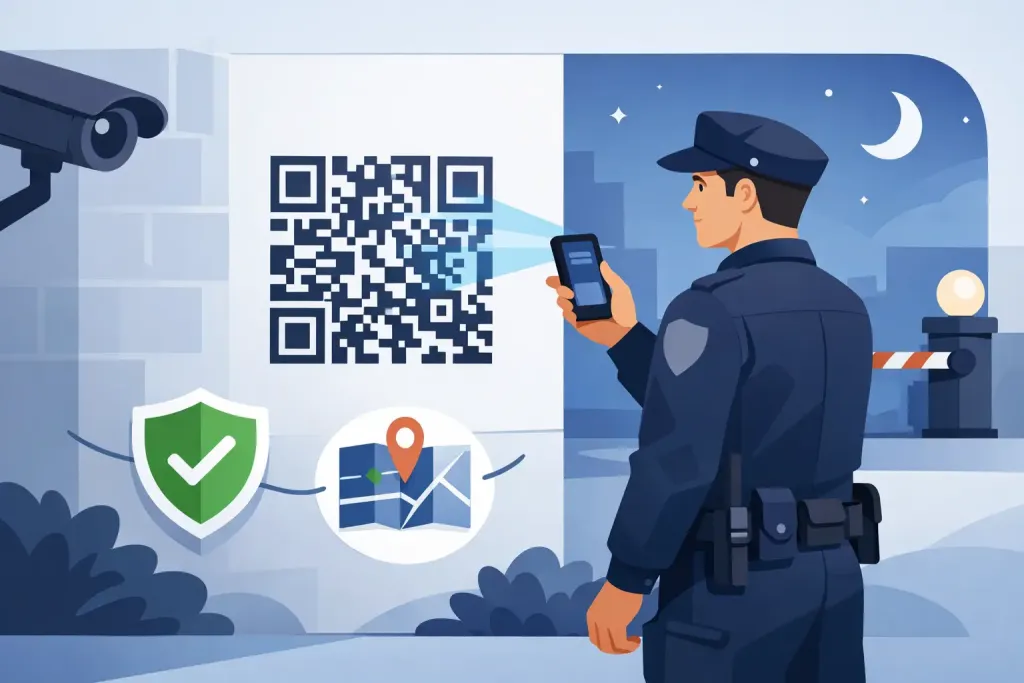
A missed patrol is rarely discovered when it happens. It appears later, after an incident, a client complaint or an audit request, when a paper logbook offers little more than a handwritten claim. So, can QR codes verify patrols? Yes, provided the QR scan is part of a controlled digital patrol process rather than a standalone tick-box exercise.
A QR checkpoint gives a security manager time-stamped proof that a guard using an authorised device scanned a specific checkpoint. Connected to a cloud-based patrol system, that scan becomes a live record: who attended, which checkpoint they reached, when they arrived and whether the patrol followed the expected route. The result is a far more defensible account of service delivery than manual records alone.
What QR code patrol verification actually proves
A QR code placed at a patrol point acts as a physical checkpoint. A guard scans it with a mobile app during a scheduled or ad hoc patrol. The system records the event against the guard, site, route and time, then makes the information available to supervisors and managers.
That creates evidence of presence at a named location. For a warehouse perimeter, this might be the rear gate, loading bay, plant room and fire exit. At a hotel, it could be the service corridor, car park, reception entrance and restricted-access floor. Each completed scan builds a transparent digital record of the patrol.
The strongest systems do more than record a successful scan. They compare the event with the planned schedule and route. If a guard reaches a checkpoint late, misses it completely or scans points in an unexpected order, the manager can see the exception rather than waiting until the end of a shift. This changes patrol verification from retrospective administration into live operational control.
A QR scan does not, by itself, prove that every part of the surrounding area was inspected properly. No checkpoint technology can guarantee a guard looked behind every door or identified every hazard. What it can do is establish reliable evidence that the guard attended the designated control point at a recorded time. Inspection quality is then reinforced through patrol instructions, task prompts, incident reporting and supervisor review.
Can QR codes verify patrols where fraud is a concern?
They can, but the configuration matters. The common concern is that a guard could photograph a QR code and scan it from somewhere else. This is why QR checkpoints should not be treated as the only source of verification on higher-risk sites.
A properly configured patrol platform can add layers of control around the scan. GPS data can help confirm that the device was in the expected area, while device and user authentication associate the activity with the assigned guard. Time-based route rules can flag implausibly quick patrols, repeated scans or checkpoints completed in the wrong sequence. Requiring a photo, note or task response at selected points adds further evidence that the guard completed a meaningful inspection.
For example, a guard scanning a QR code at a construction-site fuel store may also be required to photograph the lock, confirm that fencing is intact and report any signs of unauthorised access. The checkpoint confirms attendance; the task record shows what was checked; an incident report captures any exception. Together, those records provide substantially stronger assurance than a lone QR scan.
Where the risk of copied codes is especially high, organisations can combine QR codes with NFC tags, Bluetooth beacons or GPS-based virtual checkpoints. Each technology has a different role. QR codes are low-cost, quick to deploy and visible to guards. NFC tags require close physical contact with the device. Beacons can verify proximity in areas where a tag may be difficult to access. GPS checkpoints suit large external estates and vehicle patrols, although GPS accuracy is less dependable indoors or around dense buildings.
The right approach depends on the site, the threat profile and the level of evidence required by the client.
From checkpoint scan to live patrol oversight
The practical value of QR verification comes from what happens after the scan. A system should synchronise the record immediately, not leave it stored on a device until the guard returns to base. Managers need visibility while an issue can still be addressed.
A typical QR patrol workflow is straightforward. A supervisor sets the route, checkpoint locations, shift windows and instructions. The guard receives the patrol on their smartphone and scans each QR code as they move through the site. If they find an unlocked door, damaged fence or unsafe condition, they submit an occurrence with photographs, notes and the relevant location. The control room or manager receives the update and can direct an immediate response.
This approach closes several common gaps in physical security operations. It reduces dependence on paper occurrence books, removes the uncertainty of handwritten times and makes it easier to identify missed or late patrols. It also gives site supervisors a current view of patrol status across multiple buildings or contracts without chasing guards by phone.
QR-Patrol combines QR checkpoints with NFC, beacon and GPS options, allowing organisations to apply the appropriate verification method to each part of an estate. That flexibility is useful where one contract includes indoor office floors, external perimeter routes and isolated technical areas with different coverage requirements.
Designing QR checkpoints that support real security work
A QR code is only as useful as the patrol design behind it. Placing codes at convenient locations may produce complete reports while leaving high-risk areas unobserved. Checkpoint planning should begin with the risks the patrol is intended to control.
Consider access points, fire exits, vulnerable assets, areas with poor natural surveillance, lone-working locations and places where hazards can develop between inspections. The route should be practical enough to complete properly, but not so predictable that it creates a routine an intruder could exploit. On some sites, varying the order or timing of checkpoints is sensible.
Checkpoint placement also requires basic physical judgement. Codes should be protected from weather, cleaning damage and casual removal, but still accessible to an authorised guard. Avoid placing them where a scan can be completed from a public corridor if the purpose is to verify an internal inspection. Use clear location names that make sense in an incident report, such as “West loading bay pedestrian gate” rather than “Point 14”.
The instructions attached to each point should be proportionate. A high-value server room may require confirmation of door security, temperature alarms and unauthorised items. A routine corridor checkpoint may only need a presence scan unless an issue is found. Excessive prompts slow the guard and encourage poor-quality responses; too few leave managers without meaningful evidence.
The compliance and reporting value of verified patrol data
Security providers and in-house teams are often expected to demonstrate that contracted patrols took place, incidents were escalated and site procedures were followed. Digital checkpoint records support this requirement with clear, exportable evidence.
For organisations working to BS 7499 principles, verifiable patrol records help demonstrate management oversight, assignment instructions and the monitoring of security officers. They can also support client service-level agreements by showing whether agreed frequencies and routes were completed. When a dispute arises, a time-stamped report is more credible than a reconstructed account at the end of the month.
Data handling still matters. A patrol system records information about employees, locations and sometimes incident subjects. Organisations should define who can access records, how long information is retained and what data is genuinely necessary for the security purpose. GPS tracking should be applied transparently and in line with GDPR obligations, with clear policies for staff and appropriate controls over access to location data.
Where QR patrol verification has limits
QR codes are not the right answer for every checkpoint. They rely on a readable label and a smartphone camera, so damaged, dirty or poorly lit codes can interrupt a patrol. A reliable system should allow guards to report a failed checkpoint and notify a supervisor, rather than forcing them to improvise or skip the location without explanation.
They are also less suitable when the checkpoint must be hidden, when scanning conditions are consistently difficult or when close-contact verification is required. NFC may be preferable in those scenarios. Similarly, a remote perimeter patrol might benefit from GPS verification, while an isolated worker needs panic alarms and man-down protection in addition to route confirmation.
The key is not to ask one technology to solve every operational problem. Use QR codes for what they do well: clear, affordable proof of attendance at defined physical points, supported by live monitoring, task evidence and exception management.
A useful next step is to pilot QR checkpoints on one high-priority route, review the missed-patrol and incident data after several weeks, then refine the route before wider deployment. The most effective patrol verification does not merely prove a guard was there – it helps managers act when security coverage needs attention.