
A missed checkpoint at the rear of a warehouse is rarely just a missed scan. It can mean an unsecured access point, a delayed response to damage, or a client asking whether the patrol took place at all. When comparing NFC tags versus Bluetooth beacons, security managers need to look beyond the technology itself and ask a more operational question: what level of proof, speed and control does each location require?
Both technologies can strengthen guard accountability when connected to a cloud-based patrol system. Each gives managers a time-stamped record of activity and can trigger instructions, forms or alerts at key locations. Their practical difference is how close a guard must be to verify a checkpoint, and that difference affects audit evidence, patrol design and day-to-day reliability.
NFC Tags Versus Bluetooth Beacons: The Core Difference
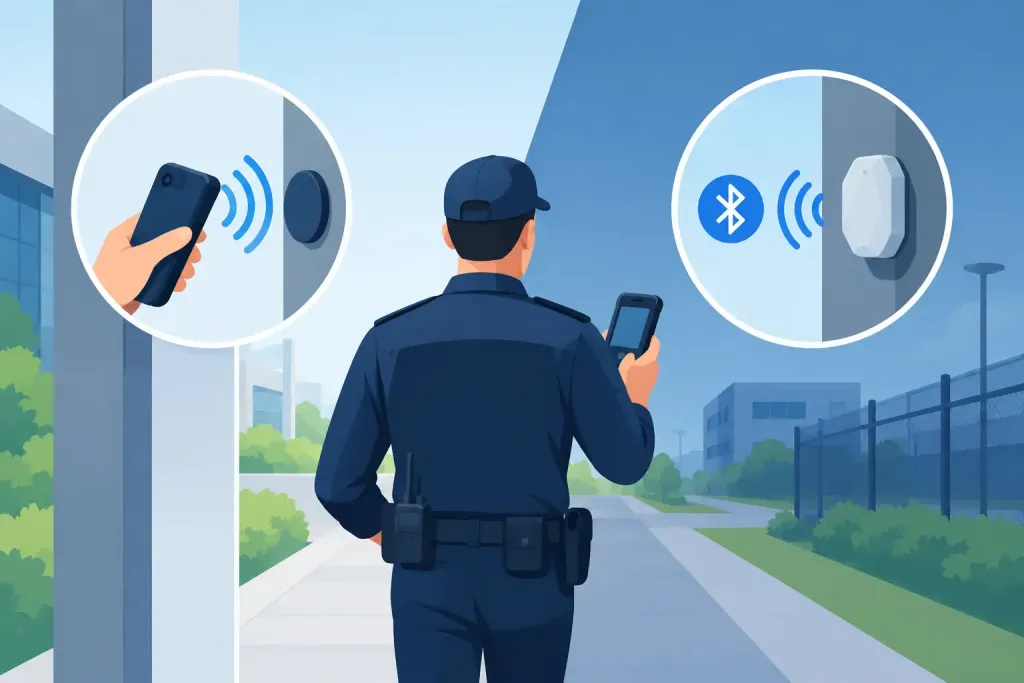
NFC tags use near-field communication. A guard holds a compatible smartphone within a few centimetres of the tag to scan it. This deliberate action creates highly specific proof that the officer reached the physical checkpoint.
Bluetooth beacons transmit a low-energy signal over a wider area. A smartphone running the patrol application can detect the beacon when the guard comes within its configured range. Depending on the workflow, this can record a visit automatically or prompt the guard to confirm the checkpoint.
In simple terms, NFC confirms close physical contact. Bluetooth confirms proximity. Neither is universally better. The right option depends on whether the patrol point demands exact proof of presence or whether hands-free, lower-friction monitoring is more valuable.
When NFC Tags Are the Better Patrol Control
NFC is particularly effective where a site needs defensible evidence that a guard attended a precise location. A tag placed inside a plant room, at a fire exit, beside a key cabinet or on a remote perimeter gate requires the officer to stand directly at that point and scan.
This has clear value for client reporting and compliance. If a client challenges whether a particular door, welfare unit or restricted area was checked, the record can show a defined scan at a specific time. The guard cannot complete the checkpoint simply by walking through a nearby corridor or working from another side of a wall.
NFC tags are also passive. They do not rely on a battery, charging schedule or ongoing radio transmission. Once correctly installed, they are a practical choice for checkpoints across large estates, construction sites and external patrol routes where routine maintenance needs to remain low.
The trade-off is deliberate interaction. The guard must take out the handset and scan the tag. On a standard patrol route, that is often a strength rather than a weakness: it creates a moment to inspect the location, read site instructions and report anything abnormal. But on routes with frequent checkpoints, in poor weather or where officers must keep both hands available, repeated scans can add friction.
NFC also requires thoughtful placement. Tags should be mounted where they are accessible to authorised staff but not obvious or easy to remove. Their location should support the inspection task. A checkpoint intended to confirm a fire door is secure belongs at the fire door, not several metres away on a convenient wall.
Where NFC delivers the strongest evidence
NFC is normally the sensible choice for high-value, high-risk or compliance-critical locations. Examples include lone-worker welfare points, access-controlled doors, rooftop plant areas, hazardous material stores and external gates. It is also well suited to client contracts that specify strict checkpoint verification or require detailed, defensible patrol records.
When Bluetooth Beacons Improve Patrol Execution
Bluetooth beacons are designed for situations where proximity is enough and reducing manual scanning improves patrol flow. They can be effective in reception areas, large internal zones, vehicle yards, loading bays, multi-floor office environments and locations where an officer may be carrying equipment.
A beacon can register that a guard entered a defined area without requiring them to pause and scan a tag. This supports more natural movement through a building and can reduce the chance of missed checkpoints caused by a busy shift, gloves, poor lighting or an awkward scanning position.
For operations managers, this is useful where the patrol objective is to verify coverage of a zone rather than a single asset. A beacon placed in a warehouse aisle, for example, can help confirm that the officer moved through the area. It may be less appropriate if the requirement is to prove inspection of a particular emergency exit at the end of that aisle.
Bluetooth also gives more flexibility in some temporary deployments. Beacons can be positioned quickly for an event, a short-term construction project or an evolving site layout. However, that flexibility must be balanced against battery management and configuration control. A beacon with a depleted battery cannot provide reliable evidence, and an excessive detection range can create false confidence about where the guard actually was.
Range must be configured for the environment
Bluetooth range is not a fixed operational fact. Concrete, metal racking, doors, machinery, layout changes and other radio signals can affect detection. A beacon that performs well in an open office may behave differently in a warehouse, basement or airport service area.
Testing is therefore essential before a beacon-based route goes live. Security teams should verify where the device is detected, whether adjacent rooms are unintentionally included, and whether the chosen range reflects the inspection requirement. A wider range is convenient, but it weakens location precision. A narrow range can improve evidence but may remove the hands-free advantage that led to the choice of beacons in the first place.
Evidence Quality Matters More Than Convenience
The most common mistake is selecting one technology for every checkpoint because it appears simpler to administer. Security operations are rarely that uniform. A patrol route may include a vulnerable external gate, a vehicle yard, a reception area, a boiler room and a lone-worker check-in point. Those locations do not carry the same risk or need the same proof.
NFC is harder to dispute where exact attendance matters. Bluetooth can provide efficient, continuous evidence that guards covered larger operational areas. GPS virtual checkpoints add another layer for outdoor routes or wide estates, though GPS is generally unsuitable for proving attendance at a precise indoor point.
A mixed checkpoint strategy is often the most controlled approach. Use NFC for critical assets and mandatory inspections, Bluetooth for broad coverage zones, and GPS where outdoor location verification is required. The result is a patrol design based on operational risk rather than a compromise forced by a single technology.
Implementation Controls That Protect the Audit Trail
Technology only creates useful evidence when it is supported by clear procedures. Each checkpoint should have a documented purpose: what the guard is expected to inspect, what must be recorded, and what happens if an issue is found.
For NFC, site supervisors should record the exact tag location, inspect tags during routine site checks and replace any damaged or missing units promptly. For Bluetooth, battery status and beacon placement need a defined maintenance schedule. Any relocation, replacement or range adjustment should be logged so historical patrol data remains meaningful.
The mobile application should also make exceptions visible. If a checkpoint is missed, completed late or detected outside the expected route window, a supervisor needs immediate notification and a clear escalation process. A late report reviewed the following morning does not protect a site during the night shift.
QR-Patrol supports NFC, Bluetooth beacon and GPS-based checkpoints within the same mobile patrol workflow, allowing managers to match the verification method to the task. More importantly, checkpoint activity can sit alongside incident reports, photographs, forms, panic alerts and live guard status. This gives the control room context rather than a list of isolated scans.
Choosing for Your Site
Start with the inspection objective. If the question is, did the officer physically check this exact door, asset or restricted point, NFC is usually the stronger control. If the question is, did the officer patrol this defined area while maintaining a safe, efficient workflow, Bluetooth may be the better fit.
Then consider the operating conditions. Remote sites and external routes often benefit from passive NFC tags with no battery dependency. Complex indoor environments may benefit from beacons, provided their real-world range is tested. High-risk environments may require both: a beacon to confirm area coverage and an NFC tag at the critical point where a hands-on inspection must occur.
The right checkpoint is the one that produces credible evidence without distracting guards from the security task itself. Build the route around the risk you need to control, and every scan or detection becomes more than a timestamp: it becomes proof that the right action happened in the right place.
