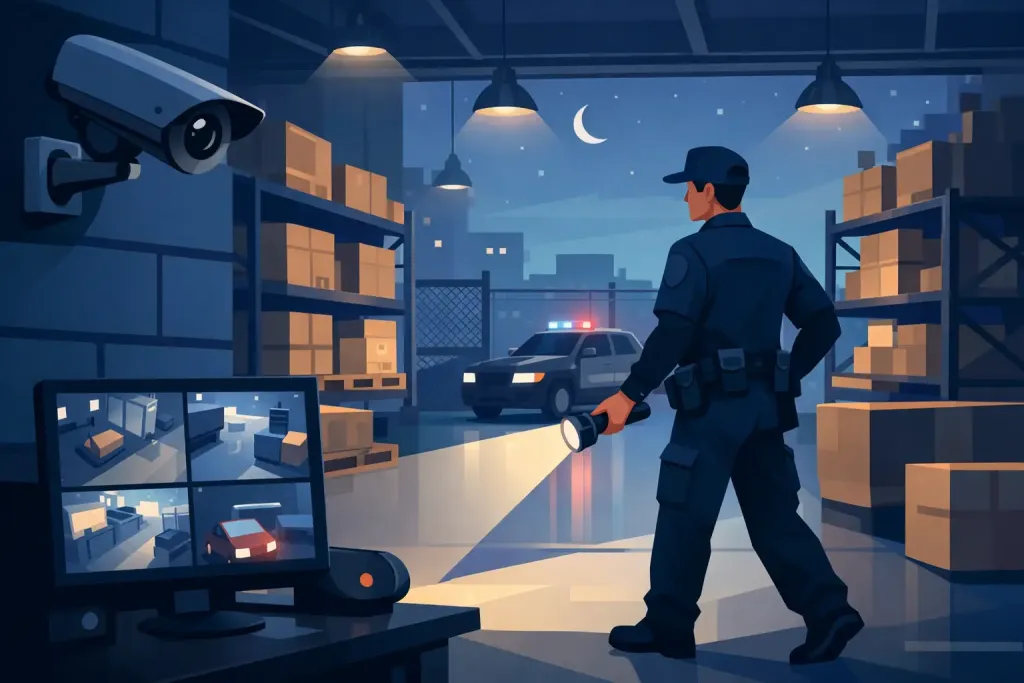
A warehouse can look secure from the gatehouse while critical areas remain unchecked for hours. A loading-bay door is left on a faulty latch, a visitor has entered a restricted zone, or a lone guard has stopped responding in a remote yard. Warehouse security patrols turn those unknowns into a controlled, evidenced routine – but only when every patrol point, exception and response is visible to the people responsible for the site.
For security providers, facilities teams and warehouse operators, the challenge is not simply assigning a guard to walk the perimeter. It is proving that the right checks took place, at the right time, and that emerging risks were acted on before they became a loss, injury or service failure.
Why warehouses need disciplined patrol control
Warehouses have a changing risk profile across every shift. Deliveries arrive early, agency staff move between zones, roller shutters open and close repeatedly, and high-value stock may sit close to access points. The site can also extend beyond the building itself, covering vehicle yards, fuel stores, external cages, plant rooms and parking areas.
Static CCTV and access control are valuable layers, but they do not replace physical verification. Cameras may show that a corridor is empty, yet they cannot always confirm a fire exit is secured, a sprinkler valve room is clear, an emergency light is functioning or a damaged fence has created an access route. A patrol gives the site an active human presence capable of checking conditions, deterring opportunistic crime and escalating defects.
The operational risk rises during quieter periods. Night shifts, bank holidays and reduced staffing can create longer gaps between routine activity. A guard working alone may also face a greater personal safety risk when investigating an alarm, challenging an intruder or entering an isolated external area. Patrol planning must account for both the protection of the premises and the welfare of the person carrying out the work.
What effective warehouse security patrols should cover
A useful patrol route reflects the warehouse’s actual risks, not a generic sequence of checkpoints. It should be reviewed whenever the building layout, stock profile, working hours or contractor activity changes. A site handling pharmaceuticals, for example, may prioritise restricted storage and temperature-sensitive areas. A distribution centre with a large vehicle yard may need more frequent external boundary checks.
Perimeter, access and vehicle areas
Guards should inspect gates, fencing, pedestrian access points, dock doors, barriers and areas where vehicles queue or park. The purpose is to identify forced entry, tailgating opportunities, damaged physical security and suspicious activity before it reaches the building.
External patrols also need to consider practical hazards. Poor lighting, uneven ground, unsecured pallets and reversing vehicles can put a guard at risk. Routes should be safe to complete and should not require a lone worker to enter an area where visibility or communications are poor without defined controls.
Loading bays and dispatch zones
Loading bays are busy, exposed and frequently overlooked once daytime operations end. Patrol checks can verify that doors are closed or alarmed as required, keys are controlled, high-value consignments are secure and unauthorised persons are not waiting within restricted areas.
At dispatch points, guards may also identify signs of attempted theft or process failure, such as broken seals, unaccounted-for stock, abandoned packaging or an open bay outside planned operating hours. Recording the detail immediately protects the integrity of the investigation that may follow.
Internal high-risk and life-safety areas
Plant rooms, server rooms, hazardous materials stores, cages, fire exits, electrical cupboards and sprinkler control areas all require clearly defined checks. The guard does not need to become a maintenance engineer. They do need to recognise and report conditions that require action, such as an obstruction, leak, unauthorised access or damaged door.
A patrol plan should state what good looks like at each location. “Check plant room” is vague. “Confirm door is locked, no water leak is visible, access route is clear and no alarm panel fault is displayed” gives the guard an accountable task and provides managers with meaningful records.
Proof of presence is not the same as a completed patrol
Traditional clocking systems can establish that a guard reached a point. That remains useful, but a time stamp alone says little about what the guard found, what decision they made or whether an issue was resolved. For warehouse operations, the evidence needs to be richer.
A mobile patrol system can require a guard to scan QR codes, NFC tags or other checkpoint technologies at defined locations. The scan confirms presence at the point, while custom instructions guide the required inspection. If something is wrong, the guard can log an occurrence, add photographs, complete a form and notify the appropriate contact without returning to a control room or waiting until the end of the shift.
This creates a clear operational chain: the patrol was due, the checkpoint was reached, the inspection was completed, an exception was recorded and the right person was informed. It also makes missed checkpoints visible while there is still time to intervene, rather than discovering a gap in a weekly report.
There is a balance to strike. Too many checkpoints can encourage rushed scanning and distract guards from real observation. Too few leave blind spots. The right design focuses on critical control points, varies timing where predictable routes create a weakness, and gives guards enough time to investigate and document exceptions properly.
Build a patrol workflow that supports rapid action
A defensible warehouse patrol programme starts before the first checkpoint is scanned. Site supervisors should document the route, expected frequency, escalation contacts, safety controls and any instructions for out-of-hours access. These requirements must be clear enough for a relief officer to follow without relying on informal local knowledge.
During the shift, live visibility matters. If a patrol is overdue, a guard misses a checkpoint or an incident is raised, managers need an immediate alert rather than a paper log reviewed the next morning. Delayed awareness turns manageable faults into longer periods of exposure.
When an incident occurs, the guard should be able to capture the essentials at the scene: time, location, category, observations, actions taken and supporting photographs where appropriate. The report should distinguish fact from assumption. For example, “rear pedestrian gate found open at 02:14; gate secured; no person seen in vicinity; supervisor notified” is clearer and more useful than “possible break-in”.
The final stage is verification. A supervisor reviews exceptions, confirms follow-up tasks are assigned and checks whether repeat incidents point to a wider issue. Repeated door faults may be a maintenance problem. Repeated unsecured bays may indicate a process gap or training requirement. Patrol data should inform operational decisions, not sit in an archive until a client asks for evidence.
Protecting lone workers during patrols
Many warehouse patrols take place with a single officer on site, particularly overnight. This makes welfare monitoring a core security control, not an optional add-on. Guards need a reliable method to raise a panic alarm, report a threat and trigger support if they become injured or incapacitated.
Scheduled welfare checks, man-down alerts and location-aware incident reporting can give supervisors earlier warning when something is wrong. The response procedure must be equally practical. Decide who receives the alert, how they confirm the guard’s status, when police or emergency services are contacted and who can access the premises if a welfare intervention is needed.
Technology supports this process, but it does not remove the need for training. Guards should understand when to withdraw, when to observe from a safe position and when an incident requires emergency escalation rather than direct intervention. No stock loss justifies putting a lone officer into avoidable danger.
Reporting that stands up to scrutiny
Warehouse security is often measured against client SLAs, insurer expectations, health and safety duties and contractual requirements. When theft, damage, injury or an access-control failure is investigated, incomplete handwritten records create uncertainty at exactly the wrong time.
Digital reports provide a consistent record of patrol activity, incidents, acknowledgements and corrective actions. For multi-site operators, standardised reporting also allows managers to compare performance across locations without manually collating different logbook formats. A site with frequent missed external patrols or recurring gate defects becomes easier to identify and address.
Records must be managed responsibly. Photographs, staff details and incident notes can contain personal data, so access permissions, retention periods and handling procedures should support GDPR obligations. The goal is transparent evidence for authorised users, not uncontrolled collection of information.
QR-Patrol brings patrol checkpoints, live activity, incident records, lone-worker safeguards and client-ready reporting into one cloud-based operational view. That gives security managers evidence while the shift is still active, rather than relying on a retrospective account after an incident has escalated.
A warehouse patrol is most valuable when it changes what happens next. Give guards clear inspection standards, make exceptions impossible to ignore and ensure a missed check receives the same attention as a physical defect. That is how routine rounds become a dependable control over people, property and operational risk.