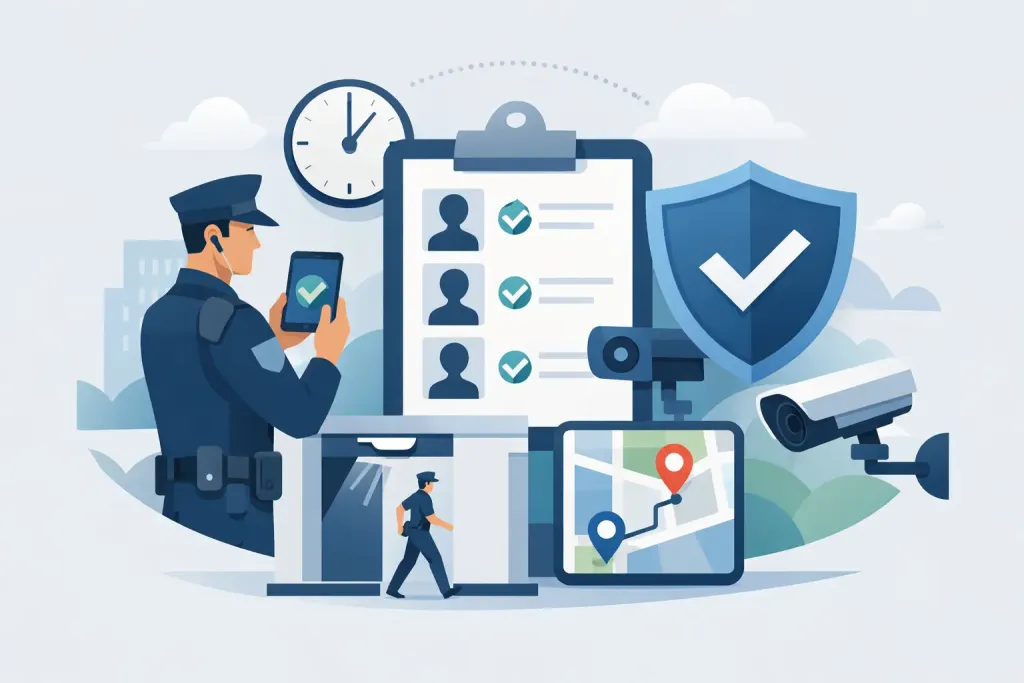
A signed timesheet can show that an officer was rostered. It cannot reliably show what happened after they arrived, whether required patrol points were visited, or whether a missed check was identified in time. What proves guard attendance is a connected, time-stamped record of presence and activity that can stand up to scrutiny from a client, manager, insurer or auditor.
For security providers and in-house teams, attendance is not merely a payroll question. It is evidence that a contracted service was delivered, a risk control was active and the site was under appropriate supervision. The strongest proof combines verified checkpoint activity with live operational context.
What proves guard attendance in practice?
No single data point proves every aspect of guard attendance. A GPS position may indicate that a phone was near a site, but it does not confirm that the officer inspected the plant room, fire exit or perimeter gate. A QR scan confirms interaction with a physical point, but on its own it may not explain why a check was late or whether an issue was found.
Defensible proof is created when several records agree: the scheduled shift, the officer identity, a checkpoint scan, a precise timestamp, location validation where appropriate, and the actions recorded during the round. Together, these records provide a clear answer to the questions that matter: who attended, where they attended, when they attended and what they did.
A modern patrol management system should capture this information as work happens, rather than asking officers or supervisors to reconstruct a shift at the end of the day. Immediate cloud synchronisation gives control room staff and site managers live visibility, while preserving a consistent audit trail for later reporting.
The evidence that carries operational weight
A verified officer identity
The record must be tied to the individual assigned to the shift. Secure app login, managed user accounts and role-based access help establish which officer performed the activity. This matters when several officers work the same site, when relief cover is introduced at short notice, or when an investigation requires a reliable account of responsibility.
A record labelled only with a site name and time is weak. A record connected to an identified officer, a defined tour and an approved schedule is much more useful. It allows supervisors to distinguish a genuine handover or approved reassignment from an unplanned absence.
Time-stamped checkpoint scans
Physical checkpoints remain one of the most practical forms of proof. QR codes, NFC tags and Bluetooth beacons can be positioned at locations that officers must inspect: access gates, welfare areas, loading bays, restricted corridors, plant rooms and vulnerable perimeter points.
When an officer scans a checkpoint through a patrol app, the system records the exact time and the checkpoint identity. Managers can compare the result with the planned route and frequency. This turns a vague claim that patrols were completed into a chronological record of each required visit.
Checkpoint placement matters. Tags should sit at meaningful inspection points, not simply where they are easy to scan. A tag inside a loading bay is stronger evidence of a loading-bay check than one placed at the entrance to the building. Sites should also protect tags from tampering and include their condition in routine reviews.
Location data matched to the task
GPS-based virtual checkpoints are particularly valuable for open sites, large estates, construction projects and remote locations where installing physical tags is impractical. They can confirm that a guard reached a defined geographic area and can support exception alerts when a patrol is outside its expected route.
Location data has limits. Accuracy can reduce indoors, beneath dense structures or in poor signal areas. It should therefore support, rather than replace, physical verification at high-risk internal locations. The appropriate mix depends on the site: a warehouse may use NFC at critical doors and GPS for external perimeter patrols, while a dispersed property portfolio may rely more heavily on virtual checkpoints.
Task completion and condition checks
Attendance only proves presence. Security managers also need evidence that the officer completed the purpose of the visit. Digital tasks and custom forms connect a checkpoint to the required action, such as checking that a fire exit is secure, confirming contractor access controls, recording a temperature reading or inspecting a vacant unit for damage.
This is where a patrol record becomes a service record. An officer can confirm the result, add comments and, where needed, attach photographs. If a gate is unsecured, the record should show more than the fact that the guard reached it. It should show the fault, the escalation and the action taken to reduce risk.
Incident and escalation records
An incident report is not proof that an entire shift was completed, but it is a critical part of the operational picture. It records the circumstances discovered by the officer, the time of discovery, supporting images or notes, and the response initiated.
Immediate notifications make that information actionable. If an officer reports forced entry, a safety hazard or a failed access-control point, the right supervisor can be alerted while the incident is still developing. In a later review, the organisation can demonstrate both attendance and reasonable response.
Exception records, not just successful scans
A system that records only completed patrols can hide the very issues managers need to manage. Missed, late and out-of-sequence checkpoints should be visible as exceptions, with a reason recorded where one is available. A delayed scan may be justified by an emergency, a client request or an officer supporting a colleague. It may also reveal a coverage gap or missed patrol.
Transparent exception handling protects good officers as well as clients. It gives supervisors the opportunity to investigate the facts instead of relying on assumptions, and it creates a permanent record of the decision taken.
Why paper logs and basic clocking fall short
Paper occurrence books and handwritten patrol sheets have a place as contingency measures, but they are vulnerable to delayed entry, incomplete detail and retrospective completion. A supervisor may struggle to establish whether a round was performed at 22:00 or simply written down after midnight. Searching historic records is slow, particularly across multiple locations.
Clocking systems have a different limitation. They can confirm that someone clocked in at a site entrance, but they do not provide evidence of patrol coverage across the site. For client-facing security contracts, this distinction is significant. The agreed service usually concerns specified checks, frequencies and response expectations, not simply an officer standing at the front gate.
Digital records are not valuable because they remove all human judgement. They are valuable because they make the operational facts visible early enough to act on them, then preserve those facts consistently for reporting and review.
Building a defensible attendance process
Start by defining what attendance needs to prove at each site. A corporate reception may require confirmation of opening and closing checks, visitor-management tasks and periodic floor patrols. A distribution centre may need evidence of trailer-yard checks, perimeter inspections and key control. A lone-worker assignment may also require scheduled welfare check-ins and a tested escalation path.
Set routes and checkpoint frequencies around risk, contract requirements and practical patrol times. Overloading a route with unnecessary scans can encourage rushed behaviour; too few checkpoints create blind spots. Supervisors should walk the route, test mobile coverage and decide where QR, NFC, beacon or GPS verification provides the most credible evidence.
Then establish a clear response process for exceptions. Decide who receives alerts, what constitutes an overdue patrol, how relief cover is recorded and when an incident requires client notification. This is as important as the technology itself. Live data only improves security when someone has ownership of the response.
Finally, retain records in a format that can be understood outside the control room. Client reports should show planned versus completed activity, exceptions, incidents and corrective action in plain language. For audits and disputes, the record should be exportable, time ordered and protected by appropriate access controls.
Attendance evidence, privacy and compliance
Location and activity records are operationally necessary in many security roles, but they must be managed proportionately. Organisations should be clear with officers about what data is collected, why it is collected, who can access it and how long it is retained. That supports GDPR obligations and helps maintain trust with the workforce.
The objective is not indiscriminate surveillance. It is accountable delivery of a safety-critical service. When the data is limited to legitimate operational purposes, access is controlled and retention is governed, attendance records support both workforce fairness and client assurance.
Platforms such as QR-Patrol bring schedules, checkpoint verification, live monitoring, incident reporting and lone-worker safeguards into one operational record. That gives managers a clearer view of whether guards are safe, present and completing the work the site depends on.
The practical test is simple: if a client asks for evidence of a patrol at a specific time and place, your team should be able to show the verified record, the outcome of the check and any response taken within minutes. If that answer currently depends on memory, a handwritten sheet or a phone call, the site still has an accountability gap worth closing.