
Modern-day security scenarios are more demanding than ever before, and UK companies are struggling to protect their employees, assets, and enterprises. Professional security patrols would be one of the most effective ways of doing this. Not every patrol is the same. Learning about types of patrol in security can serve the purpose of business owners and security managers in organising the necessary solutions that fit their needs. This blog post provides a detailed explanation of the methods implemented, such as security foot patrols and mobile and remote technology, in a variety of businesses in the UK.
What is Security Patrolling?
Security patrolling refers to active surveillance of a particular area with the view to ensuring that threats are discouraged, suspicious activities are observed, and incidents are handled on time. Patrolling can be either preventive or responsive, and it is part of regular security patrols within professional security plans.
The very presence of patrolling security officers creates a psychological deterrence towards criminal acts in most cases. Moreover, they conduct security guard patrols so that facilities, assets, and vulnerable access points are always kept under check. Patrolling can be done at regular intervals, randomly or on a requirement basis, as per the security plan.
What are the Different Types of Patrol in Security?
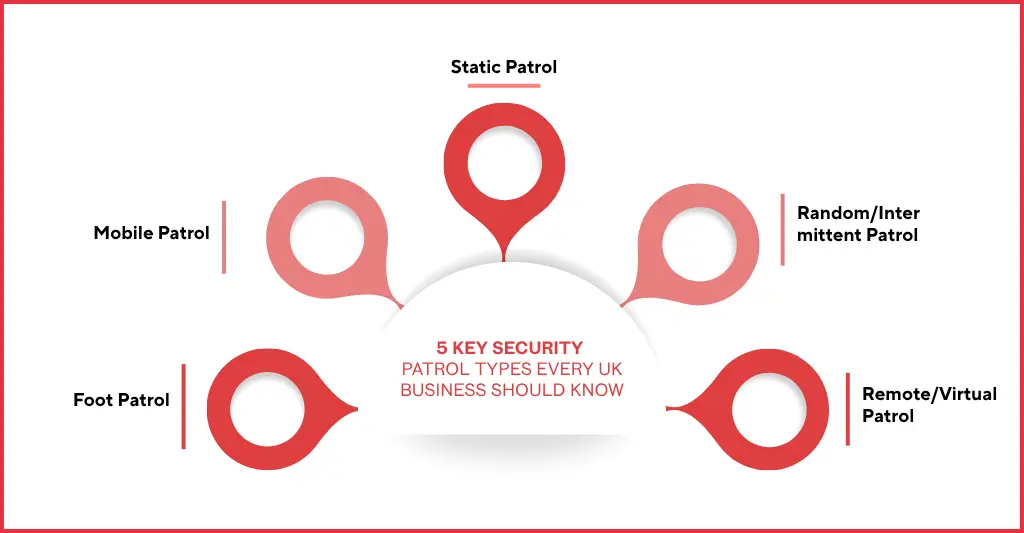
The variety of security patrols is several, as they cater to various operational and environmental requirements. The most frequently used types of patrol in the UK security are as follows:
1. Foot Patrols (Security Foot Patrols UK)
Foot patrol refers to security guards on patrol walking along predetermined areas to ensure that they monitor activities and detect any anomalies, as well as reach out to strangers or the staff. The innovative aspect of such patrols is that they work well where the presence of the police is necessary.
- Common sites: malls, offices, schools and hospitals.
- Advantages: Meticulous attention to the area, high level of visibility, ease of acquainting more people.
2. Mobile Patrols (Mobile Security Patrols UK)
Mobile patrol is done through vehicles, e.g. through the use of security cars, motorcycles or bicycles. The guards are able to patrol more areas within a given timeframe, and this is suitable when the business premises are large.
- Common sites: industrial parks, distribution centres, unoccupied buildings, and gated communities.
- Advantages: fast deployment capability in case of an incident, coverage of expansive areas, and amicable shifts.
3. Static Patrols
Also known as fixed-point security, the static patrols are the deployment of guards in designated locations, like gates, reception desks or CCTV monitoring rooms. These guards will be mainly stationary, but periodic checks of the perimeter may be conducted.
- Common sites: Include corporate offices, construction entry points, and banks.
- Advantages: Possibility to manage access points, permanent observation of sensitive areas.
4. Random/Intermittent Patrols
Random or not regularly scheduled patrols keep offenders from being able to forecast the security patterns. They are especially efficient when it comes to preventing planned offences.
- Common sites: shopping malls, warehouses and parking.
- Advantages: Unpredictability, failure to cover blind spots, and low cost.
5. Remote and Virtual Patrols
Together with the technology of security patrol in the UK, remote patrols on the basis of cameras, motion sensors and monitoring software became popular. Patrolling security officers can observe the area at a central point and act through the communication channels or through the deployment of physical security.
- Common sites: Data centres, off-site warehouses, intelligent buildings.
- Advantages: Standby, inexpensive, scalable.
Industry-Specific Patrols Common in the UK
The various industries in the United Kingdom have different risks and operational issues, which determine the type of patrol:
- Retail: An emphasis on shoplifting detection, the safety of customers, and stock prevention. CTV-connected, remotely controlled patrols are usual, as well as foot patrol security.
- Construction: Mobile and random patrols are regularly conducted to prevent theft of the tools and materials when the construction is not in operation.
- Logistics: Security officer patrols, Mobile Patrol and vehicle inspections will be used to ensure the supply chain security.
- Hospitality and Events: Foot patrols with interaction with clients, particularly in festivals, concerts and hotels.
- Education: Security guard patrols are in place to provide security on and off campus grounds to the students and staff.
Every single industry needs a custom model for security with a detention of visibility, responsiveness and technological interface.
Role of Technology in Modern Security Patrolling

Use of Guard Tour Systems like PLM Group’s QR Patrol
The application of technology has essentially changed the forms in which planning, conducting, and management of security patrols occur. Among such remarkable innovations in the UK is the QR code-based system of touring guards available courtesy of service providers such as PLM Group.
With systems like QR Patrol, guards scan QR codes placed strategically across patrol routes using a mobile device. Each scan is timestamped and recorded in the system’s dashboard.
Beyond QR codes, the system also supports other technologies such as NFC, Beacon, and Virtual Checkpoints. Virtual Checkpoints work by using GPS-defined locations instead of physical tags, allowing guards to perform scans when they enter a specified area. This makes them particularly useful in environments where physical installation is not possible, such as large open sites or temporary locations. The scans can be triggered automatically based on location or manually through the app, providing a flexible and efficient way to monitor patrols without compromising accuracy
Benefits of Security Guard Tour Systems UK:
- Real-time tracking of patrolling security guards.
- Automated incident reports are sent instantly to managers.
- GPS and NFC integration for accurate location data, including Beacon and Virtual Checkpoints.
- Performance tracking to ensure guard compliance.
- Cloud-based management for remote oversight.
The tools enhance transparency and accountability to the point that the response time to security issues is also faster, as supervisors are notified immediately if there is a problem.
Compliance and Licensing for UK Security Patrol Staff
In the UK, all individuals working in security-related jobs in patrolling need to be able to meet regulatory requirements that are provided by the Security Industry Authority (SIA).
Key Legal Requirements:
- SIA Licence: Guards need to have a valid SIA licence to work as security guards (or public space surveillance).
- Training: A post-completion training programme, which includes the modules of conflict management, patrolling methods, and emergency response, must be attended by the candidate.
- Background Checks: It is mandatory to do a criminal record check through the Disclosure and Barring Service (DBS).
- Company Compliance: The security companies will have to comply with the British Standard 7499 on their security guard services.
Failure to comply may lead to financial penalties or even a restriction on the activities, and it is vital that companies deal with recommended companies only.
Why UK Businesses Should Invest in Security Patrol Solutions
Security patrols are no more a luxury; in this day and age of threats, it is a need of the business.
Top Reasons to Invest:
- Enhanced Deterrence: Thieves, vandals and anti-social behaviour are deterred by the presence of visible patrols.
- Quick Response Times: Patrol would be able to see and respond to incidents before the situation blows out of control.
- Improved Insurance Ratings: Insurers usually offer lower insurance rates in properties which have patrolled systems which are verified.
- Digital Records and Audits: Guard tour systems can provide evidence of an activity, which can be useful in the course of an investigation or audit.
- Reputation Management: A secured business generates customer confidence and stakeholder confidence.
Frequently Asked Questions (FAQs)
How should a warehouse in a remote location in the UK be patrolled?
A combination of mobile security guards and remote surveillance solutions monitoring would be preferable, as this will provide both real-world, physical safeguarding and remote surveillance.
Is it possible to monitor the location of my security guards patrolling?
Yes. Mobile solutions such as QR Patrol employ the use of GPS and real-time monitoring dashboards so that you can track the movement of the security officer patrols.
Do the laws in the UK require security patrols?
Not always. Regulations, however, may require you to reach particular security standards depending on your type of industry (e.g., events, high-risk construction).
How can I determine whether a patrol guard is doing his or her work?
Security guard tour systems in the UK allow you to get real-time updates and historical logs, so you can easily confirm that patrols have been performed or identify gaps.
Conclusion
Security threats are constantly changing, and so is your response to them. UK businesses can also take smarter and more efficient solutions as they understand the kinds of patrols in security. All businesses, large and small, have security needs and can benefit in various ways depending on need and industry; foot patrol security services in the UK keep charge of security coverage on the ground, mobile security patrols in the UK give full area coverage, and the incorporation of new technology watches over security patrol in the UK.
To have a security that can be ahead of the future, invest in the current security patrolling tools, abide by the UK laws, and personalise your strategies with respect to the particular risks that your business has. The correct patrol plan is not only a security measure on your premises, but it is also about your success.