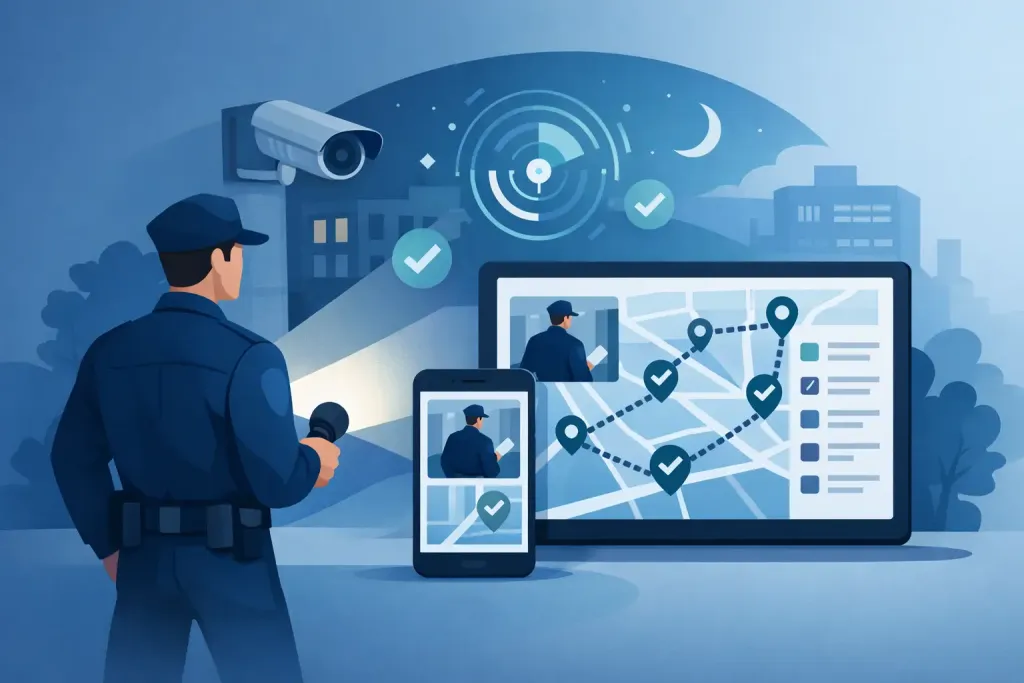
A missed patrol is rarely just a missed checkpoint. It can mean an unsecured access point, an overlooked fire door, a lone worker without support, or a client asking why there is no evidence that a contracted service was delivered. Real time patrol monitoring replaces assumptions with live operational facts: who is on site, which checkpoints have been completed, what has been found and whether action is under way.
For security companies, facilities teams and in-house departments, that visibility changes the way patrols are managed. Supervisors no longer have to wait until the end of a shift to discover a route was incomplete or an incident report was never submitted. They can see exceptions while there is still time to intervene.
Why paper logs and offline tours leave gaps
Paper occurrence books and traditional guard tour devices can confirm activity only after records have been collected, reviewed and interpreted. By then, the opportunity to correct a missed round or respond to an escalating issue may have passed. A handwritten entry can also be incomplete, difficult to read or impossible to verify against the time and location of the event.
Offline systems improve consistency at the checkpoint, but they still create a delay between the patrol and management awareness. That delay matters at a busy warehouse, a construction site after hours, a remote industrial facility or a multi-building estate. Security threats do not follow reporting schedules.
Real-time oversight creates a more useful control point. A manager can identify an overdue checkpoint, contact the officer, assess the reason for the exception and record the response. The objective is not to monitor staff for its own sake. It is to maintain service standards, protect people and preserve a defensible record when something goes wrong.
How real time patrol monitoring works
A practical system connects field activity directly to a central management platform. Guards use a smartphone application to scan a checkpoint as they complete their route. Depending on the environment, checkpoints can be QR codes, NFC tags, Bluetooth beacons or GPS-based virtual locations.
Each verified scan records the relevant time, location and officer identity, then synchronises the result to the cloud. Managers can view patrol progress through a live dashboard, receive alerts for exceptions and review completed rounds without chasing paper forms or collecting dedicated readers.
The same workflow can capture much more than presence. An officer can report a damaged perimeter fence, a blocked emergency exit, a suspicious vehicle or a faulty light at the point of discovery. Photographs, notes, categories and follow-up actions can be attached to the incident record, creating evidence that is clearer than a retrospective narrative written at the end of a shift.
Proof of presence needs context
A checkpoint scan is valuable because it establishes that an officer attended a specific place at a specific time. However, attendance alone does not prove that the site was secure. The stronger operational model combines checkpoint verification with tasks and observations.
For example, a patrol at a plant room may require the officer to verify the door is locked, check for leaks and confirm that no alarms are active. At a loading bay, the task may be to inspect vehicle access controls and report unauthorised parking. This gives clients and managers evidence of the service outcome, not just the route taken.
There are sensible limits. GPS is useful for open areas, large estates and vehicle patrols, but its accuracy can be affected indoors or around dense buildings. Fixed QR or NFC checkpoints offer more precise confirmation at a door, gate or critical asset. The right approach often combines technologies according to the risk profile of the site.
Live exception management improves response
The most valuable information is often the information that shows something did not happen as planned. A patrol may be late because an officer is dealing with an incident. A checkpoint may be missed because access is obstructed. Or an officer may fail to respond because they need immediate assistance.
A live monitoring platform should distinguish these situations quickly. Automated notifications can alert the appropriate supervisor when a route is overdue, a task remains incomplete or an incident is raised. The supervisor can then make an informed decision: contact the guard, send relief, escalate to site management or initiate emergency procedures.
This is particularly significant for lone workers. Regular welfare checks, man-down alerts and panic alarms provide an additional layer of control where guards work alone, at night or in isolated locations. Technology does not remove the need for clear procedures and trained supervisors, but it shortens the gap between a problem occurring and someone being able to act.
A better record for clients and audits
Security contracts are judged on more than whether a guard was visibly present at the gate. Clients expect evidence that agreed patrol frequencies, inspection points and reporting standards have been met. When an incident occurs, they need a credible chronology of what was seen, reported and done next.
Digital patrol records provide that chronology. Managers can produce reports showing completed rounds, missed or late checkpoints, incident details, photographs, task responses and acknowledgement times. A digital occurrence book also creates a continuous record across shifts, preventing important information from being lost in handovers.
For organisations working to BS 7499 expectations, client service-level agreements and health and safety duties, consistency is central. Records must be accessible, accurate and retained appropriately. Cloud-based systems support this need, but they must also be configured responsibly. Access controls, retention policies and lawful handling of personal data are essential for GDPR compliance.
Implementing patrol monitoring without disrupting operations
The strongest rollout starts with operational design, not with device settings. Identify the areas that matter most: vulnerable entrances, fire exits, plant rooms, perimeter gates, welfare points, high-value assets and locations where incidents have previously occurred. Then define what officers should check and what constitutes an exception.
Avoid turning every route into a lengthy sequence of low-value scans. Too many checkpoints can encourage rushed behaviour and create alert fatigue for supervisors. Too few can leave critical risks unverified. Patrol frequency and route design should reflect the site’s hours, public access, incident history, asset value and the consequences of failure.
Before launch, agree who receives alerts and what they are expected to do. An overdue patrol notification is only useful if it reaches someone authorised and available to respond. Test mobile coverage in basements, plant areas and remote parts of the estate, and establish an appropriate process for temporary connectivity loss.
Training should cover more than scanning a tag. Officers need to understand why accurate incident categorisation, clear notes and timely escalation matter. Supervisors need confidence using the live view, reviewing exceptions and closing actions. QR-Patrol supports this smartphone-first model by bringing patrol verification, incident reporting, lone-worker safeguards and reporting into one operational platform.
Turning data into better site control
Once patrol records are collected consistently, they can reveal patterns that are difficult to see in isolated reports. Repeated incidents at one entrance may justify a change to lighting, access control or patrol timing. Frequent late patrols may indicate an unrealistic route, inadequate staffing or a recurring operational obstruction.
Use this information carefully. Data should drive practical improvement, not automatic blame. An exception can expose poor performance, but it can also reveal a legitimate conflict between duties, such as an officer assisting a visitor during a scheduled round. Managers should review the context before making decisions about individuals or contract performance.
The operational value comes from closing the loop. Assign corrective actions, record who owns them, confirm completion and use the next patrol to verify that the issue has been resolved. That is how live information becomes a safer, more accountable site.
A patrol is only as reliable as the evidence behind it and the response that follows it. When managers can see activity as it happens, support officers when they need it and show clients exactly what was delivered, security operations become easier to manage and harder to dispute.