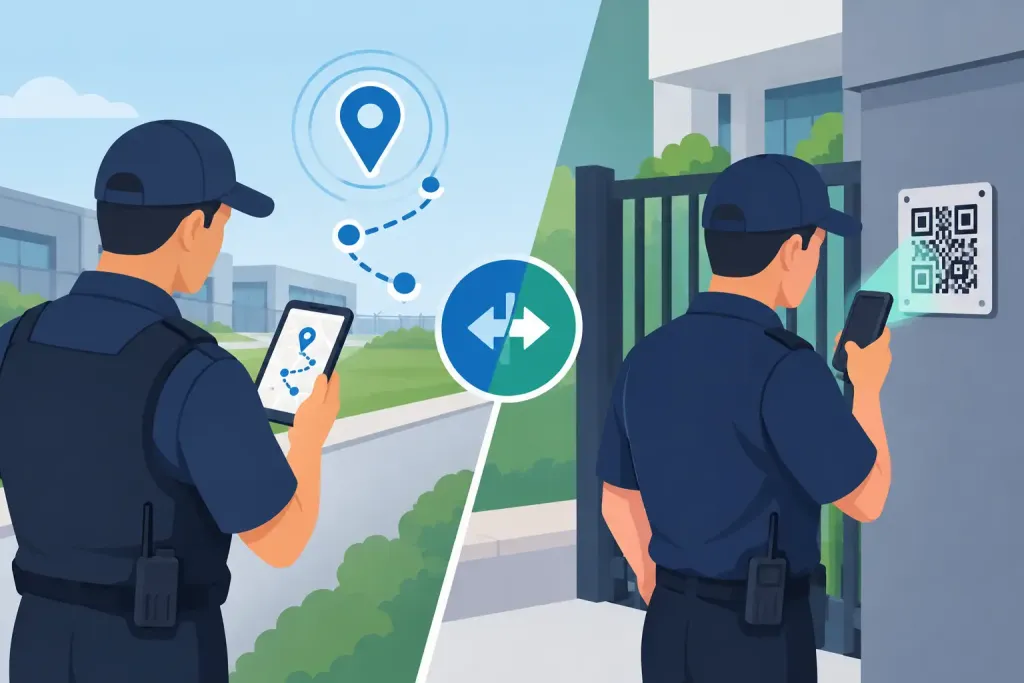
A guard reports a completed perimeter patrol, but the site manager still has one critical question: was the officer at the required inspection point, or merely somewhere nearby? That is the practical distinction behind GPS checkpoints versus QR codes. Both can strengthen patrol accountability, but they prove different things and suit different operating conditions.
For security teams managing client SLAs, lone workers, high-risk areas and multiple sites, the decision should not be driven by convenience alone. It should be based on the level of evidence required, the physical environment, the risk of checkpoint tampering and the speed at which managers need to act on missed activity.
GPS checkpoints versus QR codes: what each proves
A GPS checkpoint is a virtual location defined by latitude and longitude, usually with an acceptable radius around it. When a guard reaches that area and records a checkpoint through a mobile patrol app, the system captures the time, location and officer activity. It is particularly useful for proving attendance at open areas where there is no practical place to install a physical tag.
A QR code checkpoint is a printed code placed at a specific physical location. The guard scans it using a smartphone camera, creating a time-stamped record tied to that exact code. Because the officer must stand close enough to scan it, a QR code provides stronger evidence that they reached the intended door, plant room, fire panel, gate or equipment point.
This difference matters. GPS can show that a guard was within a defined zone. A QR code can show that the guard scanned the designated checkpoint. Neither method is automatically superior. The right control depends on what must be inspected and what evidence a client, auditor or incident investigator will expect to see.
Where GPS checkpoints are the stronger operational choice
GPS checkpoints are designed for work that moves across broad, open or changing areas. They remove the need to attach a code to every patrol point and can be deployed quickly through the management platform.
They are often the better option for external patrol routes, construction projects, large estates, car parks, rural assets and temporary security operations. A site supervisor can create a virtual checkpoint at a vulnerable boundary, a vehicle entrance or a remote storage area without waiting for physical materials to be installed.
GPS also supports flexible patrol design. If a construction site expands, fencing moves or a temporary access route changes, managers can amend the virtual point immediately. This is valuable where routes evolve frequently and fixed checkpoint locations would create unnecessary administrative work.
For mobile response teams, GPS can provide useful context beyond the patrol event itself. Managers can see whether an officer is approaching a location, has entered the expected area or has been stationary longer than planned. When paired with real-time notifications, this helps control rooms identify missed checks and potential welfare concerns before they become an operational failure.
GPS does, however, have limits. Location accuracy can be affected by building materials, dense urban areas, poor mobile signal, device settings and satellite visibility. A GPS record at a loading yard may be entirely appropriate. A GPS record for a specific electrical cabinet inside a warehouse is far less convincing.
When QR codes deliver better proof of presence
QR codes are best where the patrol point is precise and the task matters. A code placed inside a locked plant room, beside a fire exit, on a rooftop access door or at a vulnerable gate requires the guard to physically reach that location to complete the scan.
That proximity creates a clear, defensible audit trail. If a client disputes whether a checkpoint was visited, the record identifies the exact code scanned, the officer who scanned it and the time of completion. It is straightforward evidence for contract reporting, service reviews and investigations into missed patrols.
QR codes are also highly effective indoors. GPS may struggle to distinguish between floors in an office block or between adjoining units in an industrial estate. A well-positioned QR code removes that uncertainty. It tells managers that the officer was at the specific checkpoint, not simply within the general building footprint.
The technology is simple to deploy. Codes can be printed, positioned and assigned to routes without dedicated reader hardware. Guards use the same smartphone that supports incident reporting, task completion and safety features, reducing the need to carry separate devices.
The trade-off is physical management. Codes must be positioned sensibly, checked during site inspections and replaced if they are damaged, obscured or removed. They should not be installed where a guard can scan them without carrying out the intended inspection. A QR code beside a doorway, for example, may prove the doorway was reached, but not that the perimeter beyond it was checked.
QR code security depends on placement
A QR code is only as credible as its deployment. Security managers should place codes at the point where the task must be performed, not at the easiest place to scan. For a fire door check, that may mean placing the code where the officer must view the door condition. For a generator inspection, it should be close enough to require a meaningful visual check.
It is also sensible to inspect checkpoint condition as part of routine supervisory visits. If a code is damaged or missing, the system should prompt a clear exception process rather than encouraging guards to bypass the point without recording why.
Accuracy is not the only decision factor
The question is not simply whether GPS or QR codes are more accurate. It is whether the evidence matches the operational risk.
A remote boundary patrol may only require proof that an officer entered a defined area at the required time. GPS is proportionate and efficient. A pharmaceutical store, restricted server room or critical fire safety point may require evidence of attendance at one exact location. QR codes are usually the more suitable control.
Consider these four factors before deciding:
- Site environment: GPS performs best outdoors with clear satellite visibility. QR codes are dependable indoors, underground and in areas with complex layouts.
- Required evidence: Use QR codes when you need proof of attendance at a specific object, room or access point. Use GPS where a verified zone is sufficient.
- Route stability: GPS suits temporary or frequently changing patrol locations. QR codes suit permanent checkpoints with repeatable routines.
- Risk and response: Higher-risk tasks benefit from a physical checkpoint scan combined with mandatory instructions, incident reporting or photographic evidence.
For many organisations, the strongest answer is not an either-or choice. A layered patrol design combines QR codes at critical fixed points with GPS checkpoints for wider grounds, vehicle routes and temporary areas. This gives managers practical coverage without trying to force one technology into every environment.
Build patrol evidence around the task, not the technology
A checkpoint confirms presence. It does not automatically confirm that the guard completed a meaningful inspection. The patrol workflow should make the required action clear.
At a QR-coded fire exit, for example, the guard may need to confirm that the route is unobstructed, the door is secure and signage remains visible. At a GPS-marked perimeter area, they may be required to check fencing, gates, lighting and signs of intrusion. If an issue is found, the officer should be able to raise an incident immediately, add notes and images, and alert the right manager.
This creates a complete operational record: the guard arrived, completed the expected check, recorded the result and escalated exceptions without delay. That is far more valuable than a standalone scan history, particularly when demonstrating service delivery to clients or reviewing an incident after the event.
QR-Patrol supports this blended approach by allowing teams to use GPS-based virtual points alongside QR codes, NFC tags and beacons within the same cloud-managed patrol operation. Managers can apply the technology that fits each location while retaining one live record of patrols, tasks, incidents and officer activity.
Privacy, policy and compliance require the same care
GPS tracking involves personal data when it can identify an individual guard’s location. Organisations should be transparent about what is collected, why it is needed, when monitoring applies and how long records are retained. A clear workforce policy and proportionate configuration help support GDPR obligations while protecting staff safety and service quality.
The same principle applies to QR code records. Patrol data should be retained for a defined operational and contractual purpose, with appropriate access controls. For security providers working to BS 7499 expectations or client-specific SLAs, reliable time-stamped records can provide valuable evidence, but only when the data is complete, accessible and properly governed.
Managers should also plan for exceptions. A flat phone battery, damaged QR code or weak GPS signal should be recorded as an exception, not hidden in a paper note after the shift. Supervisors need live visibility of failed or overdue points so they can verify the situation, deploy support where needed and preserve the audit trail.
The best checkpoint strategy makes it easy for guards to do the right thing and difficult for missed activity to go unnoticed. Choose GPS where geographical presence is the control that matters. Use QR codes where exact physical attendance is non-negotiable. Then connect both methods to clear tasks, immediate escalation and manager oversight, so every patrol record can stand up when it is needed most.