Mobile patrolling is not a casual stroll around the property but a proactive security approach designed to identify risks, deter threats, and close security gaps before they escalate, and it is important.
Imagine you are securing an industrial site with a static guard posted at entry points, cameras monitoring main zones, and access logs. Things look perfect on paper until minor incidents like an unlocked gate keep coming up. That shows you that static presence is not enough. Once you implement mobile patrolling, your guards will be patrolling across the site on scheduled or random routes, keeping an element of surprise for criminal elements.
In 2026, clients don’t just want guards; they want accountable, visible, and proactive security. Mobile patrolling delivers exactly that.
What is Mobile Patrolling in Security?
Mobile patrolling is a flexible approach to guarding properties through scheduled or random patrols by security guards. Unlike static security guards, a mobile security guard will keep moving, covering multiple sites within the premises.
Key points:
- Guards can patrol on foot, bicycle, or in vehicles, depending on the site
- Routes are pre-defined but randomised to prevent predictable patterns
- Patrols are often tracked with guard tour patrol system using digital tools like QR codes, GPS tracking, or mobile apps
The goal of mobile patrolling is to detect threats, document observations, and deter criminal activity through visible, active presence.
What Actually Happens During a Mobile Patrol
Mobile patrols are planned yet flexible. Here’s what typically happens during a patrol shift.
- Checkpoints and Route Start: Guards will start from a designated start point and will keep scanning at checkpoints installed across the premises via mobile devices or QR codes to log their presence.
- Active Site Monitoring: Under mobile patrol, guards will conduct random inspections of perimeter fences, doors, and equipment, especially in high-risk areas.
- Incident Reporting: During patrolling, if guards find any irregularities like an unlocked door or suspicious activity, then it will be logged instantly with time stamps, photos, and notes.
- Communication: Supervisors will receive real-time alerts from guards when an incident is taking place, enabling them to send back up quickly.
- Patrol Completion: Once the patrolling is done, a digital report will be generated automatically, which can be shared with your clients for transparency and auditing purposes.
Key Duties of Mobile Patrol Officers
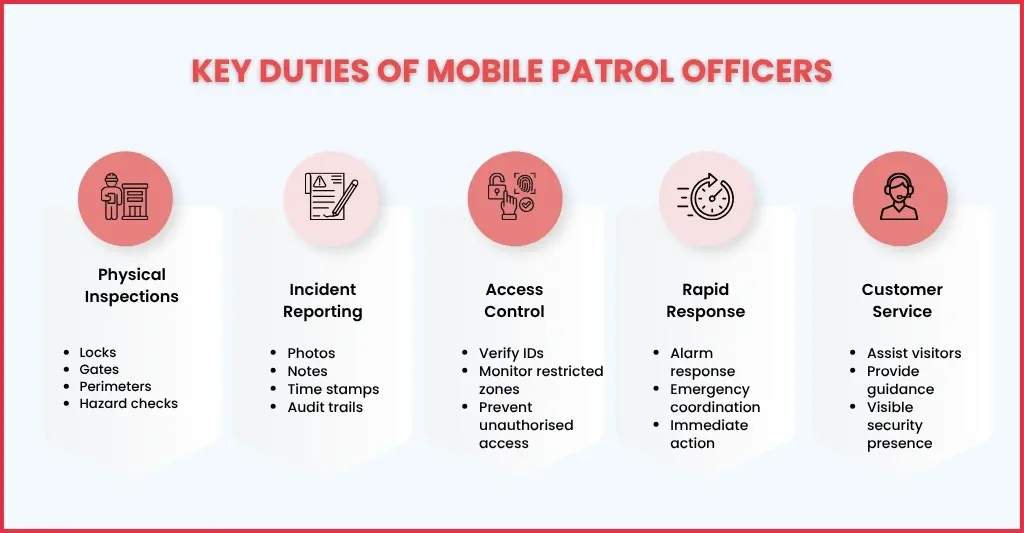
Understanding security guard duties in a mobile patrol context is essential — these officers are not just strolling your client’s premises; they will be the eyes, ears, and first responders across the site. Their role combines vigilance, reporting, and immediate action to ensure that risks are identified before they turn into incidents.
Let’s break down what their responsibilities really look like in practice.
Physical Inspections
It’s the foundation of mobile patrolling, but it goes beyond simple visual checks. It involves:
- Checking doors, windows, gates, and locks to ensure they are secure
- Examining perimeter fencing, checkpoints, entries and exits for signs of tampering
- Identifying environmental dangers like water leaks, fire hazards, or unsafe conditions
- Monitoring important infrastructure like electrical rooms, storage rooms or server rooms
Why it matters:
Even a small issue like an unlocked door, if left unnoticed, could trigger unauthorised entries escalating into a major security breach. Regular inspections will identify such gaps and resolve them early.
Incident Documentation
Another important aspect of mobile patrolling is the real-time reporting. It involves:
- Logging doubtful activities or behaviour
- Recording environmental hazards or safety risks
- Capturing photos, timestamps, and detailed notes
- Linking incidents to specific locations or checkpoints
Why it matters:
- It creates a clear audit trail
- Provides evidence for investigations
- Improves communication between guards, supervisors, and clients
Proper documentation of incidents will give your clients evidence of incidents taking place on their premises and the action taken on them.
Access Control
Guards on mobile patrol add an additional layer of security across the site. This extra will help in:
- Verification of IDs or credentials of individuals in restricted areas
- Ensuring doors and gates are not left open or unattended
- Monitoring unauthorised access attempts
- Supporting entry/exit control during off-hours
Why it matters:
Such human oversights will ensure security rules are followed throughout.
Rapid Response
Guards on mobile patrol will be the first responders to any incident taking place in your client’s premises, such as:
- Responding to alarms or triggered alerts
- Investigating suspicious activity immediately
- Coordinating with emergency services if required
- Taking action to contain risks before they escalate
Why it matters:
Speed is critical, especially when an incident is taking place. Delay in response will escalate a minor issue into a major one. Mobile security patrols will ensure it does not happen.
Customer Service
The guard on mobile patrol will not just provide protection but will register his presence to people by:
- Assisting staff, visitors, or tenants with queries
- Providing directions or guidance on-site
- Acting as a visible and approachable point of contact
Why it matters:
A professional and helpful security presence builds:
- Trust
- Confidence
- A positive experience for clients and visitors
Mobile patrol officers represent your service, not just your security.
Where Security Actually Fails Without Mobile Patrolling
It may be hard to believe, but even with the latest CCTV, alarms and static guard positioned at key entrances and exits, gaps have been found in security which have been exploited by nefarious elements.
But where the latest security system fails, mobile patrolling excels in closing these gaps. Let’s understand those gaps:
Blind Spots
CCTV cameras are always positioned along with static guards at strategic and sensitive locations like entry and exits, storage areas, and service rooms. But due to camera angles and positions, and the non-mobility of static guards, certain spots remain uncovered; these are blind spots, which can be exploited.
Delayed Response
When an incident takes place at blind spots, it will certainly go unnoticed by your security systems and static guards until it is too late.
Routine Vulnerabilities
Security systems like checkpoints, CCTV cameras, and the position of your static guards will be studied by criminal elements, along with gaps and will be exploited.
How Mobile Patrolling Closes Each Security Gap
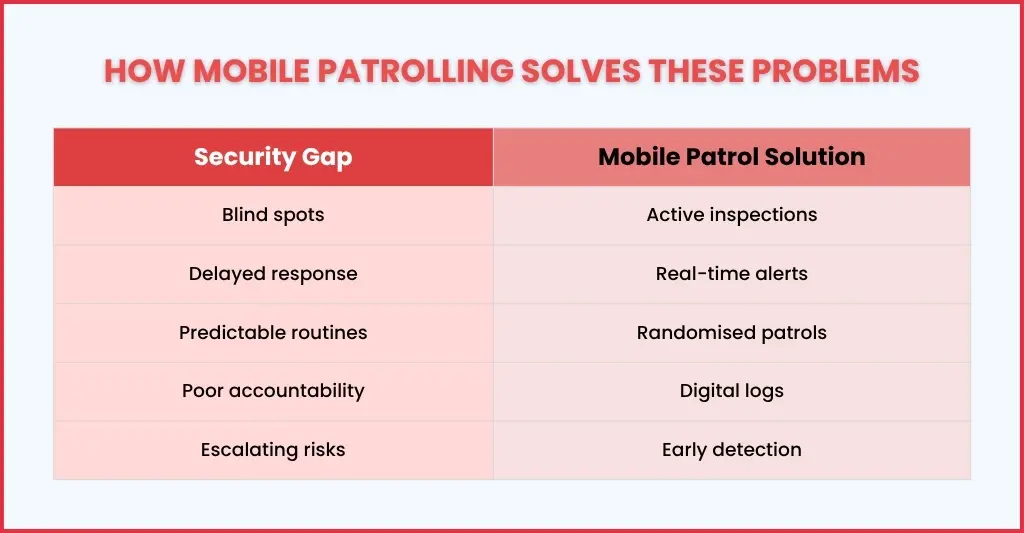
All the above-mentioned gaps can be closed by conducting an active mobile patrol. Here’s how it will achieve it.
Randomised Patrols
Static security becomes predictable, and predictability is the first thing that criminal elements look for.
Mobile patrols solve this by:
- Changing patrol times and routes frequently
- Introducing unpredictability across shifts
- Covering different areas at different intervals
Why it matters:
Intruders often study security patterns and patrol predictability to plan when and where to strike. By randomising patrols, it becomes impossible to anticipate security movements, significantly reducing the risk of targeted breaches.
Digital Logs
Manual logs are prone to human errors, incompleteness, and delays. Modern mobile patrolling systems can negate this gap.
Modern mobile patrolling systems offer:
- Real-time digital records of each checkpoint
- Timestamped entries linked to guard identity
- Location-based verification
Why it matters:
- Provides clear proof of patrol completion
- Removes ambiguity in reporting
- Strengthens accountability
Proactive Issue Resolution
Traditional security will always be in a reactive mode, and mobile patrol will shift that towards early detection and prevention. It achieves that by spotting:
- Identifying unlocked doors, broken locks, or damaged fences
- Spotting suspicious activity before escalation
- Addressing safety hazards immediately
Why it matters:
Even a small issue can become a major risk if ignored. Mobile patrols will ensure those problems are fixed at the earliest before they escalate.
Integrated Alerts
Modern mobile patrolling systems are all interconnected.
- Alerts are triggered for missed checkpoints
- Notifications are sent for unusual delays or activity
- Supervisors receive updates instantly
Why it matters:
- Enables immediate decision-making
- Reduces response time
- Ensures no issue goes unnoticed
Such integrated alerts will make your security guards react in real-time.
Flexible Coverage
Each site your guard protects will be different in size and security requirements, and risks can change quickly.
Mobile patrols will provide flexible coverage by:
- Adjust routes based on new threats
- Focus on high-risk zones during certain hours
- Increase patrol frequency when needed
Why it matters:
Static guards are limited to fixed positions, but when they conduct mobile patrols, the entire site will be actively monitored, not just key points.
Technology Behind Mobile Patrolling (What Clients Don’t See)
If you want your guards to conduct mobile patrolling efficiently, then you will have to arm them with the technology on which modern mobile patrolling depends. These technologies are:
- QR Code / NFC Checkpoints: It will be installed at strategic and vulnerable points so that when your guards patrol, they can scan points to confirm inspections.
- GPS Tracking: It enables supervisors to monitor patrols in real-time and ensure they are completed in the right order and on time.
- Cloud-Based Dashboards: Enables your supervisors to monitor multiple sites remotely.
- Automated Reports: Generates actionable data for compliance, auditing, and client reporting.
- Alerts & Notifications: Flags missed checkpoints or unusual activity instantly to your supervisors so that they can take immediate action and send backup if needed.
If you are looking to make your guards capable of mounting modern patrols, then arm them with platforms like QR Patrol that combine the above technologies with real-world operations to maximise efficiency and accountability.
When Mobile Patrolling is a Better Choice Than Static Guards
Static guards will never go extinct because of their requirements for covering entrances or high-traffic zones. But there are some areas where mobile patrolling is the perfect choice, those areas are:
- Large Facilities: Offices, warehouses, and campuses where a single point of presence isn’t enough.
- High-Risk Areas: Sites with sensitive equipment, high-value goods, or multiple access points.
- Dynamic Environments: Locations with constantly changing hazards or threats, like chemical factories, where the movement of hazardous chemicals requires moving security with it.
When you choose a mobile workforce system for your operations, look for one that integrates GPS tracking, checkpoint scanning, and automated reporting — this combination ensures your teams remain accountable, agile, and audit-ready across every site.
Many UK security firms combine static and mobile patrolling with the help of the latest technology for optimal coverage and accountability.
FAQs: Frequently Asked Questions
What is mobile patrolling in security?
Under mobile patrolling, guards will actively move throughout the site on scheduled or random routes, monitoring, documenting, and reporting activities in real-time.
How does mobile patrolling improve safety?
Mobile patrols actively cover the deficiencies that static guard method has like covering blind spots, offering proactive issue resolution, and flexible coverage.
Do mobile patrols require special equipment?
Yes. Guards typically use mobile devices, QR/NFC/RFID scanners, GPS trackers, and cloud-based reporting software to ensure accountability.
Can mobile patrols replace static guards?
No. They complement static posts, especially for perimeter, large-area, or high-risk patrols, providing dynamic coverage where static positions fall short.
How do mobile patrols assist with compliance?
Automated patrol logs and incident reports provide auditable evidence, meeting client contracts and regulatory standards such as those from the British Security Industry Association (BSIA).
Conclusion
Mobile patrolling is a proactive security solution which has turned into a vital component of modern security strategies. It ensures:
- Every checkpoint is verified
- Incidents are detected early
- Compliance is maintained
- Clients gain peace of mind
Whether managing a shopping centre, overseeing a construction site, or protecting a residential community, mobile patrol delivers peace of mind and operational safety. And by adopting mobile patrolling with tools like QR-Patrol, not only can operational efficiency be increased, but also risks can be reduced, and client trust strengthened.
Are you looking to enhance your patrol effectiveness and provide verifiable, audit-ready reports to your client? Explore QR-Patrol by filling out your requirements in the contact form.