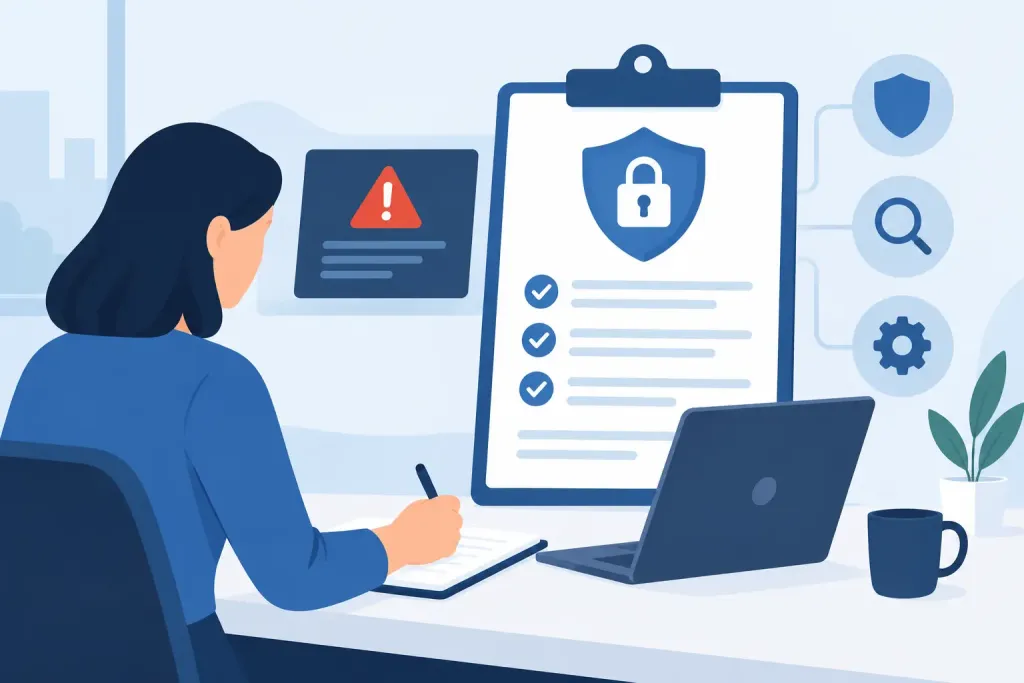
A security incident becomes harder to manage the moment the facts are delayed, incomplete or disputed. Knowing how to document security incidents gives site teams more than a written account: it creates a defensible record of what happened, who acted, when escalation occurred and whether the response met the required standard.
For security companies, facilities teams and in-house departments, incident documentation is operational evidence. It supports immediate decision-making, protects staff, demonstrates service delivery and gives clients a clear account when questions are asked days, weeks or months later.
Start with safety and escalation, not the report
A report must never delay action. If there is an immediate threat to life, property or site operations, the guard’s first responsibility is to follow emergency procedures, summon the appropriate support and make the area safe where it is safe to do so.
The initial incident entry should be created as soon as practicable. A short real-time record is better than a detailed report reconstructed from memory at the end of a shift. Record the basic facts first: the time, location, incident type, people involved, immediate risk and action taken. The fuller narrative can follow once the situation is under control.
This distinction matters. A lone-worker alarm, forced entry, fire safety concern or aggressive visitor may require supervisors, emergency services or a client contact to be notified immediately. The incident record should show exactly when that happened and by whom. It should not rely on vague phrases such as “manager informed”.
How to document security incidents with clear facts
A useful report allows someone who was not present to understand the event without guessing. Write in chronological order, using factual and observable language. State what the guard saw, heard, found or was told, then separate this from any conclusion or allegation.
For example, “At 22:14, I observed the rear loading-bay door open approximately 30 cm. The door alarm panel displayed a fault indication” is clear and verifiable. “The door had probably been left open by a careless employee” introduces an assumption that may be wrong and should not appear as fact.
Every report should establish the same core record:
- the exact date and time the incident was discovered, reported and resolved or handed over
- the precise location, including building, floor, zone, checkpoint or asset reference
- the name or identifier of the reporting officer and all persons directly involved
- a factual description of events in the order they occurred
- actions taken, including containment, first aid, access control measures and notifications
- evidence gathered, such as photographs, CCTV references, witness details or damaged-property records
- the current status, outstanding actions and handover requirements
Do not use a generic location such as “car park” when a north entrance, level or bay number is available. Specificity reduces wasted time during follow-up and makes trends easier to identify across a multi-site estate.
Use plain language and record direct quotes carefully
Plain language is usually the strongest choice. Avoid jargon, speculation and emotionally charged descriptions. If a person makes a significant statement, record their words as accurately as possible and use quotation marks. Note who made the statement, when and where.
Descriptions of people should be relevant to identification or safeguarding, not subjective. Record clothing, direction of travel, behaviour, vehicle registration or access credentials where appropriate. Avoid unnecessary personal information, particularly where it has no bearing on the incident.
Capture evidence while it is available
Physical conditions change quickly. A spill is cleaned, a door is secured, a delivery vehicle leaves and CCTV footage may be overwritten. Where policy and circumstances permit, capture evidence at the point of discovery.
Time-stamped photographs can show damage, obstruction, poor lighting, unsecured access points or unsafe conditions. Attach them to the same incident record rather than storing them on personal devices or sending them through informal messaging channels. If CCTV is relevant, log the camera number, time range and who has been asked to preserve footage. A report does not need to include the footage itself to prove that the preservation step was taken.
Witness information also needs care. Record names and contact details only when authorised and necessary. Note whether a witness gave a written statement, spoke to a supervisor or declined to provide details. Never pressure someone to speculate or sign wording they do not agree with.
Evidence handling is especially critical where police involvement, injury, theft, criminal damage or disciplinary action may follow. Guard teams should know when to protect a scene, when to avoid touching items, and when to wait for the relevant authority. The report should document these decisions, including any instructions received.
Make the timeline auditable
A good incident report is not only a narrative. It is a timeline of accountable actions. The difference is significant when a client asks why an issue was not escalated for 20 minutes, or when a supervisor needs to establish whether patrols continued during a disruption.
Use the actual time for each material event: discovery, call to the control room, supervisor attendance, emergency service contact, area isolation, return to normal operation and shift handover. If an exact time is unavailable, say so and explain the basis for the estimate rather than presenting it as certain.
Digital patrol systems strengthen this timeline by linking an incident to a verified checkpoint scan, GPS position where appropriate, task completion and officer identity. This gives managers a clearer picture than a paper occurrence book completed at the end of a long shift. It also makes it easier to identify whether the same fault, access issue or safety hazard has appeared before.
QR-Patrol, for example, allows officers to submit mobile incident forms with live synchronisation, supporting faster visibility for supervisors while preserving a central record for reporting and review.
Protect confidentiality and data quality
Incident records often contain personal data, commercially sensitive information and details that could create further risk if shared carelessly. Access must be limited to people who need the information for operational management, investigation, compliance or safeguarding.
For UK organisations, documentation practices should align with GDPR principles. Collect only relevant information, keep it accurate, store it securely and retain it according to the organisation’s documented retention schedule. A report about an unauthorised visitor may need a name, visitor pass number and relevant CCTV reference. It rarely needs unrelated personal history or broad opinions about the individual.
Digital systems should apply role-based permissions, secure audit trails and controlled editing. If a report needs correction, preserve the original entry and record what changed, who changed it and why. Silent amendments weaken confidence in the record, even when the intention was harmless.
Build a review process around every report
Documentation is not complete when the guard presses submit. Supervisors should review significant reports promptly for clarity, correct categorisation, adequate escalation and any missing evidence. A quick quality check also helps less experienced officers develop stronger reporting habits before poor practice becomes routine.
The level of review depends on the event. A minor maintenance observation may only require confirmation that a job was raised. An assault allegation, serious injury, missing key, suspected theft or repeated perimeter breach needs management oversight, documented follow-up and, where relevant, client communication.
Look for patterns, not just individual events. Repeated false alarms at one access point may indicate a technical fault. Multiple reports of poor visibility on a route may require lighting improvements. Frequent visitor-access issues may point to a process failure rather than poor guard performance. Incident data should inform risk assessments, patrol routes, site instructions, training and client service reviews.
Close the incident properly
An incident should not be marked closed simply because the immediate disruption has ended. Record the final outcome, who accepted responsibility for outstanding actions and whether the site returned to a safe operating condition. If a maintenance fault remains open, the handover must say what controls are in place until repair.
For client-facing contracts, the closing record should also demonstrate SLA performance: response times, attendance, notifications and evidence of completed actions. This turns the report from an administrative burden into proof of service.
The strongest security records are created close to the event, written without assumptions and reviewed with purpose. Give officers a simple mobile process, clear escalation rules and the confidence to record what they know. When pressure rises, that disciplined record may be the evidence that protects your people, your client and your operation.