To answer the question of how to improve construction site security, put in a layered defence, verify that they are working, and document everything. Just having a single camera or guard doing unverified rounds will not work in 2026. You will need a combination of perimeter control, monitored surveillance, controlled access, and a patrol verification system that demonstrates your security measures are actually being carried out rather than just assumed to be.
With multiple industry estimates putting UK construction industry site theft losses at over £1 billion annually, it’s right to say organised criminals are looking for sites that have predictable routine or less security. This means your security site system must be ready to tackle them. This guide walks through the practical steps to make that happen, and to genuinely reduce the risk in the first place.
Start With a Site-Specific Risk Assessment
Before implementing security measures, you need to conduct a thorough site inspection for risk assessment. Each construction site has a different layout, assets, and crime history of the location, which means one security plan does not work for another.
A proper risk assessment will map out the site perimeter, identify high-value assets, find blind spots, crime profile in the area, and which hours are risky. This assessment is the foundation of your security plan and the security system which you get for your clients.
Practical Measures to Improve Construction Site Security
Strengthen the Perimeter First
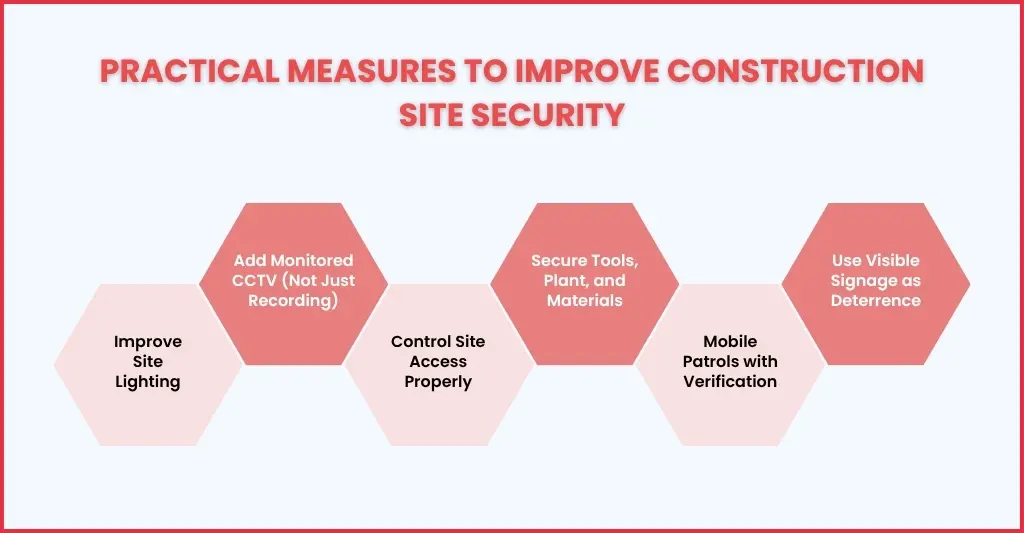
Thieves usually come across a perimeter that separates them from vital assets, and that barrier should not be showpiece. Deploy Heras fencing, which is standard across most UK sites, but its effectiveness depends on how well it’s maintained, whether it’s properly secured at every join, and whether it’s been reinforced at the most vulnerable points.
When combined with anti-climb measures and clearly marked restricted zones, it slows down intruders and helps establish intent if prosecution follows.
Improve Site Lighting
Poor lighting is a direct invitation to criminals to do their deeds. Thieves and vandals choose sites where they can work in darkness without being easily spotted by passing vehicles, neighbours, or guards. To save on the bills, deploy motion-activated lighting at access points, along the perimeter, and around plant compounds.
Add Monitored CCTV, Not Just Recorded CCTV
When CCTV is monitored continuously by your supervisors, they can respond in real-time, and this is being ignored by many. For high-value sites or those with a history of incidents, monitored CCTV is the more appropriate choice.
Control Access Properly
Access control means knowing who is entering the site and when. Workers, contractors, and authorised visitors can get unrestricted access but not the unauthorised ones. These days biometric or card-based access systems are increasingly common on larger UK sites and create an automatic log of all entries and exits.
Secure Plant, Tools and Materials Specifically
Your client’s machinery like power tools, fuel tanks, and copper cabling require extra security measures. This includes immobilisers on vehicles and plant, secured storage compounds with additional perimeter control, fuel tank locks, and asset marking (GPS trackers, UV marking, or forensic property marking) so that stolen items can be traced and recovered.
Changing machinery position and keeping less fuel during the night will reduce the chances of theft to a great extent.
Use Mobile Patrols and Guard Tour Systems to Verify Coverage
Give emphasis on mobile patrols along with CCTV coverage; this will add a human presence to your security layer. But guards who complete rounds without any verification system leave you and your clients unable to prove coverage if an incident is disputed.
This is where a digital guard tour system like QR-Patrol comes into the picture. It features Welfare Check which allows for managers to set specific timings after which even stationary guards must respond to a check-in on the application. This ensures that CCTV-monitoring guards are alert and actively reviewing CCTV footage.
Use Signage as a Low-Cost Deterrent Layer
Visible signage is one of the cheapest deterrents available and consistently underused. “CCTV in Operation,” “24-Hour Security Patrols,” and “No Trespassing” signs placed at the perimeter, near access points, and on compound fencing raise the perceived risk for opportunistic thieves without any ongoing cost.
Why Layering These Measures Matters More Than Any Single One
A single security measure is never foolproof. A perimeter fence can be cut, cameras will stop working, and guards cannot provide comprehensive security alone. Layered security is effective because when one security measure fails, the other closes the gap. It raises the time, effort, and risk for criminals to breach the site.
| Security Layer | What It Does Well | What It Doesn’t Cover Alone |
| Perimeter fencing | Slows and deters access | Can be cut or climbed |
| Lighting | Removes cover of darkness | Doesn’t stop a determined intruder |
| CCTV (recorded) | Creates evidence after an incident | Can’t trigger an active response |
| CCTV (monitored) | Enables real-time response | Requires human operators to be watching |
| Access control | Logs all site entries | Only covers controlled entry points |
| Asset-specific security | Protects high-value targets directly | Doesn’t protect the wider perimeter |
| Mobile patrols | Active human presence and deterrence | Unverifiable without a guard tour system |
| Guard tour system | Proves patrols happened, triggers missed-checkpoint alerts | Not a physical deterrent on its own |
| Signage | Low-cost deterrence layer | Ineffective if not supported by real measures |
Why Construction Sites Specifically Need a Guard Tour System
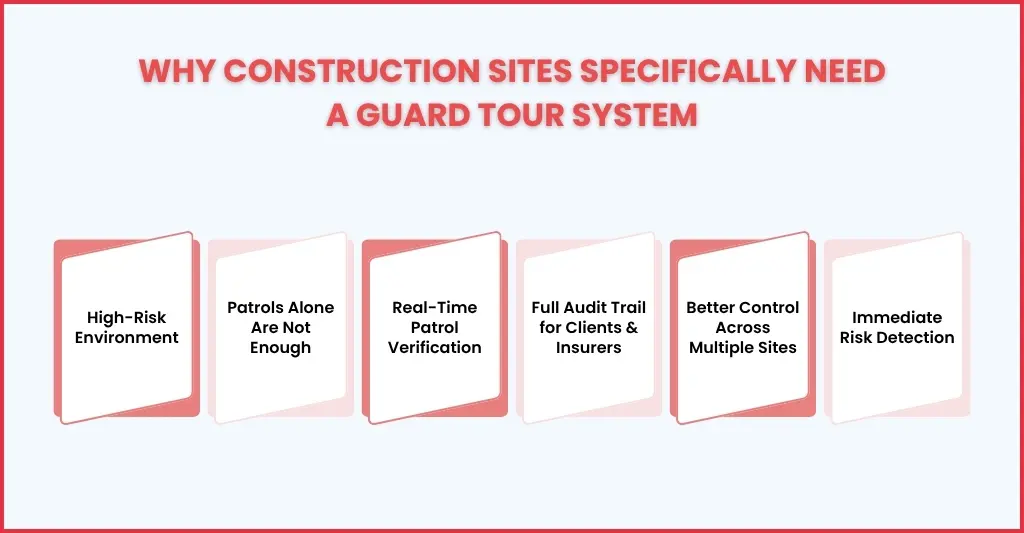
Of all the measures above, a digital guard tour system sits in a unique position: it doesn’t just make your security better, it makes it provable, and in 2026, provability is the currency security firms need most.
Construction sites are higher-risk environments than commercial premises because of the changing layouts, high-value assets, and multiple access points. When those gaps aren’t monitored digitally, they’re invisible until something goes wrong.
A guard tour system like QR-Patrol changes that dynamic entirely. Guards scan QR code checkpoints placed strategically across the site, at the main gate, the plant compound, the materials store, the rear perimeter, and each scan is logged with a precise timestamp and GPS location.
Supervisors monitoring remotely can see in real time whether patrols are running on schedule. If a guard misses a checkpoint, an alert fires immediately. If a client or insurer requests a patrol report after an incident, it’s ready to export in minutes, not pieced together from handwritten logs.
For security firms operating across multiple UK construction sites, this also reduces supervisory overhead significantly. One operations manager can monitor several sites simultaneously rather than relying on after-shift phone calls to confirm everything ran smoothly.
FAQs: Frequently Asked Questions
What are the most common causes of theft on UK construction sites?
Organised crime groups targeting plant and fuel, opportunistic theft of tools and materials left unsecured overnight, and sites with predictable, unverified patrol patterns are the most frequently cited causes. The combination of high-value assets and typically lower overnight visibility makes construction sites disproportionately attractive targets.
How often should security patrols happen on a construction site?
This depends on the site’s risk profile, but industry guidance generally recommends randomised patrols rather than fixed-interval rounds, since predictable timing allows thieves to plan around them. A guard tour system can record randomised routes while still ensuring full checkpoint coverage.
Does CCTV alone provide adequate security for a construction site?
No. CCTV is a vital component, but it records rather than prevents, and it only covers areas within camera range. Active patrols, perimeter control, and access management are all required alongside it.
What documentation should a security firm provide to a construction site client?
At minimum: real-time patrol logs with checkpoint timestamps, incident reports, access records, and regular summary reports for the client. Digital patrol systems automate most of this, making compliance straightforward.
Is a guard tour system difficult to implement on a construction site?
Not at all. QR-code-based systems like QR-Patrol require only printed or laminated checkpoint tags placed around the site, no wiring, no complex installation, and guards use a standard smartphone app. Most sites are up and running within a day.
Conclusion
Construction site security in 2026 can only be provided through a layered system where each element supports the other. Backed by verifiable documentation that protects your client’s assets, supports insurance claims, and demonstrates to contract decision-makers that your firm delivers real, provable security rather than a best-effort guess.
If your security team is still relying on unverified patrols and paper logs to protect construction sites worth millions of pounds in assets, now is the time to close that gap. QR-Patrol gives UK security firms the real-time patrol verification, instant missed-checkpoint alerts, and exportable audit trails that modern construction clients and insurers expect as standard. Find out more and get started with QR-Patrol today, and make 2026 the year your security offer becomes genuinely unbeatable.